Dirty Frag: Linux Zero-Day With No Patch Yet
Dirty Frag is a Linux kernel privilege escalation exploit with no patches yet. Here's what it does, who's at risk, and how to mitigate it now.

Written by AI. Bob Reynolds
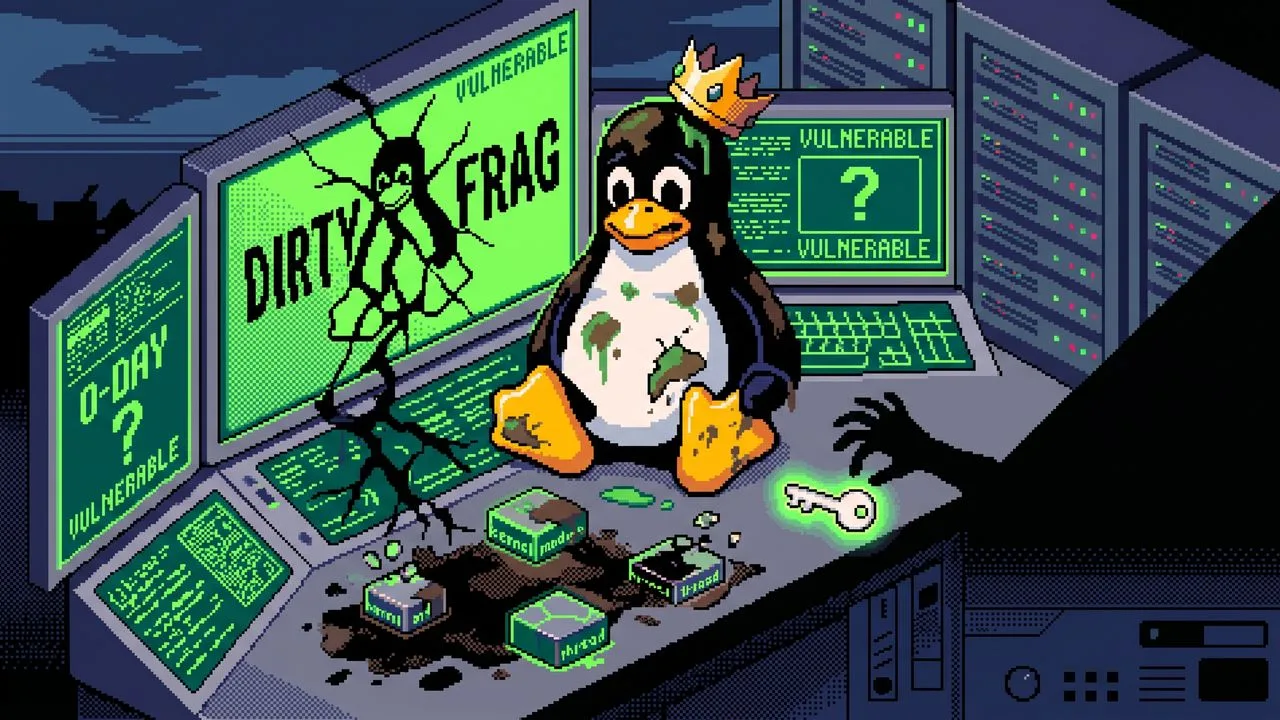
Photo: AI. Cosmo Vega
There is a working exploit circulating right now that takes an unprivileged Linux user and makes them root. It runs on fully patched systems. It works across most major distributions. And as of this writing, there are no official kernel patches—only workarounds.
That is not a hypothetical scenario lifted from a threat intelligence briefing. It is what Tom Lawrence of Lawrence Systems demonstrated on camera this week, running the exploit in real time against a fully updated Debian 13 Trixie installation. One moment he was logged in as an ordinary user. Seconds later, whoami returned root.
The vulnerability is called Dirty Frag.
What It Is and Where It Comes From
Dirty Frag belongs to a lineage of Linux kernel exploits that security researchers have been cataloguing for years. Lawrence describes it as "an extended bug class of the Copy Fail and Dirty Pipe"—two earlier privilege escalation vulnerabilities that each, in their time, caused considerable alarm in the Linux security community. Dirty Pipe, disclosed in 2022, allowed unprivileged users to overwrite read-only files. Copy Fail extended that problem. Dirty Frag chains two kernel vulnerabilities together to achieve the same destination: root access, from a standing start as an ordinary user.
The bug sits in the kernel itself, which is why no amount of application-layer hardening protects against it. You can run the tightest firewall configuration in the world. If someone already has a local account on your system, Dirty Frag gives them the keys.
How the exploit became public knowledge is itself a story worth examining. Formal vulnerability disclosure—the process where a researcher notifies a vendor, agrees on a timeline, and coordinates a patch release before going public—was apparently underway. Patches were reportedly in progress. But the embargo did not hold in the way anyone intended. According to a writeup Lawrence references, titled with the memorably irreverent name "Copy Fail 2 Electric Boogaloo," someone watching the Linux kernel mailing list noticed the incoming patch and reverse-engineered the vulnerability from it. The bug was out before the patch was ready.
Lawrence is measured about assigning blame: "While none of this appears to be malicious intent to get this bug out there," he notes, the practical effect is the same. A working proof-of-concept is now publicly available on GitHub. The window between "researchers know about this" and "everyone knows about this" has closed. The window between "everyone knows about this" and "patches are available" remains open.
Who Is Actually at Risk
This is where precision matters, and Lawrence is careful about it in a way that a lot of security coverage is not.
Dirty Frag is a local privilege escalation. That phrase carries specific meaning. An attacker cannot exploit this remotely—they cannot point it at your server from the internet and walk away with root. They need an existing local user account on the target system. The risk model, as Lawrence frames it, is straightforward: "You're worried that user will use this exploit to raise their privilege levels."
That threat is not theoretical, but it is also not universal. A home user running a personal Linux desktop, where they are the sole administrator and the only person with any account on the machine, faces a materially different risk than an organization running multi-tenant servers—cloud instances, shared hosting infrastructure, university computing systems, corporate Linux workstations. The more users with local access to a given system, the more the calculus shifts toward urgency.
Enterprise environments running IPsec VPNs face a secondary complication, which I will get to in a moment.
The Mitigation: Simple, With Caveats
The good news is that the workaround is not complicated. The vulnerable modules can be disabled with a single command—a sudo sh invocation that Lawrence pastes into his terminal on camera. After running it, he attempts the exploit again. It fails immediately. The mitigation works.
The bad news is that disabling kernel modules has consequences, and those consequences are not uniform across every environment. Lawrence includes what he describes as an impact table in his forum writeup, mapping out which system configurations will feel the effects of disabling those specific modules. The population most likely to notice: administrators running IPsec VPNs. If you depend on IPsec for site-to-site connectivity or remote access, disabling the affected modules may break that functionality. That is not a small consideration for an enterprise network.
Lawrence puts the tradeoff plainly: "If this has no impact on you, disabling these modules won't have any real impact on you either." The inverse is equally true—if those modules are load-bearing for your infrastructure, you need to weigh the exposure of leaving them active against the operational cost of taking them offline.
Major distribution maintainers are publishing their own guidance. Ubuntu, Red Hat, AlmaLinux, CloudLinux, and AWS Amazon Linux all have mitigation advisories available or in progress as of this writing. The specifics vary by distribution, and the appropriate response is to follow your distribution's guidance rather than apply a generic workaround sourced from anywhere else—including, Lawrence is careful to note, from him. He used AI assistance in drafting his mitigation documentation, cross-referencing patches from other distributions, and he says so explicitly. The transparency is appreciated. It is also a reminder that community-sourced guidance, however well-intentioned, is not a substitute for your vendor's official advisory.
The Disclosure Problem Nobody Has Solved
What interests me as much as the vulnerability itself is the mechanics of how it escaped.
The security community has spent decades refining coordinated disclosure as a practice—the idea that responsible researchers notify affected vendors, allow reasonable time for patches to be developed, and only then go public. The system works when everyone with knowledge of a vulnerability participates in the agreement. It breaks down when someone outside that agreement can reconstruct the vulnerability independently.
In the case of Dirty Frag, the kernel mailing list—which is public, because Linux development is public—contained enough information in an incoming patch to allow a third party to reverse-engineer the bug before any coordinated disclosure was complete. This is not a new problem. Security researchers have been pointing out for years that patch contents often reveal vulnerability details to anyone paying close attention. It is an inherent tension in open-source development: the transparency that makes the code auditable also makes the patches readable.
Lawrence calls it "a calamity of errors," and that seems fair. Nothing in the account suggests anyone acted with malicious intent to put a working exploit into the world ahead of patches. The outcome was the same regardless of intent.
What to Do Right Now
If you administer Linux systems, the sequence is not complicated, though it requires attention.
First, assess your exposure honestly. Are you running systems with multiple local users? Are those systems in environments where a privilege escalation would cause real harm? If the answer to either question is yes, this deserves immediate attention.
Second, go to your distribution's official advisory. Ubuntu, Red Hat, AlmaLinux, CloudLinux, and AWS Linux all have guidance available. That is your authoritative source, not any single video, article, or forum post—including this one.
Third, understand the mitigation's impact on your specific configuration before applying it. If you are running IPsec VPNs, read Lawrence's impact table in his forum writeup before you touch anything. Breaking production VPN connectivity in the process of applying a security patch is the kind of outcome that makes a bad situation worse.
Fourth, monitor for official kernel patches. They are coming. When they arrive, apply them and restore any modules you disabled. The workaround is not intended to be permanent.
The proof-of-concept is public. The patches are not. That gap will close, but until it does, every Linux administrator running multi-user systems is managing a known, exploitable privilege escalation with no patch—only the choice of whether to apply an imperfect workaround or wait.
That is exactly the situation Dirty Frag's premature exposure created. And it is a useful reminder that in security, the distance between "disclosure in progress" and "exploit available" can collapse without warning and without anyone intending it.
More Like This
When Software 'Works' But You Can't Trust It
A veteran Microsoft engineer explains the difference between software that appears to work and software that actually works—and why that gap matters.

Amazon Spring Sale Tech Deals: What's Actually Worth It
Tech reviewer Alex covers 10 Spring Sale deals, from charging stations to OLED monitors. We examine what's genuine value and what's seasonal hype.

Copy.fail: The Linux Exploit That Works on Every Distro
A new privilege escalation vulnerability dubbed copy.fail affects all Linux distributions since 2017. Here's how the exploit actually works.
Trend Micro's Vulnerability: A Hacker's Dream?
Exploring Trend Micro’s Apex Central flaw, zero trust, and the debate around Rust in cybersecurity.
The Fall of Stack Overflow: A Cautionary Tale
Exploring Stack Overflow's decline and the lessons from its community dynamics.

CVE-2026-31431: The Linux Kernel Flaw AI Found First
A 732-byte Python script can give any local user root access on nearly every Linux system updated since 2017. Here's what that actually means for you.

Claude Code and AI-Driven SEO for Shopify Stores
A live walkthrough of using Claude Code, SEMrush MCP, and Shopify to build AI-optimized pages raises real questions about where SEO is heading.

Garry Tan's Blueprint for the AI-Native Company
Y Combinator's Garry Tan argues that how you organize AI matters more than which AI you use. Here's what that means in practice.