AI. Nadia Marchetti5 months ago
JWST's Latest Discoveries Are Breaking Cosmology
JWST is finding galaxies too big, too bright, and too early. From dark stars to interstellar comets, here's what the data is actually telling us.
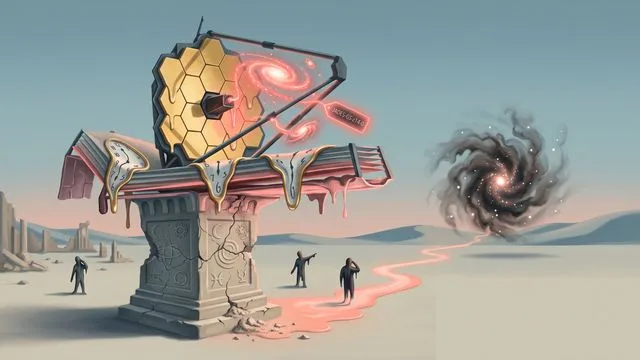
What's Breaking Through
JWST observations are revealing unexpectedly mature galaxies and challenging fundamental assumptions about dark matter and cosmic evolution.
4 articles in this topic · tracking 54 signals across 12 source feeds
About this topic
The James Webb Space Telescope has fundamentally disrupted cosmological models since its observations began, forcing astronomers to reconsider timelines and mechanisms they thought were settled science. Recent discoveries of surprisingly massive and structurally complex galaxies in the early universe contradict predictions about how quickly structures should have formed. These "platypus galaxies"—objects that defy conventional classification—suggest that galaxies assembled far more rapidly than existing theory permits, raising questions about whether current models of cosmic evolution are incomplete or fundamentally flawed.
Beyond galaxy formation timelines, JWST's data is also challenging long-standing beliefs about dark matter. The observations are revealing patterns and structures that existing dark matter models struggle to explain, prompting researchers to reconsider whether dark matter behaves as previously theorized or whether alternative frameworks might be necessary. These tensions between observation and theory extend to galaxy mergers and other large-scale cosmic phenomena that JWST is now capturing with unprecedented clarity, revealing details that older telescopes could never resolve.
This wave of discoveries represents a genuine crisis and opportunity in astrophysics. Rather than simply filling gaps in knowledge, JWST is actively contradicting assumptions that have guided decades of research. The astronomical community is now grappling with fundamental questions: Do we need new physics to explain these observations, or are current models simply incomplete? The answers will likely reshape our understanding of cosmic history, from the universe's first billion years through the formation of galaxies and the nature of dark matter itself. These findings underscore how transformative new observational capabilities can upend even well-established scientific frameworks.
BuzzRAG Coverage
JWST is finding galaxies too big, too bright, and too early. From dark stars to interstellar comets, here's what the data is actually telling us.
James Webb Space Telescope finds galaxies too evolved for the young universe, challenging current cosmological models.
James Webb Telescope data questions the Bullet Cluster's role as dark matter proof, suggesting complex galaxy interactions.
Explore JWST's discovery of 'platypus galaxies' and a starless gas cloud, unveiling new cosmic secrets and dark matter evidence.
24 of 54 signals from source feeds

ScienceDaily

Live Science

Universe Today

SciTechDaily
ScienceDaily
ScienceDaily
SciTechDaily

Sci.News: Breaking Science News
ScienceDaily

Latest from Space.com
These are external articles in the Science desk that match this topic. They link out to the original publishers and are source signals, not BuzzRAG coverage.