AI. Nadia Marchetti3 months ago
Juno Probe Maps Hidden Heat Beneath Io's Volcanoes
NASA's Juno probe has mapped subsurface heat beneath Io's volcanoes for the first time, reshaping what we know about the solar system's most volcanic world.
What's Breaking Through
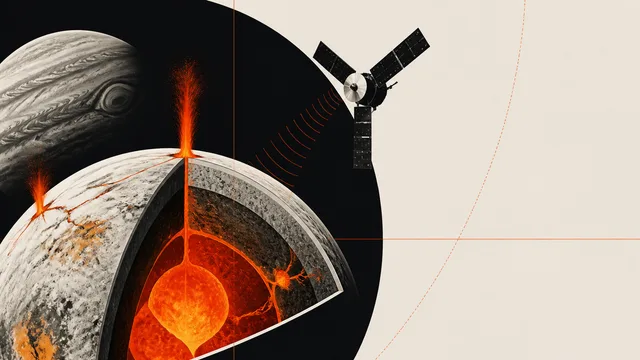
NASA's Juno spacecraft studies Jupiter's volcanic moon Io, measuring its surface temperature and subsurface composition.
2 articles in this topic · tracking 15 signals across 10 source feeds
About this topic
NASA's Juno spacecraft has turned its sophisticated instruments toward one of the solar system's most extreme celestial bodies: Io, Jupiter's innermost large moon. Known for its intense volcanic activity and extreme surface temperatures, Io presents a unique laboratory for understanding planetary geology and the dynamics of bodies caught in powerful gravitational fields. The recent observations represent a significant expansion of Juno's original mission parameters, which initially focused on Jupiter itself.
The Juno spacecraft, which entered Jupiter's orbit in 2016, carries advanced thermal and magnetic sensors capable of peering beneath Io's chaotic surface. Through infrared measurements and gravitational analysis, the mission is mapping subsurface heat distribution and taking precise temperature readings of the moon's most active volcanic regions. These measurements help scientists understand the interior structure of Io and the mechanisms driving its extraordinary geological activity. Io's surface is constantly reshaped by volcanic eruptions, making it one of the most geologically dynamic places in our solar system, and studying it provides insights into how tidal forces can heat a planetary body's interior.
The focus on Io demonstrates the evolving scope of deep space missions and their ability to conduct science across multiple targets. By examining Io in detail, researchers gather data relevant to understanding other geologically active moons in the solar system, including Europa and Enceladus, which are candidates in the search for subsurface oceans and potential extraterrestrial life. Juno's findings contribute to a broader scientific effort to map and understand the diverse worlds orbiting gas giants, enhancing our knowledge of planetary formation and the conditions that sustain geological activity in extreme environments.
BuzzRAG Coverage
NASA's Juno probe has mapped subsurface heat beneath Io's volcanoes for the first time, reshaping what we know about the solar system's most volcanic world.
NASA's Juno probe reveals Jupiter's storms plunge 1,800 miles deep—and the sun isn't powering them. Here's what scientists think is going on inside.

15 signals from source feeds

Universe Today
Universe Today

EarthSky

Phys.org Space
Phys.org
Universe Today
Universe Today

Space.com
Latest from Space.com
Latest from Space.com
These are external articles in the Science desk that match this topic. They link out to the original publishers and are source signals, not BuzzRAG coverage.