AI. Priya Sharma11 hours ago
A Black Hole Jet Rule Faces Its First Big Scale Test
A study of 10 tidal disruption events links delayed black hole jets to a 2% Eddington threshold, suggesting one rule may span very different black hole sizes.
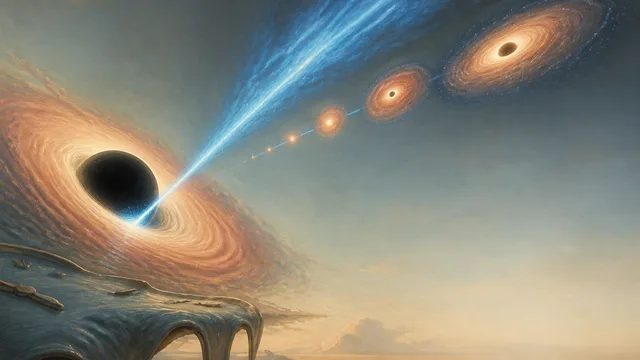
What's Breaking Through
A black hole has been continuously emitting powerful radio waves for over eight years, revealing properties of the early universe.
1 article in this topic · tracking 28 signals across 9 source feeds
About this topic
Astronomers have observed an unusually persistent radio outburst originating from a black hole that has been active for more than eight years. This extended emission is remarkable because such long-lived radio phenomena are relatively rare in the cosmos. The sustained nature of the outburst has provided scientists with an extended observation window to study the mechanisms driving these powerful jets of energy that black holes can produce.
What makes this particular discovery scientifically significant is that the radio waves being emitted exhibit properties that researchers associate with the early universe. By studying the characteristics of these radio emissions, astronomers can gain insights into physical processes that were more common in the universe's distant past. The black hole's outburst essentially serves as a natural laboratory, allowing researchers to observe and measure phenomena that would otherwise require observations of extremely distant objects billions of light-years away.
This ongoing observation campaign highlights how patient, long-term astronomical monitoring can yield unexpected scientific rewards. Rather than being a one-time explosive event, this black hole has maintained its radio emission over multiple years, allowing for detailed analysis of how the jet's properties evolve over time. Such studies contribute to a broader understanding of black hole physics, accretion processes, and the energetic phenomena that occur in the vicinity of these extreme cosmic objects. The findings underscore the importance of maintaining continuous observation networks and demonstrate how individual black holes can serve as windows into understanding fundamental properties of the universe at different epochs.
BuzzRAG Coverage
20 of 28 signals from source feeds

Phys.org
Phys.org Space

ScienceDaily

Knowridge Science Report
Phys.org
Phys.org Space
Knowridge Science Report

SciTechDaily

Universe Today
Knowridge Science Report
These are external articles in the Science desk that match this topic. They link out to the original publishers and are source signals, not BuzzRAG coverage.