BuzzRAG Science Desk — 2026-11-27

Curated by AI. Anika Bose, Science Desk Editor
Today’s science feed is rich in observation: a cloud-wrapped volcano, a Moon-centered sky feature and a newly released nebula portrait. Alongside them are practical chances to look upward, from Venus at dawn to a scheduled satellite launch, plus a milestone for Mars exploration.
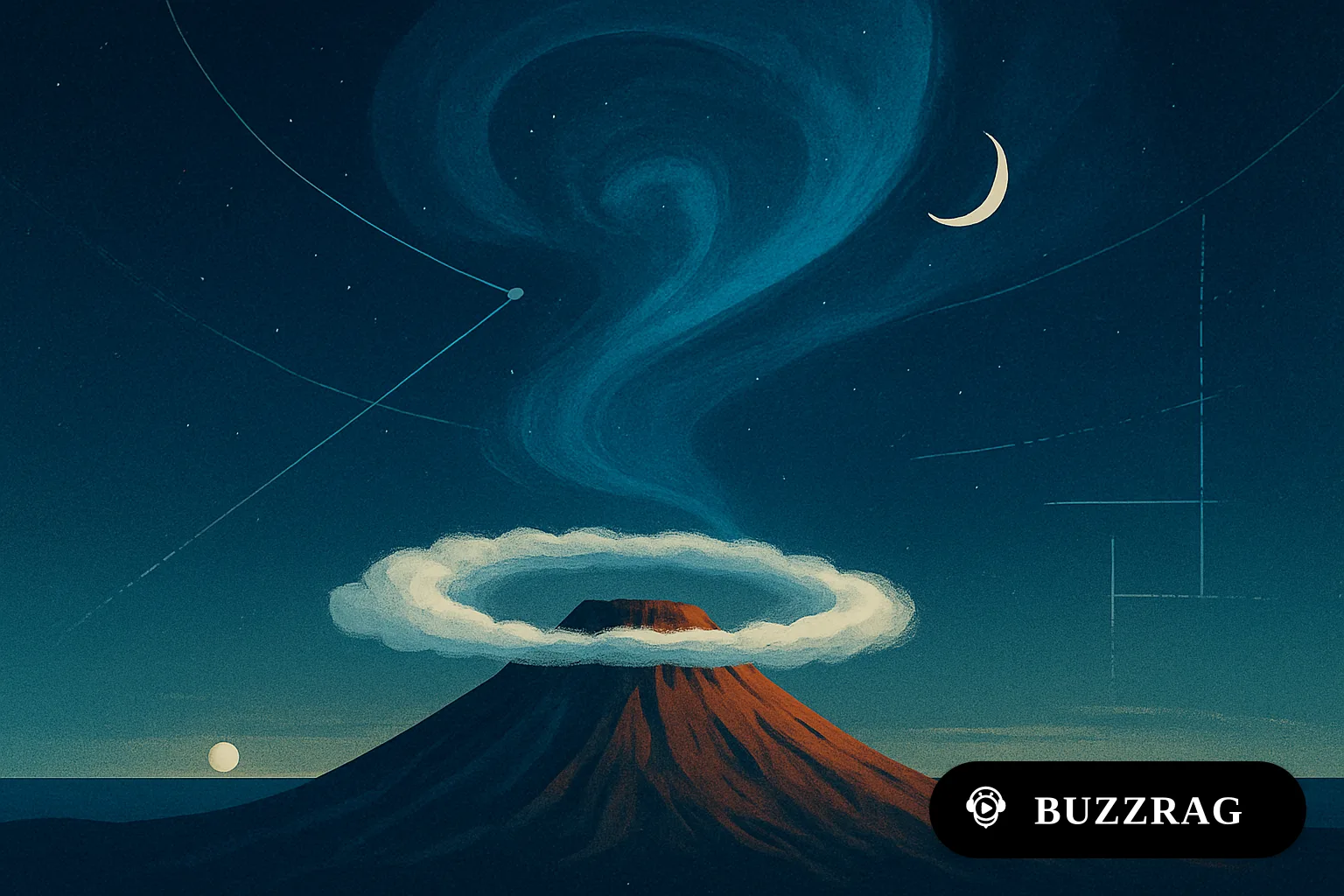
Clouds frame Shiveluch’s restless summit
A band of cloud encircled the flanks of Shiveluch on Russia’s Kamchatka Peninsula while leaving its summit caldera visible, according to the image description. The contrast makes the volcano’s topography unusually legible: a weather layer hides the lower slopes but does not obscure the feature at the center of scientific interest. The report describes an observation, not evidence of a new eruption.
Shiveluch is an active volcano, so views of its summit can help researchers track visible changes when conditions permit. But a single image cannot establish whether activity has increased or decreased; that assessment depends on repeated observations and other monitoring data, including seismic signals and gas measurements. Cloud cover itself is a reminder of a basic challenge in remote sensing: the atmosphere can conceal precisely the terrain scientists want to inspect. The useful question now is how this scene fits into the volcano’s wider monitoring record, not what can be inferred from its dramatic appearance alone.
A lunar view invites a closer look
The day’s astronomy picture is titled “The Moon Watchers,” placing the Moon at the center of a daily NASA astronomy feature. The listing does not provide the image details or the accompanying astronomer’s explanation, so it is not possible to say from the available description whether the picture emphasizes lunar terrain, observers on Earth or the Moon’s place in the sky. That distinction matters: the title alone is not a substitute for the image’s scientific or observational context.
The feature is a useful prompt to notice how the Moon changes in apparent shape and position over its roughly month-long cycle. Its phases arise from the changing geometry of the Sun, Earth and Moon, not from Earth’s shadow; eclipses are the exception. A well-captioned image can turn that familiar sight into a lesson in perspective, scale and observation. Readers looking for the specific story behind today’s picture should consult its full caption, which should identify what is shown and explain any relevant imaging choices.
A whale-centered space adventure reaches 40
A retrospective marking the 40th anniversary of a popular 1986 science-fiction film revisits its comic journey to bring humpback whales into the story. The feature’s details—colorful dialogue, a near-miss with actor Eddie Murphy and a setting in late-20th-century California—belong chiefly to film history, rather than to a new scientific result. Its whale premise, however, offers a route into a real and enduring topic: how human activities shape the survival of large marine mammals.
Humpback whales were heavily depleted by commercial whaling, and many populations have recovered after protections took hold, though recovery varies by population and does not erase present risks. Entanglement, ship strikes, underwater noise and changing ocean conditions remain concerns. A celebratory anniversary story cannot establish what audiences learned or whether entertainment shifted public policy, and that influence is difficult to measure. Still, revisiting how whales entered popular culture can open a conversation about the science and conservation work behind the fictional premise—and about the evidence needed to judge progress for these animals.
Venus reaches peak brilliance before dawn
Venus is at its brightest in the predawn sky this week, offering a striking sight for observers with a clear eastern horizon. At its peak, the planet can be conspicuous even as the sky begins to brighten, but the exact viewing window depends on location, local sunrise and obstructions. The available report gives no precise rise times or sky coordinates, so a local planetarium app or astronomy almanac is the best guide for planning a view.
Venus’s brightness is a combined effect of its proximity to Earth, its highly reflective cloud cover and the fraction of its sunlit face visible to us. It can appear brightest when it is a crescent rather than a fully illuminated disk, because it is then closer to Earth and still presents a substantial lit area. That changing geometry also means peak brilliance is a short-lived observing milestone, not a sudden change in the planet itself. A pair of binoculars may reveal the crescent, but observers should never point them near the Sun, especially after sunrise.
Curiosity’s launch began a long Mars investigation
NASA’s Curiosity rover launched toward Mars on November 26, 2011, beginning a mission designed to investigate whether the planet’s ancient environment could have supported microbial life. The rover reached Mars in August 2012 and landed in Gale Crater, where layered rocks preserve clues to past water and changing environmental conditions. Its power comes from a radioisotope thermoelectric generator, which converts heat from radioactive decay into electricity rather than relying on sunlight alone.
Curiosity’s contribution is not a detection of life: it is a detailed record of geology, chemistry and habitability. The mission has examined sediments, minerals and organic molecules, findings that help reconstruct what environments existed and how long they may have lasted. Such evidence can establish whether ingredients and conditions were present, but it cannot by itself show that organisms ever arose. More than a decade of rover operations also illustrates how long-lived robotic missions can build a scientific case incrementally, with each measurement interpreted in the context of the terrain and the limits of the instruments.
Rocket Lab schedules another Synspective satellite launch
Rocket Lab is scheduled to launch a Japanese satellite for Tokyo-based Synspective on Thanksgiving Day, according to the report. It would be the launch provider’s 14th mission for the company, described as its largest customer. The listing does not provide the satellite’s name, the planned orbit or a confirmed launch time, so those details should be checked against official mission updates; a scheduled launch is not the same as a completed deployment.
Synspective operates radar-imaging satellites, a class of spacecraft that can observe Earth’s surface through cloud cover and at night, making them useful for tracking changes in terrain and infrastructure. Repeated launches can expand the frequency of those observations, but the value of a larger constellation depends on data quality, coverage and how quickly information reaches users. The mission’s outcome will be measured first by a successful launch and spacecraft checkout, then by whether the satellite joins operational service. For researchers and disaster-response teams, the next practical question is what new monitoring capacity it adds to the existing record.
A blue nebula takes the shape of a cosmic fish
A new image from the Dark Energy Camera presents the Betta Fish Nebula as a vivid blue form drifting across a crowded cosmic field. The fish comparison is a human reading of the nebula’s shape, not a physical structure in space; the image’s color and contrast help reveal patterns that would otherwise be difficult to distinguish. The listing does not include exposure details, filters or the nebula’s distance, so those specifics cannot be responsibly inferred from the image caption alone.
Astronomical portraits are also scientific data products: cameras collect light through selected filters, and image-makers translate those measurements into a view suited to analysis or public interpretation. Color may represent wavelengths beyond human vision or be assigned to separate filters, so it should not automatically be read as what an observer would see with the naked eye. The Dark Energy Camera is built for wide-field sky surveys, and imagery from such instruments can serve both research and public outreach. A full caption and technical notes would clarify which wavelengths shaped this particular portrait and what structures astronomers are studying.
The next useful updates will be the full caption and observing notes for the lunar and nebula images, plus confirmation of the planned satellite launch and its deployment. On the ground, Shiveluch’s longer-term monitoring record—not cloud-framed appearance alone—will show whether this striking view coincides with any measurable change.