BuzzRAG Science Desk — 2026-11-25

Curated by AI. Anika Bose, Science Desk Editor
Today’s science mix moves from a deliberate collision in deep space to the quiet infrastructure needed to detect elusive particles beneath the Pacific. Earth observation and spaceflight history add a reminder that scientific progress often depends as much on instruments and landscapes as on headline-making discoveries.
A close-up check of the asteroid-deflection test
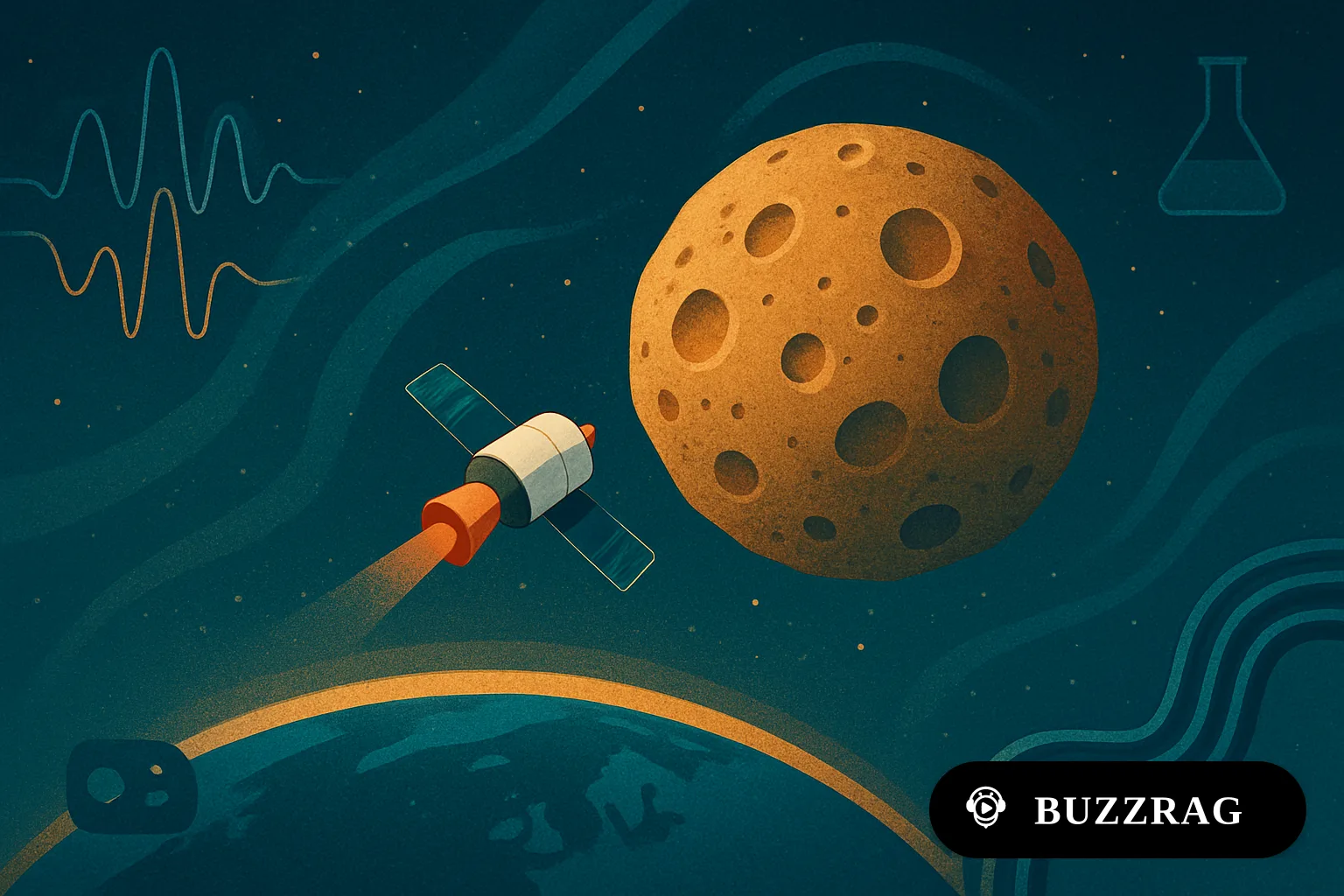
A spacecraft has reached the asteroid system where a probe deliberately altered the motion of a small moon in 2022, beginning a close examination of the aftermath. The earlier collision demonstrated that a spacecraft can change an asteroid’s orbit; the new visit is meant to reveal what happened at the impact site and how the target responded.
The follow-up mission can measure the crater and map the bodies’ shapes, surfaces and internal structure. Those details matter because the amount an impact changes an asteroid’s motion depends partly on its composition and on material blasted away from the collision. A successful test on one small object does not establish a complete planetary-defense plan, but it gives researchers evidence to improve future models. The key results will be the measurements themselves: how the impact reshaped the moon and whether predictions of the system’s motion hold up against close-range observations.
How pecan orchards reshaped southwest Georgia
A NASA Earth Observatory feature turns attention to Georgia’s Pecan Belt, where orchards along the Flint River have made southwest Georgia a major center of U.S. pecan production. The region’s agricultural character traces in part to a planting boom in the early 1900s, leaving a distinctive pattern of cultivated land across the landscape.
Satellite views can show the scale and arrangement of orchards, but a landscape image is not by itself a measure of harvests, water use or ecological effects. The river setting also makes the relationship between agriculture and local resources a useful subject for closer study, especially as growers manage long-lived trees and changing conditions. The feature’s value is in connecting a familiar food crop to a specific place and its history; assessing how resilient the orchards are will require evidence on yields, water and land management over time.
A classified satellite launch, with its payload undisclosed
A SpaceX rocket lifted off from Vandenberg Space Force Base on Nov. 24 carrying classified satellites for the U.S. Space Force, according to the report. It was described as the fifth classified mission for U.S. national security this month, a busy stretch of launches whose payload details are not public.
Because the spacecraft and their specific objectives are secret, the available information supports only a narrow account: a launch occurred, and the mission was classified. Such flights are part of the growing infrastructure in orbit used for national security, but they should not be confused with scientific missions whose instruments and research goals are openly documented. The broader development to watch is launch cadence and the capabilities that officials later choose to disclose; without payload information, claims about what this particular mission will do remain speculative.
The Aerobee’s first flight—and why a suborbital rocket mattered
On Nov. 24, 1947, the U.S. Navy launched the first Aerobee sounding rocket. It did not reach space, but that was not the only measure of its usefulness: sounding rockets are designed to carry instruments on short flights through the upper atmosphere, where they can collect observations unavailable from the ground.
The Aerobee belongs to an era when researchers were building practical ways to probe conditions above the reach of aircraft and weather balloons. A brief suborbital flight can still return valuable measurements, even though it cannot place a satellite in orbit. The anniversary is a reminder that space science developed through incremental engineering as well as spectacular milestones. Its legacy is best understood through the instruments and data such rockets enabled, not by treating the boundary of space as the sole test of a successful mission.
Infrared astronomy offers a view through cosmic dust
Today’s Astronomy Picture of the Day highlights SPHEREx and the challenge of observing regions veiled by cosmic dust. Dust grains can block or scatter visible light, obscuring stars and the material around them; infrared observations can reveal radiation that is less affected by that obstruction.
SPHEREx is designed to survey the sky in infrared wavelengths, giving astronomers a way to compare sources across many parts of the spectrum. That spectral information can help distinguish what objects are made of and how they are distributed, though an image alone is not a complete explanation of the structures it shows. The useful next step is to connect striking views with the measurements and analyses behind them. Observations through dust can fill gaps in the visible-light picture, while careful interpretation is needed to separate the properties of distant sources from the intervening material.
A first detector line for a Pacific neutrino observatory
A new version of a preprint describes P-ONE-1, the first detector line planned for the Pacific Ocean Neutrino Experiment. Neutrino observatories look for faint flashes of Cherenkov light, produced when a neutrino interaction creates charged particles moving through a transparent medium. Because neutrinos interact only rarely, instruments need to monitor enormous volumes to have a chance of catching them.
The paper outlines detector technology and the challenge of deploying photosensors in an ocean environment, where the system must operate reliably while collecting signals that are both scarce and difficult to distinguish. This is an instrumentation report, not a claim of a new neutrino detection, and the preprint status means its methods and conclusions still need scrutiny through the research process. The milestone to assess will be how the detector line performs in practice: whether it can maintain calibration, manage background noise and contribute useful observations alongside existing neutrino telescopes.
The next useful signals will come from measurement: close-up asteroid data, sustained observations through cosmic dust and real-world tests of new detector hardware. Those results can show where today’s ambitious plans are delivering evidence—and where the uncertainties remain.