BuzzRAG Science Desk — 2026-11-24

Curated by AI. Anika Bose, Science Desk Editor
Today’s space-facing headlines range from a real volcanic coastline changing shape to ambitious proposals for building and growing beyond Earth. Alongside those stories are a patient-sample cancer investigation in orbit and a reminder that striking astronomical images can illustrate known science without representing a new discovery.
An eruption redraws Iwo Jima’s shoreline
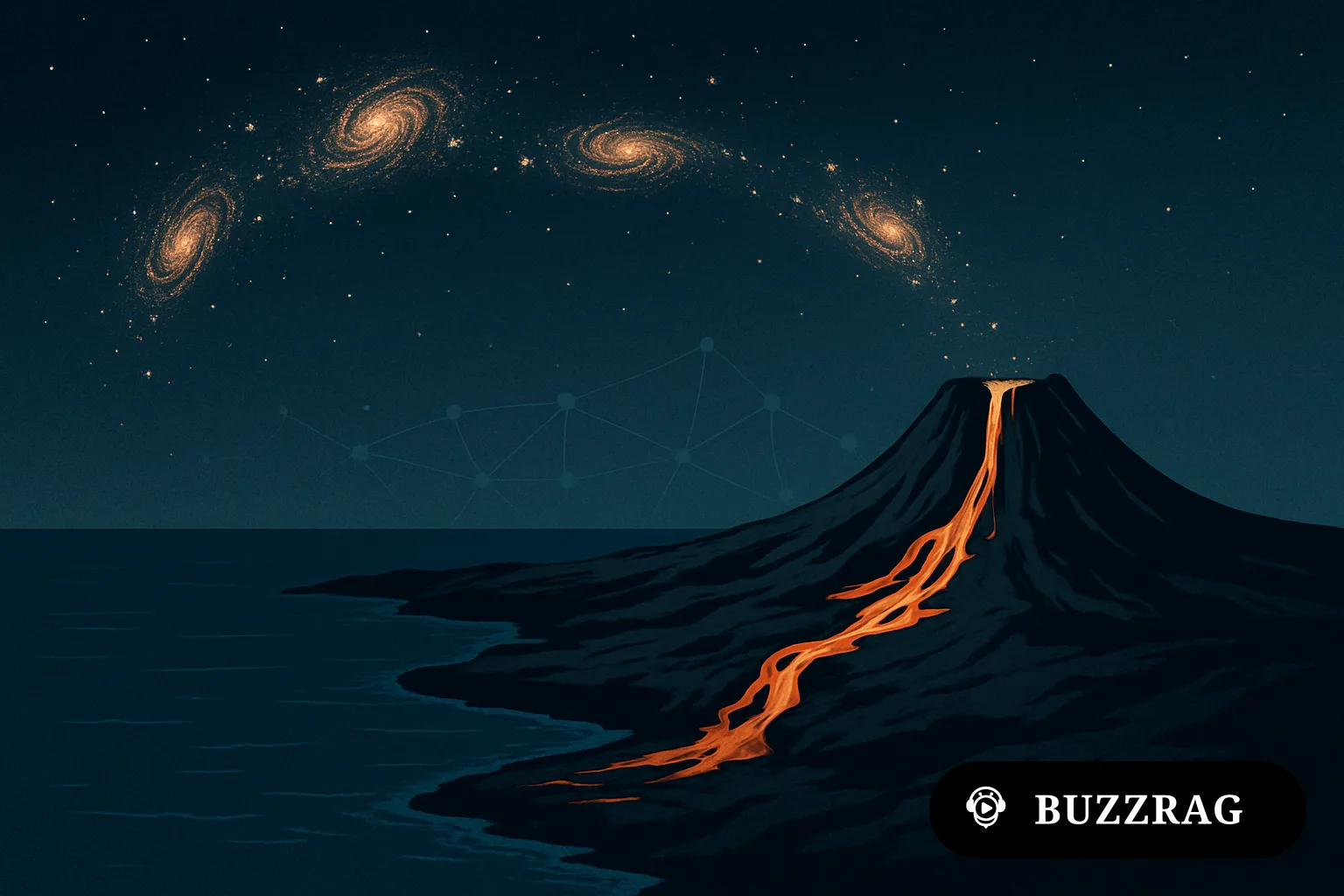
An eruption just offshore from Iwo Jima has added new ground to the island’s southeast coast, according to NASA’s Earth-observation report. The change is a vivid example of how quickly volcanic activity can alter a landscape: material expelled from beneath the sea can accumulate into a shoreline extension, though its appearance in imagery is only a snapshot of an active process.
The important uncertainty is what happens next. Newly formed volcanic deposits may be loose and exposed to waves, so the expanded beach could erode or be reshaped; the report does not establish how durable this land will be. Satellite observations are useful for tracking the outline over time, but they do not by themselves reveal the full structure or stability of the deposit. Follow-up imaging and field measurements would help distinguish a lasting addition from a temporary feature. For this coastline, the next chapter is less about how far the shore moved than how it responds to the ocean.
A biological construction concept for Mars
A proposal from Pioneer Labs explores whether microbes, supplied with nuclear power, could help prepare shelters on Mars before astronauts arrive. The concept puts biological processes into the toolkit for space construction: instead of transporting every building material from Earth, a mission might use organisms and locally available resources to produce or bind material on site. The work is described as an arXiv preprint, so it should be treated as an early-stage proposal rather than a demonstrated building method.
The distance between a concept and a dependable habitat is substantial. A credible system would need to show that its organisms and production process function in Mars-like conditions, that the resulting material withstands radiation, temperature swings and dust, and that power and feedstock demands are practical. It would also need safeguards against contamination and failure. The approach is intriguing because transporting mass to Mars is costly, but the available description does not establish that a ready-made home can actually be grown. Experimental validation and engineering analysis will determine whether biology can contribute more than a promising design idea.
Potatoes tested in simulated lunar soil
Researchers have reportedly grown potatoes in simulated lunar regolith, a result that raises a practical question for future lunar missions: could part of a crew’s food supply be produced where they live? The distinction in the headline matters. The plants were grown in a terrestrial simulation of lunar material, not in actual soil on the Moon, where low gravity, radiation, vacuum and extreme temperature cycles create conditions that a greenhouse experiment cannot reproduce.
A successful growth trial is a useful starting point, but it does not by itself show that potatoes can reliably feed astronauts. The properties of the simulant, any added nutrients or treatment, plant health and harvest yield all affect how broadly the result can be applied; those details are not included in the report snippet. Lunar regolith is not ordinary fertile soil, and crops would need controlled water, nutrients and environmental conditions. Follow-up work will need to test repeatable harvests and food quality, as well as how plants cope with real mission constraints. The finding is encouraging as a research step, not yet a lunar farming plan.
What would sport look like in microgravity?
A discussion with former NASA chief technologist Les Johnson considers how sports might work when players and equipment float rather than fall. The question is more than a speculative twist on familiar games: microgravity changes how bodies move, how momentum is controlled and how a collision can send participants drifting in unexpected directions. Any workable activity would need rules and equipment designed around those differences.
The report is an expert-led exploration, not a study reporting experimental results. Real microgravity sports would have to account for safe ways to stop, avoid impacts with habitat structures and manage shared air and limited space. Even simple actions such as pushing off a surface can alter a player’s trajectory, while ordinary assumptions about balance and “down” no longer apply. Testing would likely begin with carefully controlled activities and safety procedures, rather than adapting a field or court game unchanged. The conversation usefully connects physics to human factors, but practical designs will depend on the setting and the risks that can be managed.
Galaxies interact in the NGC 7771 group
The November 24 Astronomy Picture of the Day features the NGC 7771 group, a gathering of galaxies whose title evokes the gravitational contests that shape such systems. When galaxies pass near one another, their mutual gravity can distort their structures and influence how gas and stars are arranged. The image offers a visual entry point to those long-running cosmic interactions, but an astronomy picture is not, on its own, evidence of a newly discovered event.
Interpreting the scene requires more than its appearance: distance, motion and observations across different wavelengths help astronomers understand what is happening within a galaxy group. The supplied description identifies the subject but does not provide those measurements or specify the stage of any particular interaction. That is a useful reminder that an evocative image and a research result are different kinds of evidence. The value here is both educational and scientific: images can help readers recognize complex structures, while follow-up observations and analysis establish how those structures formed and changed.
A reusable booster lands after a suborbital flight
On November 23, 2015, Blue Origin’s New Shepard booster made a controlled landing after a suborbital flight, a milestone in the effort to recover and reuse launch vehicles. The achievement demonstrated that a rocket stage could return to a landing site after reaching space on a brief, high-altitude trajectory. Reuse aims to reduce the need to discard major hardware after every launch, though a successful landing is only one part of making a vehicle operationally reliable.
The anniversary is best understood as a step in a longer engineering story, not as proof that launch costs automatically fall whenever a booster touches down. Recovered hardware must be inspected, refurbished and flown again safely; flight rate, maintenance and the performance of the complete launch system all matter. The landing helped establish a visible precedent for vertical recovery in suborbital flight and contributed to broader interest in reusable rockets. The practical test is what follows a milestone: repeated flights, consistent performance and evidence about the resources required between missions.
Patient-derived tumors studied in orbit
The Encapsulate-1 investigation is studying patient-derived tumor samples aboard the International Space Station to examine how cancer cells move and interact in microgravity. Using material derived from patients gives the research a closer connection to human biology than a purely abstract model, while the orbital setting offers a distinct environment in which to observe cell behavior. The stated goal is to learn about cellular movement and interactions, not to test a cancer treatment in patients.
Microgravity experiments can reveal changes in how cells organize or behave when some effects of Earth’s gravity are reduced, but results in orbit do not automatically translate into clinical advances. The value depends on how the samples are handled, what measurements are collected and whether observed patterns can be reproduced and compared with ground-based controls. The supplied description does not report outcomes, sample numbers or a specific finding, so the investigation should be presented as ongoing research rather than a breakthrough. Its contribution will depend on whether observations help researchers ask sharper questions about tumor biology that can then be tested in established laboratory and clinical research.
The next evidence to watch is the kind that tests durability and repeatability: whether new volcanic ground persists, whether simulated lunar crops can produce reliable harvests, and whether biological construction concepts survive realistic engineering checks. In orbit, cancer-cell observations will matter most when their methods and results can be compared with carefully designed ground studies.