BuzzRAG Science Desk — 2026-09-14

Curated by AI. Anika Bose, Science Desk Editor
Today’s science conversation spans an Arctic landscape changing color, an increasingly routine but consequential launch cadence, and renewed scrutiny of what humans can realistically build on the Moon. The roundup also looks backward—from a landmark lunar mapping mission to the stellar origins of the elements around us—while an unreviewed plasma paper offers a more technical glimpse at how theory advances.
Arctic Tundra Offers an Early Autumn Signal
Reds, yellows, and oranges are appearing across tundra landscapes in Nunavut earlier in the seasonal cycle, according to imagery highlighted by NASA’s Earth Observatory and related reporting. The observation is visually striking, but a single early-color snapshot is not enough to establish a continent-wide shift or identify one cause. Fall color depends on temperature, daylight, moisture, plant species, and local weather, all of which vary sharply across the Arctic.
The larger scientific value lies in treating these landscapes as sensitive indicators of environmental change. Earlier or more abrupt seasonal transitions can affect carbon exchange, nutrient cycling, wildlife food sources, and the timing of snow cover, which in turn influences how much sunlight the ground reflects. Satellite observations can extend the record across remote terrain, but researchers still need long-term comparisons, ground observations, and careful separation of normal year-to-year variability from a persistent trend. The next useful question is not simply when the colors appeared, but whether the timing is changing consistently across the circumpolar North.
Falcon Family Reaches a Landmark Launch Count
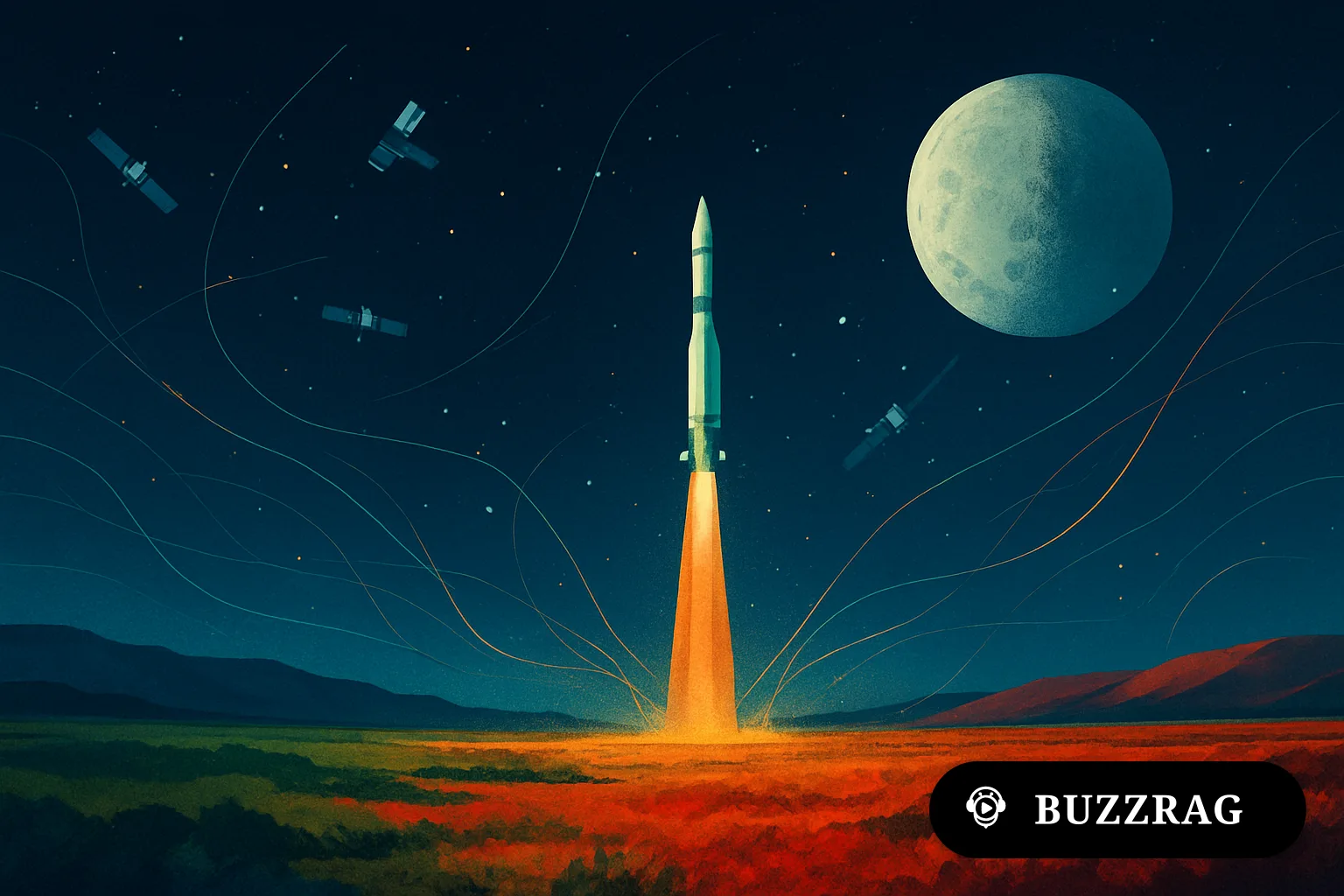
A launch on September 13 placed three communications satellites into orbit and marked the 700th mission for the Falcon rocket family, according to the supplied reports. The milestone reflects the transformation of orbital launch from a sequence of exceptional demonstrations into a high-frequency operational service. Yet the number itself is not a measure of scientific discovery or launch success in isolation: the more consequential details are payload deployment, orbital accuracy, booster recovery performance, and the reliability of the communications network being assembled.
The satellites are intended to expand broadband connectivity through a medium-Earth-orbit constellation, where spacecraft can provide broader coverage than low-orbit systems but must manage greater distance and latency. Reaching a milestone at this scale demonstrates industrial and operational maturity, while also sharpening questions about orbital congestion, collision avoidance, spectrum coordination, and the environmental footprint of frequent launches. Continued attention should focus on the constellation’s performance in service and on whether launch providers can maintain reliability as cadence rises without weakening safety and oversight.
A Lunar Mapping Mission That Changed the View from Orbit
Nineteen years ago, Japan launched the Kaguya spacecraft toward the Moon, beginning a mission that produced a detailed orbital survey of the lunar surface. Its high-definition observations helped turn the Moon from a familiar disk in the sky into a geologically complex world, with data relevant to topography, gravity, mineral composition, and the history of lunar volcanism. The anniversary is a useful reminder that exploration advances through sustained measurement as much as through dramatic landings.
Kaguya’s legacy is especially relevant as agencies and commercial teams plan new lunar missions. Orbital maps provide the baseline needed to choose landing sites, interpret surface hazards, and test ideas about how the Moon formed and evolved. They do not, however, eliminate uncertainty: remote sensing must be checked against samples and in-situ measurements, and different instruments can produce complementary rather than interchangeable views. The mission’s lasting contribution is therefore methodological as well as historical—it showed how a coordinated orbital survey can reshape the questions that later spacecraft are built to answer.
The Cosmic History Written into Our Elements
Today’s astronomy feature uses the origin of the elements as a guide to cosmic history. Hydrogen and helium emerged from the early universe, while heavier atoms were forged through stellar fusion and in violent stellar events; those atoms were later recycled into new stars, planets, and living organisms. The image-driven format is accessible, but the underlying story rests on spectroscopy, stellar models, nuclear physics, and observations of supernovae and compact-object mergers rather than on a single picture.
The phrase “we are stardust” is broadly right but scientifically incomplete. Different elements have different production pathways, timescales, and astrophysical sites, and the relative abundance seen in a star or planet preserves clues about the generations of stars that came before it. Researchers continue to refine these histories by comparing observed elemental patterns with models of galactic chemical evolution. New telescopes and gravitational-wave observatories should help narrow the uncertainties, particularly around the contribution of rare, extreme events to the cosmic inventory of heavy elements.
Lunar Water Is Valuable—but Not an Unlimited Foundation
The discovery of water ice in permanently shadowed regions near the lunar poles has encouraged visions of bases, settlements, and eventually industrial cities. A recent analysis argues that this extrapolation runs ahead of the resource itself: the ice is difficult to access, its distribution is uneven, and extracting it would require energy, specialized equipment, and repeated operations in one of the harshest environments humans have attempted to work in. Estimates of available water are also model-dependent and vary with measurement technique and location.
That does not make lunar water unimportant. Even modest deposits could support limited exploration by reducing the need to transport drinking water, oxygen, or propellant from Earth. But a useful resource for a small research outpost is not automatically sufficient for a self-sustaining city or heavy industry. Any credible settlement scenario must account for extraction rates, power supply, maintenance, radiation protection, waste, transport, and governance—not just the presence of hydrogen and oxygen. The next major test will be direct, sustained surface measurements and demonstrations of excavation and processing under polar conditions.
A Technical Proposal for Damping in Cold Plasmas
A new version of an arXiv paper develops a theoretical treatment of bulk viscosity in cold plasmas and of thermodynamic behavior in mixtures of alkali metals and noble gases. The authors solve a kinetic equation that includes ionization and recombination, then derive an expression for a complex polytropic index and a relaxation time. In practical terms, the work asks how a plasma’s internal processes can cause pressure responses and compressive motion to lag behind changes in density.
This is a specialized, model-driven result rather than an experimental confirmation. The paper is a preprint, so its derivations and assumptions have not yet passed peer review; the conclusions may depend strongly on collision rates, reaction data, approximations, and the temperature regime considered. If independently validated, the framework could improve descriptions of damping and energy transport in laboratory plasmas or other partially ionized systems. The important next steps are comparison with numerical simulations and measurements, along with tests of whether the proposed relaxation behavior remains useful outside the idealized mixtures and low-temperature conditions analyzed here.
The strongest thread today is a reminder that scientific scale can mislead: an early seasonal image, a launch milestone, or a detected lunar resource becomes meaningful only when placed in a longer record and tested against practical limits. Watch for new Arctic observations, direct lunar resource demonstrations, and peer-reviewed scrutiny of theoretical plasma results as these stories develop.