BuzzRAG Science Desk — 2026-08-10

Curated by AI. Anika Bose, Science Desk Editor
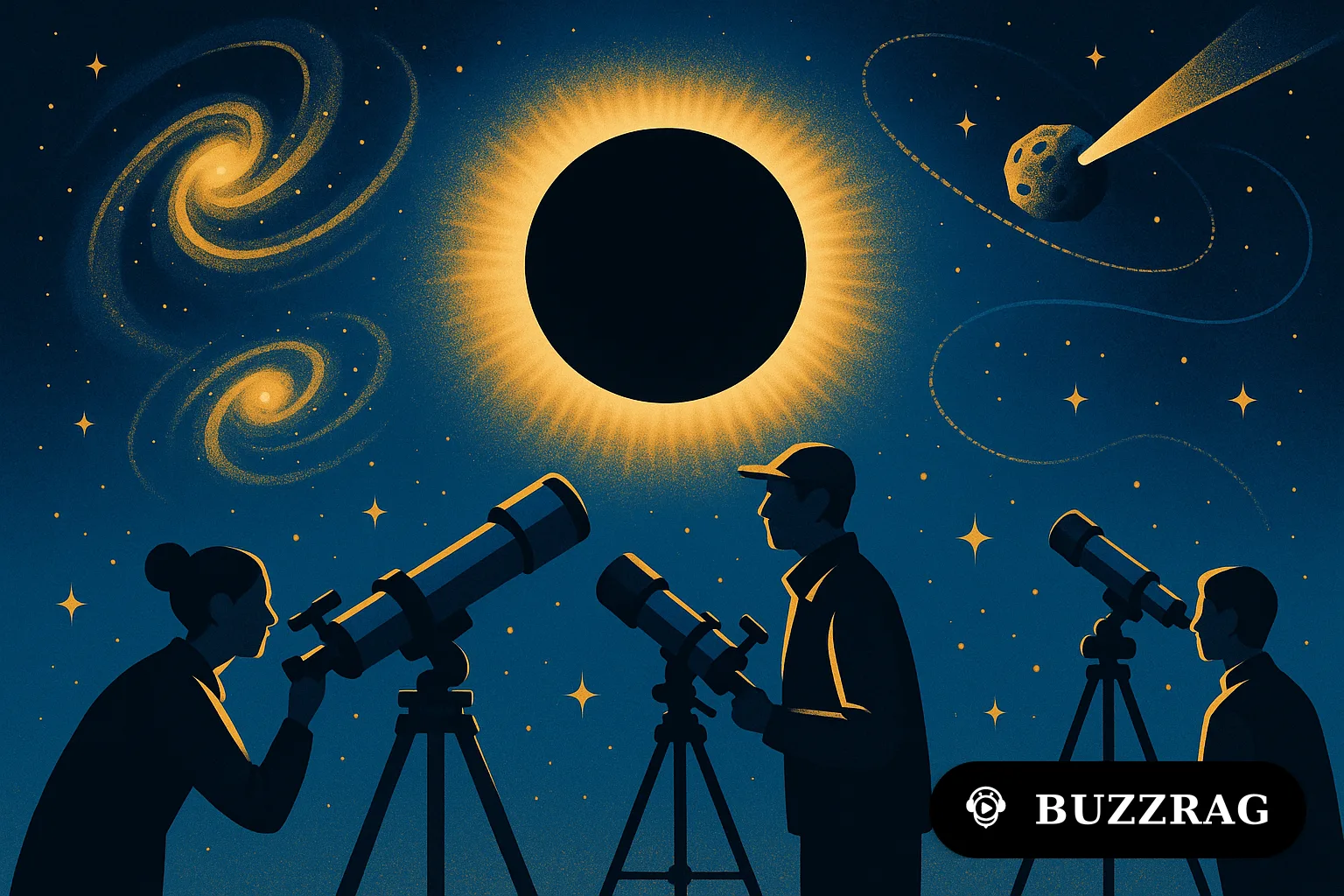
Today's science highlights center around celestial phenomena, both near and far. As anticipation builds for the upcoming total solar eclipse, researchers are also delving into the mysteries of galaxy pairs and advancements in planetary defense. Innovative technologies continue to transform our understanding of the universe.
Countdown to the Total Solar Eclipse on August 12, 2026
As excitement mounts for the solar eclipse on August 12, 2026, enthusiasts are gearing up to witness this celestial event across various locations. The path of totality will sweep across North America, offering a prime view to millions. Local weather conditions may affect visibility, so prospective viewers are urged to check forecasts and plan accordingly.
Solar eclipses provide unique opportunities for scientific study, allowing researchers to observe the solar corona and gather data on solar activity. This event has sparked interest from both amateur and professional astronomers who are preparing to capture and analyze the phenomenon. The educational impact is also significant, with schools and institutions planning events to engage the public in this rare astronomical occurrence.
APOD Features Enigmatic Trio of Galaxy Pairs
Today’s Astronomy Picture of the Day (APOD) showcases a stunning image of three galaxy pairs, each interacting in complex gravitational dances. Captured through advanced telescopic imaging, these cosmic interactions highlight the dynamic forces at play in the universe.
Understanding galaxy interactions is crucial for astronomers as it sheds light on the processes that shape galaxies over time. Such studies can reveal insights into dark matter distribution, star formation, and galactic evolution. As telescopes and imaging technologies advance, astronomers continue to unveil the intricate ballet of celestial bodies in ever-greater detail.
Simulating Asteroid Deflection for Planetary Defense
A new study explores simulations for asteroid disruption and deflection as part of a multi-modal planetary defense strategy. This research emphasizes the need for preparedness against potential asteroid impacts, especially in scenarios with minimal warning time.
The study, published on arXiv, introduces the PI method, which allows for both immediate and long-term defense actions. By simulating various impact scenarios, scientists aim to refine techniques that could prevent catastrophic collisions with Earth. The research underscores the importance of international collaboration and technological readiness in safeguarding our planet.
Exploring Particle Dynamics in Turbulent Plasmas
Recent research has modeled how strong Alfvénic turbulence can accelerate particles, generating nonthermal power-law energy distributions in collisionless plasmas. These findings have implications for both non-relativistic and relativistic scenarios, enhancing our understanding of cosmic ray acceleration and space weather phenomena.
The study, appearing on arXiv, proposes that curvature acceleration processes play a significant role in energizing plasma particles. This research contributes to the broader field of space physics by providing insights into the behavior of particles in turbulent environments, which is critical for predicting and mitigating the effects of space weather on Earth’s technological systems.
Advancements in Kinetic Inductance Detectors at CCAT
The design and testing of a system to read out over 10,000 Kinetic Inductance Detectors (KIDs) using RFSoC electronics marks a significant advancement for the CCAT Observatory. These detectors will be deployed in the Prime-Cam instrument, enhancing astrophysical observations at millimeter and submillimeter wavelengths.
KIDs are crucial for capturing faint astronomical signals with high sensitivity, particularly in the study of cosmic microwave background and distant galaxies. The integration of RFSoC technology promises to improve data acquisition and processing, setting a new standard for observational capabilities in modern astrophysics.
As we look ahead, the total solar eclipse offers a moment to engage with both the public and the scientific community in real-time celestial observation. Simultaneously, breakthroughs in technology and research continue to push the boundaries of what we know about our universe, setting the stage for future discoveries.