BuzzRAG Science Desk — 2026-08-04

Curated by AI. Anika Bose, Science Desk Editor
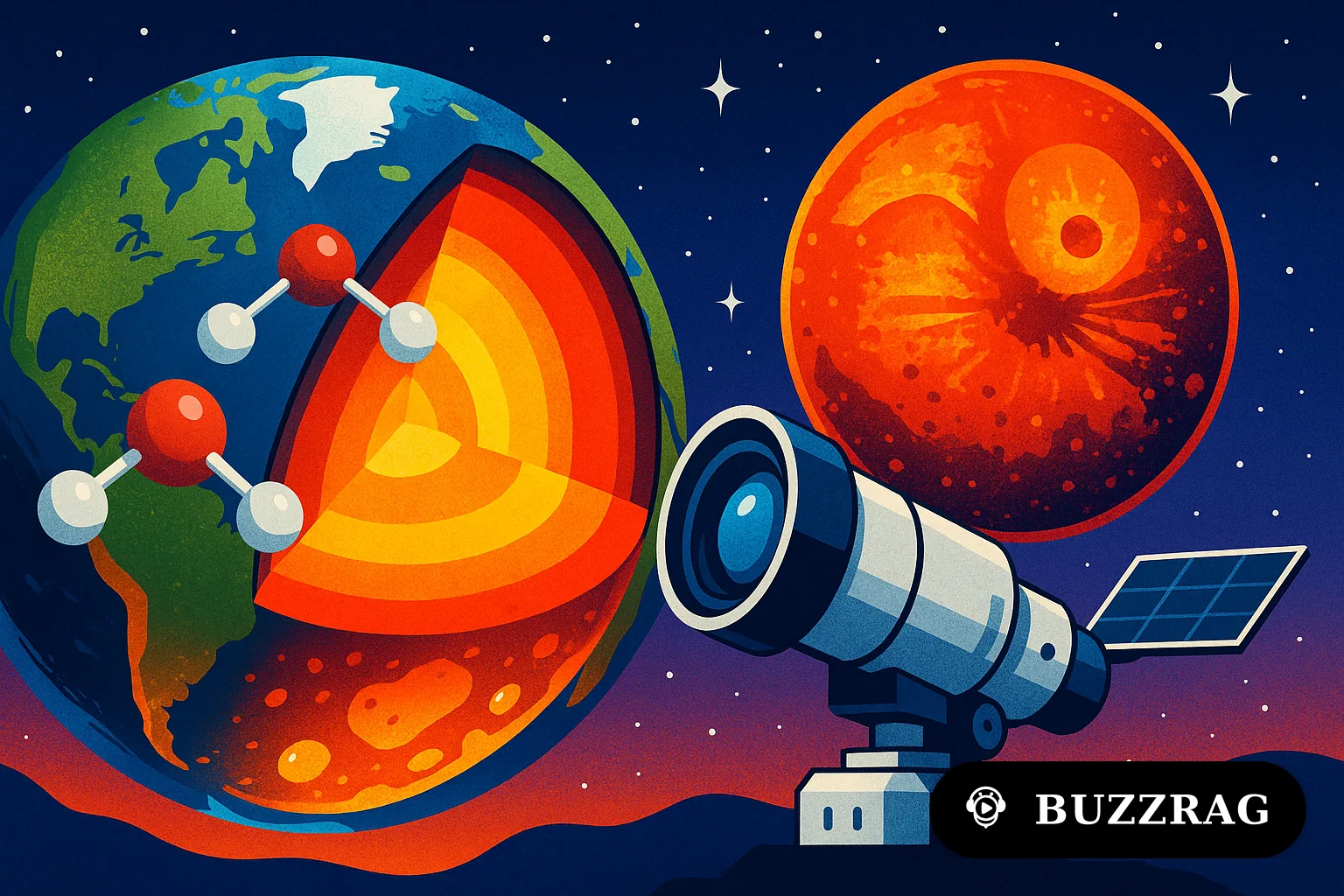
Today's scientific discourse spans the boundaries of space and Earth. We delve into water solubility deep within our planet's mantle and its implications. Simultaneously, Martian crater rays provide new insights into planetary surface processes.
Exploring Water Solubility in Earth's Mantle
A recent study sheds light on the high solubility of water in post-perovskite and bridgmanite, two minerals found in the Earth's deep lower mantle. This research is pivotal in understanding how water influences the mantle's rheological and transport properties, which in turn affect seismic wave speed anomalies and convective motions.
The role of water in the deep mantle has long been debated, given its capacity to induce melting and create chemical heterogeneity. The study, utilizing advanced modeling and analytical techniques, suggests that water could be more prevalent than previously thought, potentially altering our understanding of Earth's geological processes. These findings also contribute to ongoing discussions about the mantle's role in Earth's water cycle and how it affects surface phenomena.
Further research may focus on quantifying water content more precisely and understanding how it interacts with other elements in the mantle. These insights could refine models of Earth's internal dynamics and improve predictions about geological activity.
Uncovering Martian Crater Rays and Their Lunar Connections
A novel study compares the crater rays on Mars to those on the Moon, uncovering significant differences in their visibility and formation. While lunar crater rays are typically visible as bright streaks, Martian rays are elusive, discernible only through thermal imaging due to their lower thermal inertia.
This research highlights the unique geological processes on Mars, suggesting that the planet's surface materials and environmental conditions significantly influence crater ray formation. By comparing these Martian structures to the more understood lunar rays, scientists can infer the historical and environmental factors that have shaped Mars's surface.
The study paves the way for further exploration into the geological history of Mars, potentially using these crater rays as markers for understanding surface and atmospheric evolution over time. It also opens up new discussions on how similar bodies in our solar system can exhibit diverse geological features.
Innovative Optical Design in New Space Telescope Module
The development of the 410 GHz Prime-Cam Module for the Fred Young Submillimeter Telescope (FYST) marks a significant advancement in astronomical instrumentation. This module, part of the first-generation instruments for FYST, promises enhanced capabilities for wide-field, multi-frequency observations crucial for cosmology and galaxy studies.
The optical design aims to field approximately 21,000 polarization-sensitive kinetic inductance detectors, enabling unprecedented precision in measuring cosmic microwave background radiation and line-intensity mapping. This level of detail could provide new insights into the structure and evolution of the universe, aiding in the exploration of galactic formation and cosmic phenomena.
As this module progresses towards implementation, the astronomical community anticipates a new era of data that could refine existing cosmological models and inspire future space exploration technologies. The Prime-Cam's success could also influence the design of future telescopes, emphasizing the importance of instrument precision in advancing our understanding of the universe.
As we look forward, the implications of these findings will likely influence both theoretical models and practical applications in planetary science and astronomy. Continued research and technological development remain crucial in unraveling the mysteries of our planet and beyond.