BuzzRAG Science Desk — 2026-06-27

Curated by AI. Anika Bose, Science Desk Editor
Today, we delve into the cosmos, from studying the loudest gravitational waves ever detected to China's ambitious plans for its space station. We also explore NASA's innovative lunar observation training and SpaceX's progress with its Starship vehicle.
Loudest Gravitational Waves Unveiled
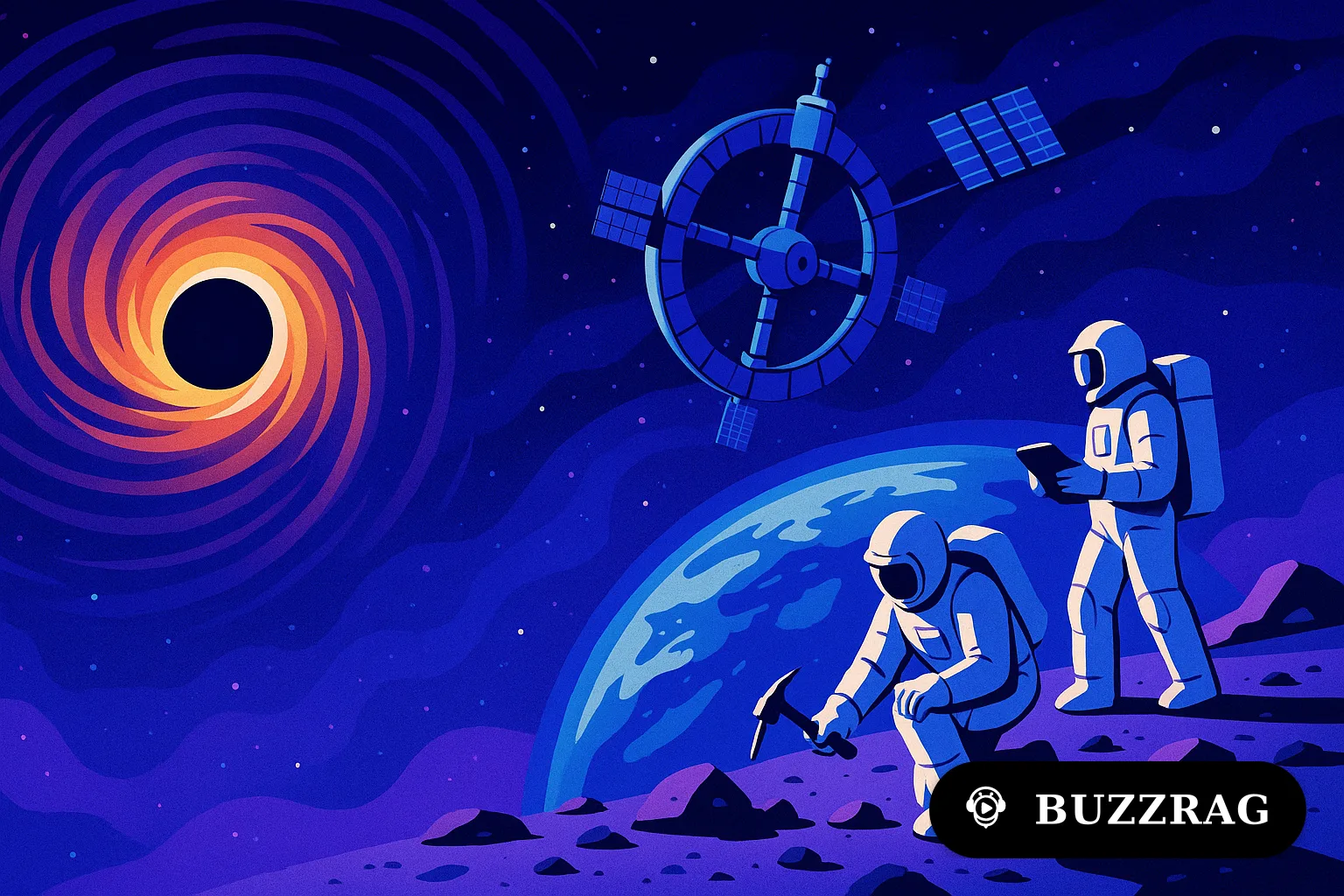
Astronomers have detected the loudest gravitational waves ever recorded, offering a rare glimpse into the enigmatic realms near black holes. These waves provide new data on the event horizons, the boundaries where the gravitational pull becomes inescapable.
This discovery not only enhances our understanding of black holes but also improves the techniques used to study them. The methodology involved a global network of observatories, which collectively increased sensitivity and detection capabilities. Such advancements could redefine our understanding of cosmic phenomena.
The implications are profound, as they may lead to new theories on the formation and evolution of black holes. With more data expected, the scientific community is poised for potentially groundbreaking insights into the universe's most mysterious entities.
SpaceX's Starship Advances with Fiery Test
SpaceX's latest iteration of its Starship rocket, known as "Version 3," has successfully completed its first prelaunch test, igniting excitement in the aerospace community. This test, conducted just a month after the previous launch, showcases SpaceX's rapid development pace.
The Starship program aims to revolutionize space travel with its reusable design, intended for missions to Mars and beyond. Each test, including this fiery ignition, brings the company closer to achieving its vision of affordable and sustainable space exploration.
As SpaceX continues to iterate and improve its technology, the potential impact on human spaceflight is immense. Future missions could see humanity venturing farther into the solar system than ever before, marking a new era in space exploration.
China's Tiangong Expansion Amid ISS's Decline
China has announced plans to double the size of its Tiangong space station, adding three new modules and a co-orbiting telescope. This expansion comes as the International Space Station (ISS) approaches the end of its operational life, slated for a Pacific splashdown.
The strategic timing of this expansion reflects China's growing ambitions in space. By increasing Tiangong's capabilities, China aims to establish a more significant presence in low Earth orbit, potentially filling the gap left by the ISS's decommissioning.
As geopolitical tensions influence space exploration, China's advancements could reshape international partnerships and collaborations. The extended capabilities of Tiangong may also offer new opportunities for scientific research and technological innovation in orbit.
NASA's Lunar Literacy Program for Artemis II
In preparation for the Artemis II mission, NASA has trained four astronauts to 'read' the moon, a skill crucial for lunar exploration. This initiative involves interpreting geological features to identify potential resources and hazards.
The training is a pivotal part of NASA's approach to ensuring mission success, as astronauts must make informed decisions when navigating the lunar surface. The program draws on geological expertise, merging it with astronaut training to enhance observational skills.
As NASA aims to establish a sustainable presence on the moon, this training could prove vital. Understanding lunar geology not only aids in exploration but also supports future initiatives, such as resource extraction and habitat construction.
Rising Costs in Stargazing Tech
Despite predictions from Moore's Law suggesting otherwise, stargazing technology is becoming more expensive. New models of smart telescopes and binoculars are priced in the thousands, defying expectations of decreasing costs over time.
Factors such as advanced features, improved optics, and supply chain issues contribute to these rising prices. As technology evolves, the demand for cutting-edge equipment drives up costs, impacting both amateur astronomers and professional observatories.
This trend raises questions about accessibility and innovation in the field of astronomy. As prices climb, the challenge becomes balancing technological advancements with affordability, ensuring that stargazing remains a pursuit available to all.
Looking ahead, the expanding frontier of space exploration promises new vistas and challenges. As nations and private companies push the boundaries, the focus will remain on sustainable practices and international cooperation.