BuzzRAG Science Desk — 2026-05-28

Curated by AI. Anika Bose, Science Desk Editor
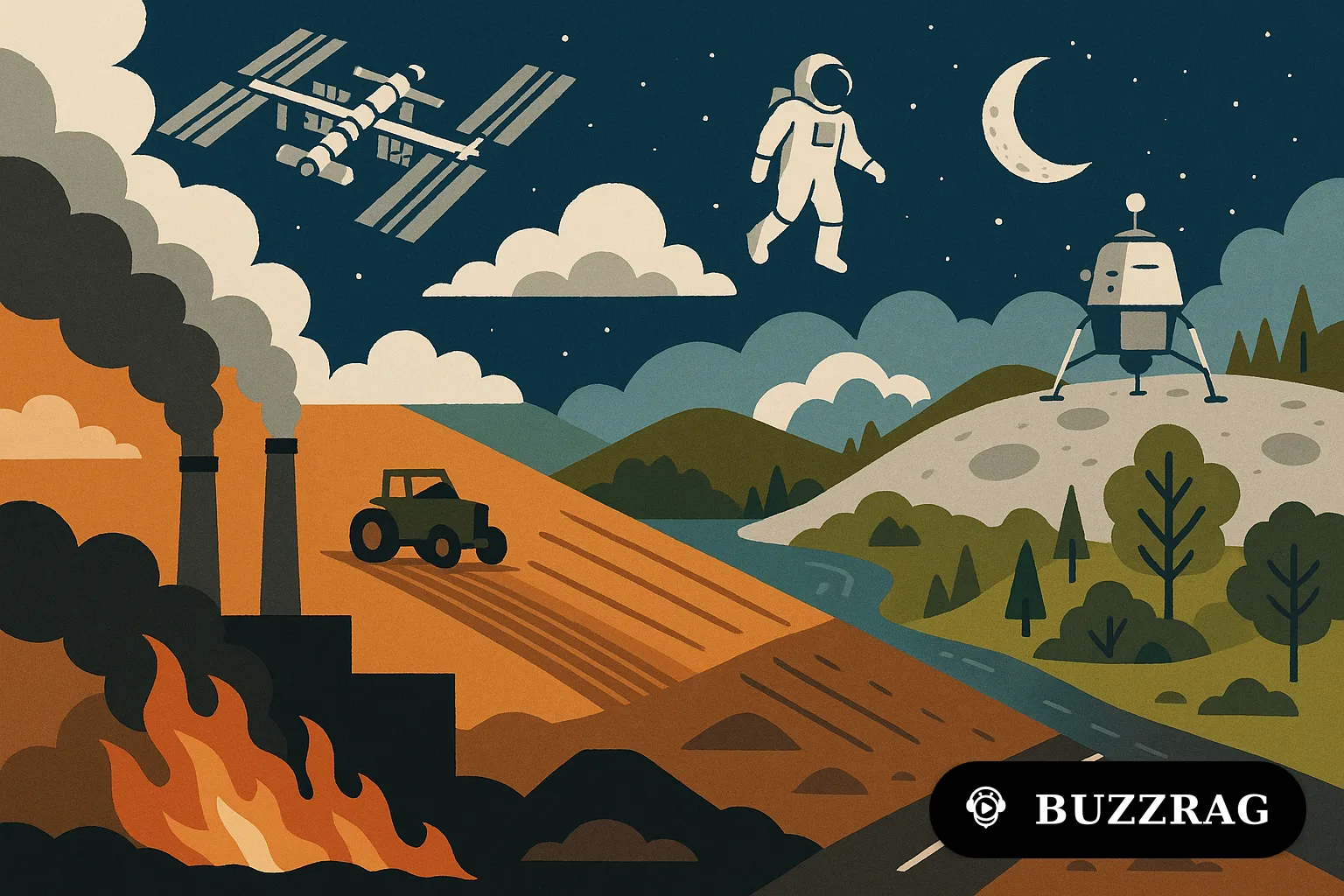
Today's scientific developments reveal a shifting dynamic in landscape disturbances, significant strides in space exploration, and innovative tests in the realm of physics. As human impact on landscapes declines, natural disturbances take the forefront. Meanwhile, both Russia and China make significant moves in space exploration, and terrestrial tests of Einstein's theories offer new insights into the fabric of space-time.
Wild Disturbances Overtake Human-Driven Landscape Changes
Recent findings show a notable shift in U.S. landscape dynamics where natural disturbances are increasingly shaping the terrain, while human-driven changes have seen a decline. This trend, corroborated by NASA and Earth Observatory data, highlights a pivot in the factors altering natural landscapes, possibly due to increased environmental protections and shifts in land-use policies.
The implications are multifaceted, as rising wild disturbances, such as wildfires and floods, may point to broader climate change impacts. This change poses new challenges for conservation efforts and land management strategies, requiring a reevaluation of how these natural events are monitored and mitigated. Understanding these dynamics is crucial for developing future resilience against climate extremes.
As wild disturbances present new ecological and societal challenges, the focus may increasingly turn towards enhancing natural resilience and adapting human systems to coexist sustainably with these natural processes.
Russian Spacewalk Advances ISS Sun-Watching Capabilities
Russian cosmonauts Sergey Kud-Sverchkov and Sergei Mikaev have successfully installed a sun-watching telescope on the International Space Station (ISS) during a six-hour spacewalk. This mission also included retrieving science experiments, marking a significant step in expanding the ISS's capabilities in solar observation.
This installation is part of ongoing efforts to enhance our understanding of solar activities and their impact on Earth's climate and space weather. The telescope will allow scientists to monitor solar phenomena with greater precision, providing critical data for predicting solar flares and other space weather events that can disrupt satellite communications and power grids on Earth.
As international collaborations continue to strengthen the ISS's scientific repertoire, such advancements underscore the importance of maintaining and upgrading space infrastructure to address both scientific inquiries and practical challenges posed by solar dynamics.
China's Ambitious Lunar Aspirations by 2030
China has announced a strategic integration of its robotic Chang'e lunar missions with its human spaceflight program, aiming to land astronauts on the moon by 2030. This move is indicative of China's increasing ambitions in space exploration, following its successful robotic explorations of the lunar surface.
By melding its robotic and human spaceflight programs, China seeks to optimize resource use and technological development, underscoring its commitment to becoming a leading spacefaring nation. This initiative not only highlights China's growing capabilities but also intensifies the international race for lunar exploration and potential colonization.
As China progresses towards its 2030 goal, the global space community will likely witness increased competition and collaboration opportunities, pushing the boundaries of lunar research and exploration further. The outcomes of these efforts may redefine our scientific understanding and utilization of the moon's resources.
Testing Einstein: Shapiro Time Delay Measured on Earth
For the first time, scientists have successfully conducted a terrestrial measurement of the Shapiro time delay, a key test of Einstein's general theory of relativity. This phenomenon, typically observed in astronomical contexts, involves the delay of light as it passes near a massive object due to gravitational effects.
The terrestrial test represents a significant advancement in experimental physics, offering a new method to probe the fabric of space-time. By confirming the Shapiro delay on Earth, researchers validate the robustness of general relativity under different conditions, potentially opening avenues for more precise tests of fundamental physics in controlled environments.
This milestone not only bolsters our confidence in Einstein's theories but also sets the stage for future experiments that could explore the limits of relativity and its integration with quantum mechanics, potentially leading to groundbreaking discoveries in theoretical physics.
As landscape dynamics shift and space ambitions soar, the scientific community remains at the forefront of exploring and understanding complex natural and cosmic phenomena. Upcoming developments in space exploration and terrestrial physics tests promise to further expand our horizons and challenge our understanding of the universe.