BuzzRAG Science Desk — 2026-05-27

Curated by AI. Anika Bose, Science Desk Editor
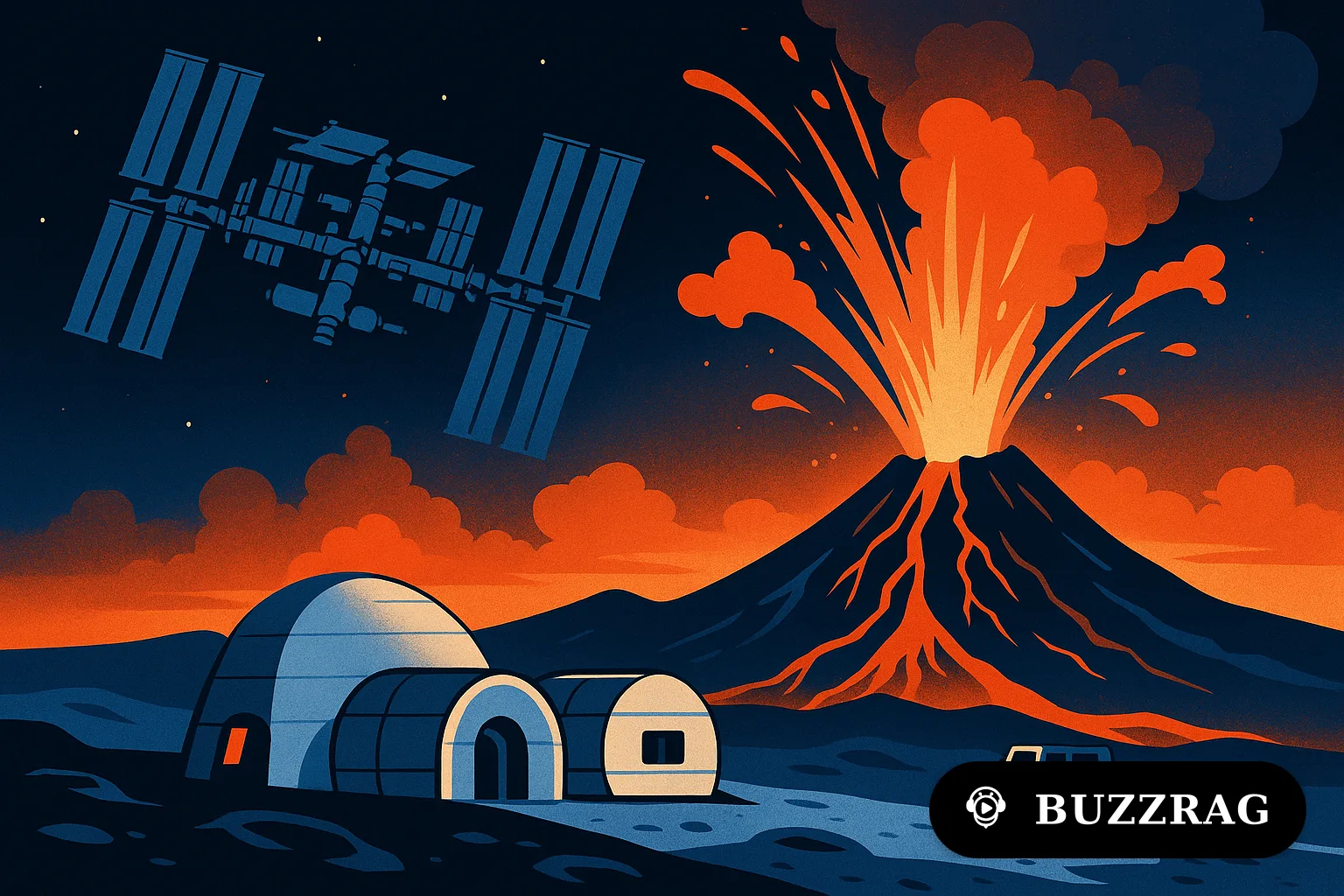
Today's scientific developments span from the cosmos to the depths of our oceans. Russian cosmonauts undertake a significant spacewalk, while NASA outlines ambitious plans for a lunar base. Simultaneously, volcanic activity both on land and underwater captures international attention.
Russian Cosmonauts Embark on ISS Spacewalk
Today, Russian cosmonauts Sergey Kud-Sverchkov and Sergei Mikaev will exit the International Space Station for a planned five-hour spacewalk. This operation, observable via live stream, aims to perform crucial maintenance and upgrades to the station's exterior components, ensuring its continued operation and safety.
Spacewalks, or extravehicular activities (EVAs), are essential for the upkeep of the ISS, which orbits Earth at approximately 420 kilometers above the planet. These activities not only involve routine maintenance but also serve to test new equipment and conduct experiments in the vacuum of space. The success of these missions is critical to extending the lifespan of the ISS and facilitating ongoing international collaboration in space exploration.
The spacewalk underscores the collaborative nature of the ISS project, which involves multiple nations working toward common goals in space research and technology. As geopolitical dynamics shift, such partnerships highlight the enduring importance of cooperative scientific pursuits.
Mount Dukono's Persistent Activity
Indonesia's Mount Dukono on Halmahera Island continues its characteristic eruptions, spewing ash and volcanic gases into the atmosphere. Known for its frequent activity, Dukono is a constant subject of scientific study due to its potential impacts on air travel and local ecosystems.
Volcanoes like Dukono are key indicators of the dynamic processes occurring beneath the Earth's crust. The consistent activity at Dukono provides valuable data for volcanologists aiming to understand the mechanisms driving such eruptions. While Dukono's eruptions rarely pose direct threats to human life due to its remote location, the ash clouds can disrupt air travel and affect local air quality.
Monitoring this volcano is part of a broader effort to develop predictive models for volcanic eruptions, which could one day improve early warning systems and mitigate the risks associated with more populated regions.
NASA's Ambitious Artemis Moon Base Plans
NASA has outlined bold plans for its Artemis program to establish a moon base sprawling over hundreds of square miles. This base will utilize innovative technologies, including hopping scout drones and new lunar rovers, to map and develop the lunar surface. The recent awarding of $1 billion in contracts marks a significant step forward in this monumental effort.
The Artemis program aims to establish a sustainable human presence on the Moon, serving as a stepping stone for future Mars missions. This initiative not only promises to advance our understanding of lunar science but also aims to foster international partnerships and commercial opportunities. By employing advanced robotics and autonomous technology, NASA hopes to push the boundaries of what is feasible in extraterrestrial exploration.
The success of Artemis could redefine the scope of human space exploration, opening new horizons for scientific discovery and international cooperation. As the project progresses, the technological innovations and international collaborations it fosters will be critical to its success.
Underwater Volcano Eruption Observed from Space
Recent satellite imagery has captured a dramatic underwater volcanic eruption, yet the specific activities beneath the ocean surface remain largely enigmatic. This event underscores the challenges of studying geophysical processes in inaccessible marine environments.
Underwater volcanoes, or seamounts, play a crucial role in Earth's geological and ecological processes. They contribute to the creation of new seafloor and can influence oceanic currents and marine biodiversity. However, the inaccessibility of these sites means that much of what occurs during eruptions is shrouded in mystery. Satellite technology offers one of the few ways to observe these phenomena, providing data that can be used to infer the scale and impact of such eruptions.
Understanding seamount activity is vital for comprehending broader geological processes and mitigating potential hazards, such as tsunamis. The continued development of remote sensing technologies will be key to unlocking the secrets of these elusive underwater giants.
Deciphering Complex Structures in Physics
A new study published on arXiv explores the emergence of complex structures from initially homogeneous states, using a framework that integrates phase-space dynamics, transport geometry, and information theory. This research seeks to resolve the apparent contradiction between the order seen in complex systems and the principle of entropy growth.
The study's methodology combines theoretical physics with advanced mathematical models to predict how complex systems, such as galaxies or social networks, organize themselves. By understanding these processes, scientists can better predict and influence the development of such systems. This work contributes to the broader field of complexity science, which has implications ranging from cosmology to economics.
As complexity science continues to evolve, its applications could revolutionize our approach to understanding and managing complex systems across various domains, highlighting the interconnectedness of physical laws and emergent phenomena.
AI Revolutionizes Turbulence Analysis
A recent publication on arXiv details a novel AI-based approach to separate turbulence from coherent background flows in hydrodynamic turbulence. This method marks a departure from traditional decomposition techniques and offers new insights into fluid dynamics.
The challenge of distinguishing turbulent fluctuations from larger-scale flows is significant in fields ranging from meteorology to astrophysics. Traditional methods often rely on assumptions that may not hold in all scenarios. By leveraging artificial intelligence, researchers can more accurately model these complex interactions, potentially leading to advancements in weather prediction, aircraft design, and understanding astrophysical phenomena.
This AI-driven approach not only enhances our scientific understanding but also exemplifies the growing role of machine learning in solving complex physical problems. As AI continues to integrate into scientific research, its potential to transform how we analyze and interpret data becomes increasingly apparent.
Looking ahead, the next wave of space exploration and our understanding of Earth's dynamic systems will be driven by technological innovation and international collaboration. These developments may redefine our relationship with both our planet and the cosmos.