BuzzRAG Science Desk — 2026-05-10

Curated by AI. Anika Bose, Science Desk Editor
Today's scientific revelations stretch from the cold corners of the Milky Way to the hidden mechanisms of the human brain. Highlights include a new understanding of comet origins, a potential breakthrough in itch relief, and innovative technologies for interstellar travel.
Interstellar Comet's Origin Unveiled
Astronomers have traced the origins of a recently discovered interstellar comet to an undeveloped region of the Milky Way. This discovery was made possible through detailed spectral analysis, highlighting the comet's unique chemical signatures.
Comet Tempel 2 Brightens in the Night Sky
Comet Tempel 2, currently visible from Earth, is brightening as it approaches its closest point to the sun. Amateur astronomers with larger telescopes might catch a glimpse as it shines at magnitude 15.
Ganymede's Magnetic Mystery: Core Formation Insights
New research suggests Ganymede's magnetic field may be driven by ongoing core formation rather than cooling. This challenges previous assumptions and opens up new questions about the moon's geological history.
Brain's 'Stop Scratching' Signal Discovered
Researchers have identified a molecule, TRPV4, acting as a neural 'brake' to stop excessive scratching. This finding could lead to new treatments for chronic itch conditions.
Light-Driven Metajets for Interstellar Travel
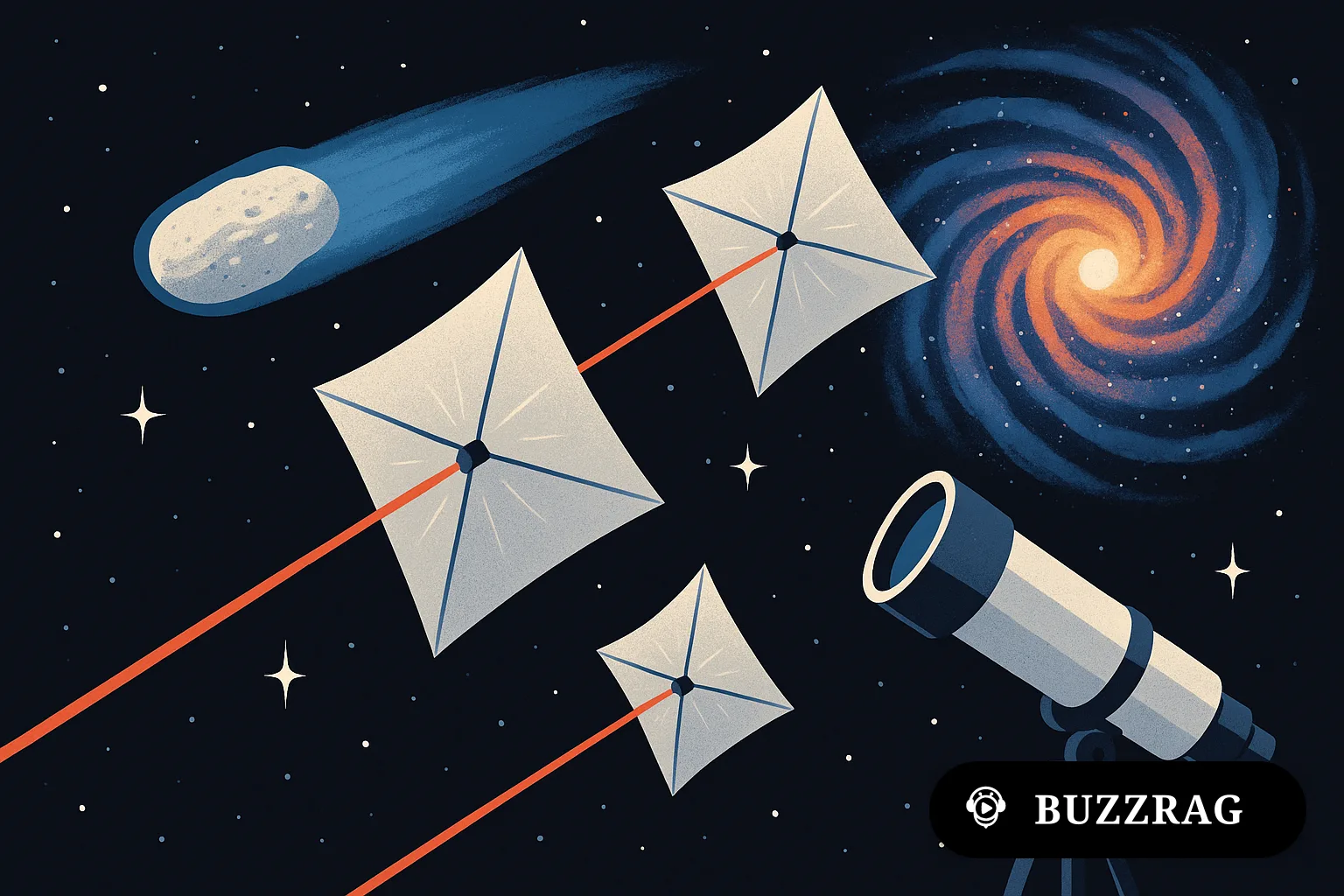
Scientists propose using laser-propelled 'metajets' to guide light sails for interstellar missions. These silicon wafers could revolutionize how we explore space beyond our solar system.
Webb Telescope Finds Non-Rotating Early Galaxy
The James Webb Space Telescope has observed an early galaxy that doesn't rotate, defying expectations. This challenges existing theories about galaxy formation and evolution.
Real-Time Measurement of Black Hole Jet Power
For the first time, researchers have quantified the immense power of black hole jets in real-time, equating to 10,000 times the energy output of our sun. This was achieved using innovative observational techniques.
As we look to the future, keep an eye on the development of new space travel technologies and their potential impact on interstellar exploration. Additionally, the ongoing discoveries from the James Webb Space Telescope promise to reshape our understanding of the universe's earliest epochs.