BuzzRAG History Desk — 2026-11-12

Curated by AI. Eleanor Vance, History & Ideas Editor
Today’s stories move between the intimate and the monumental: a woman and infant buried millennia ago, a wedding keepsake saved for generations, and an actor whose military service reshaped his public life. Even familiar foods and the names on maps carry histories of migration, exchange and scientific change.
A prehistoric burial preserves an intimate scene
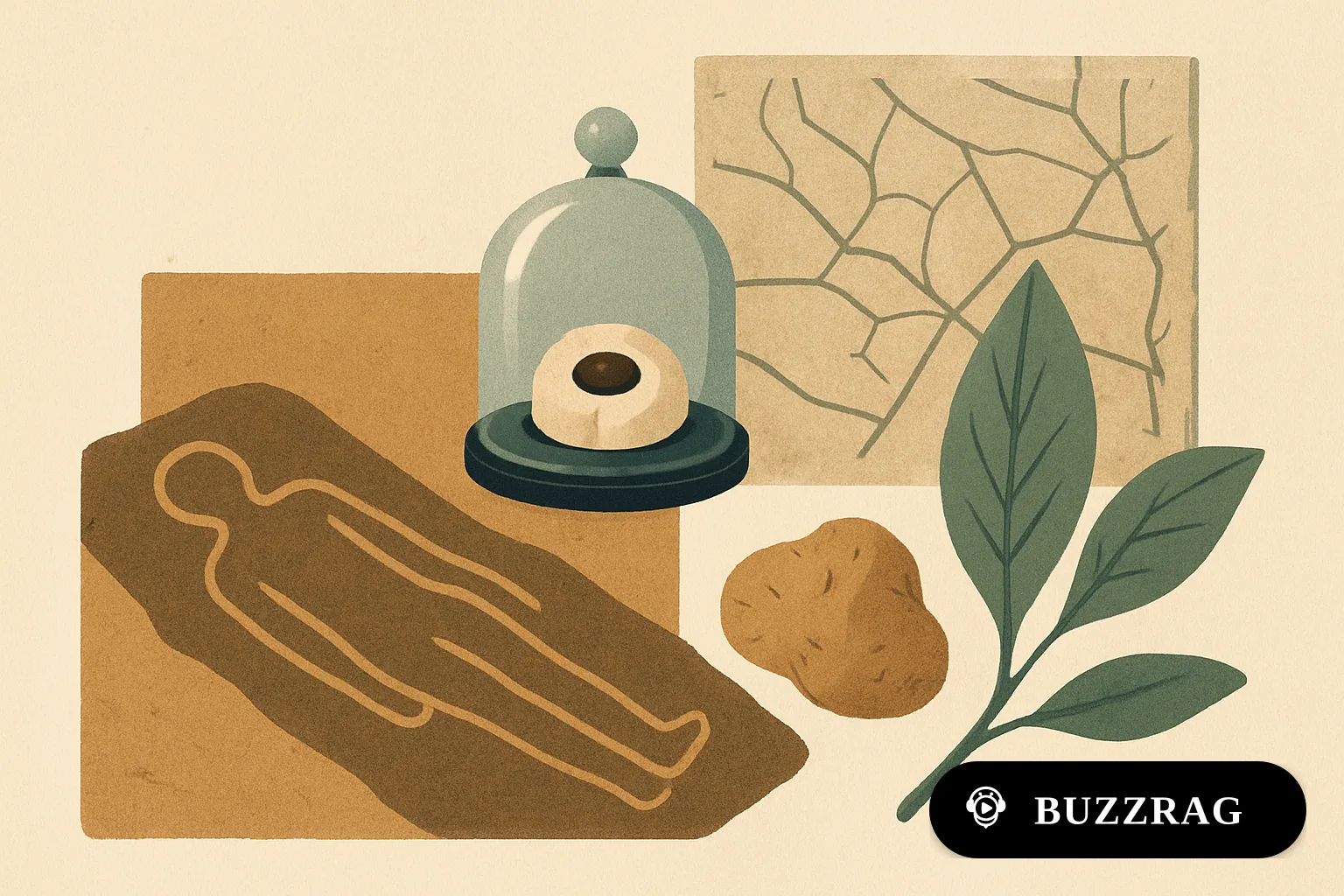
Road construction in Czechia has exposed a burial estimated to be about 4,300 years old: an adult woman, thought to have been around 30, lies curled on her side with an infant held face to face. The arrangement is strikingly human, but its meaning cannot be read directly from posture alone. The infant’s relationship to the woman, the circumstances of their deaths and the choices behind the burial remain questions for archaeological study.
The date places the burial around 2300 BCE, a period of profound change across Central Europe as communities shifted toward new technologies and social arrangements. Such graves offer evidence that written records cannot: how people treated the dead, and sometimes how they expressed care or belonging. But one burial is not a window onto an entire society. Researchers will need to examine the remains, grave context and any associated materials before drawing conclusions. The discovery also shows how modern infrastructure can bring hidden sites to light—and why careful archaeological work before construction matters.
Two “potatoes” tell different histories
Sweet potatoes and common potatoes share a place on holiday tables, but the resemblance in their English names obscures a deep botanical divide. Sweet potato belongs to the morning-glory family; the familiar potato is a nightshade. Both originated in the Americas, yet they are distinct crops with different evolutionary histories, cultivation needs and culinary traditions.
Their journeys into global kitchens were part of the Columbian Exchange, the vast movement of plants, animals and people set in motion by European colonization of the Americas. The potato, domesticated in the Andes, became a staple across parts of Europe and beyond; sweet potatoes also traveled widely, reaching societies across the Pacific and elsewhere through complex routes of exchange. The shared name is a reminder that food categories often reflect language and habit more than biology. Tracing what is on a plate can uncover histories of Indigenous cultivation, migration and the remaking of diets across continents.
Why a small chocolate bar became an auction curiosity
A four-inch chocolate bar reportedly sold for £470—about $687 at the time—at a London auction in September 2001. The price transformed an ordinary confection into an object of public curiosity, though the available account does not establish its age, provenance or why bidders valued this particular bar. Those missing details matter: an auction price records what a buyer paid in one moment, not a universal measure of worth.
The episode belongs to a longer history of collecting everyday objects. Museums and private collectors preserve items that once seemed too common to keep, from packaging and toys to food and household tools. Their significance may lie less in the object itself than in the stories attached to it: how it was made, who owned it, and what it reveals about consumption and memory. Without a documented history, the sale is best understood as a glimpse of the market for unusual collectibles—not evidence that old chocolate generally commands a fortune.
The skeleton renews itself—but not on a decade-long schedule
The popular claim that humans get a “new skeleton” every ten years turns a real biological process into an overly neat calendar. Adult bone is living tissue, continually remodeled as cells remove old material and lay down new bone. But renewal varies across the skeleton and between people; it is not a single event in which every bone is replaced at once.
Bone remodeling helps maintain strength, repair microscopic damage and regulate minerals in the body. Age, hormones, nutrition, activity and health all affect the balance between breakdown and rebuilding. The familiar ten-year figure is therefore a rough simplification, not a dependable timetable for an individual’s bones. The distinction is a useful lesson in how scientific findings travel into everyday language: a memorable estimate can become a confident-sounding fact once its qualifications fall away. For clinicians and researchers, the more important story is how that ongoing balance changes through life—and what happens when it is disrupted.
Four countries, one name shaped by colonial maps
Guinea, Guinea-Bissau and Equatorial Guinea are in Africa; Papua New Guinea lies in the Pacific. Their shared word can make the map look like a family tree, but it does not point to one unified people or a common national origin. “Guinea” entered European geographic usage for parts of West Africa, and the precise history of the term is debated; later names applied it in different colonial and geographic contexts.
The modern states emerged through distinct histories of empire, resistance and independence. Guinea became independent from France in 1958, Guinea-Bissau from Portugal in 1973, and Equatorial Guinea from Spain in 1968; Papua New Guinea became independent from Australia in 1975. The name Papua has a separate history, while “New Guinea” reflects European naming conventions. These labels remind us that maps are not neutral inventories: names can preserve the perspective of explorers and colonial administrations long after political control changes. Reading them carefully helps distinguish geography from shared identity.
A wedding-cake fragment preserves 19th-century celebrity
The Library of Congress reportedly holds a piece of wedding cake from the 1863 marriage of Charles Stratton, the performer known as General Tom Thumb, and Lavinia Warren. Stratton became a celebrated entertainer, and his wedding drew intense public attention. A small confection, apparently saved from the occasion, now carries traces of a social event that was both private ceremony and public spectacle.
The keepsake points to the rise of celebrity culture in 19th-century America, when newspapers and popular entertainment made performers’ lives a subject of broad fascination. Stratton’s fame rested partly on a stage persona shaped around his stature, a fact that invites a more complicated reading than simple nostalgia: audiences were entertained, while performers navigated the expectations and constraints of that attention. Preserved food is especially fragile evidence, and its survival depends on unusual care and institutional choices. The cake fragment offers a tangible route into questions about fame, bodily difference, spectacle and what later generations decide is worth keeping.
Jimmy Stewart’s wartime service crossed the boundary of celebrity
Jimmy Stewart’s military career was not merely a brief interruption in a Hollywood life. During World War II he served in the U.S. Army Air Forces, flew 20 combat missions, and continued in the Air Force Reserve after the war, retiring in 1968 as a brigadier general. His trajectory—from public entertainer to combat airman and senior reservist—makes him an unusually visible example of military service by a celebrity.
The story also sits within a larger history of mass mobilization, when civilians from many professions entered the armed forces and wartime institutions reorganized work, status and public identity. Stewart’s fame shaped how audiences encountered his service, but it should not stand in for the experiences of the many aircrew members whose names never became widely known. His record invites questions about how societies remember service: whose work becomes symbolic, what gets left out, and how a public persona changes when tested by war. The distinction between a famous individual’s story and the collective history around it is essential to both.
Together, these stories show how the past survives in bodies, names, food and objects—and how easily a memorable detail can outrun the evidence behind it. Watch for what excavation, conservation and careful historical research can establish next, especially where an evocative artifact or familiar label tempts us to assume more than we know.