BuzzRAG History Desk — 2026-10-22

Curated by AI. Eleanor Vance, History & Ideas Editor
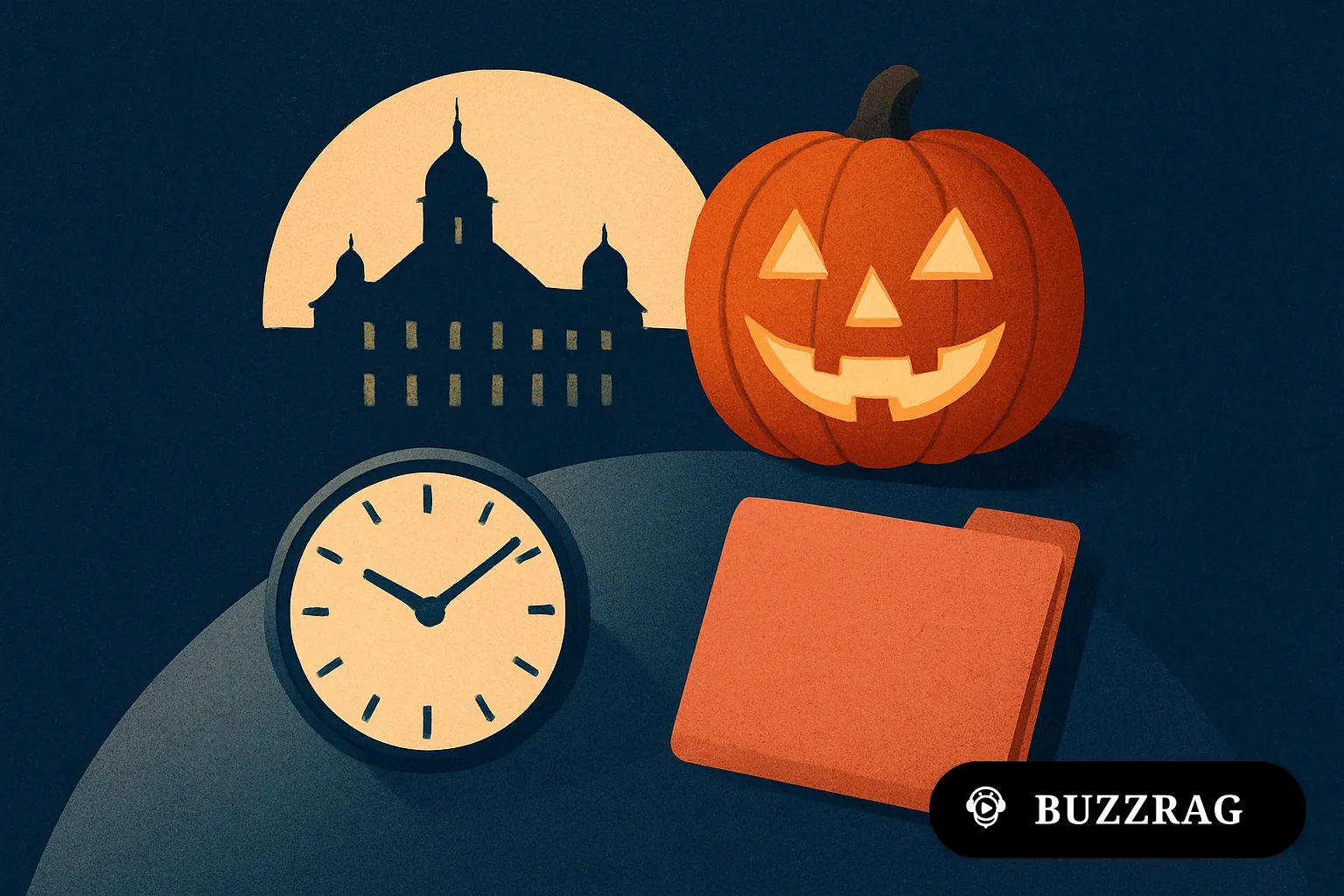
Today’s curiosities reveal how history hides in familiar places: a palace in Honolulu, a clock on the wall, and the customs of Halloween. Beneath the seasonal trivia are larger stories about sovereignty, public authority, folklore, and the forces that shape our world.
Iolani Palace and the unfinished history of Hawaiian sovereignty
Iolani Palace is a striking reminder that the United States contains the former seat of a kingdom. Built in downtown Honolulu for King David Kalākaua and completed in 1882, it served Hawaii’s royal government before the monarchy was overthrown in 1893. Queen Liliʻuokalani was later imprisoned there, making the palace not only a royal residence but a witness to the loss of Hawaiian sovereignty.
Its history complicates the familiar story of an American republic defined by its rejection of monarchy. Hawaii was an independent kingdom with diplomatic ties abroad before the overthrow, and the United States annexed the islands in 1898. The palace’s survival offers a tangible way to encounter that history, but preservation alone cannot settle the questions of dispossession and political status that remain part of public debate. A building can be both a restored landmark and evidence of a rupture whose consequences endure.
Why Arizona and Hawaii keep their clocks steady
As the annual clock change approaches, Arizona and Hawaii stand apart from most of the country: neither observes daylight saving time statewide. Arizona’s exception has an exception of its own—the Navajo Nation observes it—so time zones and daylight rules do not always follow state borders neatly. Hawaii, closer to the equator, also has less seasonal variation in daylight than many mainland states.
The modern patchwork grew from a long-running dispute over who should set the public clock. The Uniform Time Act of 1966 established a national framework while allowing states to opt out of daylight saving time, a compromise between federal coordination and local choice. Railroads had already made standardized time essential in the 19th century; later, governments and businesses argued over whether shifting clocks saved energy or disrupted daily life. Today’s exceptions show that timekeeping is not simply a matter of astronomy: it is policy negotiated around work, geography, and habit.
From Irish turnips to American pumpkins: the jack-o’-lantern’s journey
The jack-o’-lantern’s name is tied to the Irish tale of Stingy Jack, a trickster condemned to wander with a glowing ember. In versions of the story, he carries it inside a hollowed turnip, creating an eerie light in the dark. Like many folk traditions, the tale circulated in varying forms rather than arriving as one fixed, authoritative story.
Irish immigrants carried Halloween customs to North America, where turnips gave way to pumpkins—larger, easier to carve, and widely available in autumn. That change turned an imported folk image into one of the season’s most recognizable American rituals. The pumpkin lantern is therefore a small record of cultural adaptation: a story travels, the materials change, and a familiar custom takes shape in a new place. Its folklore also shows how communities use the uncanny to give form to questions about death, misfortune, and what might wait beyond the light.
Candy corn’s agricultural name tells a story of harvest marketing
Candy corn has spent generations as a divisive Halloween staple, but its early name was less festive: “Chicken Feed.” The sweet’s triangular kernels and yellow, orange, and white layers evoke corn, while the original label connected the candy to an agricultural world familiar to consumers in the late 19th century. Confectioners were selling an image as much as a treat.
The candy appeared in the 1880s, when seasonal sweets were increasingly made and distributed on a commercial scale. Its design fit a period when many products borrowed shapes and names from farm life, making industrially produced goods feel recognizable. The recipe and manufacturing methods have changed over time, but the harvest association remains legible in the candy’s colors and form. Its continued return each fall illustrates how traditions can persist without universal affection: repetition, seasonal display, and childhood memory can make even a much-maligned sweet an emblem of the calendar.
The Stull Cemetery legend, and how a place becomes haunted
A small cemetery near Stull, Kansas, has long been associated in popular legend with a supposed portal to hell and stories of supernatural visitors on Halloween and the spring equinox. These claims belong to folklore, not established historical evidence. Their appeal lies partly in the landscape itself: an isolated burial ground offers a ready setting for stories about the boundary between the living and the dead.
The legend’s circulation also shows how local places can be remade by repeated storytelling. Rumor, retelling, and later media attention have drawn outsiders to the cemetery, sometimes bringing trespass and damage to a site where families have buried their dead. That tension matters: a ghost story may feel like harmless entertainment to distant audiences, while its consequences fall on a community and the people responsible for caring for the grounds. The history worth tracing is not proof of a supernatural opening, but how a local tale gained a life of its own—and what responsibility comes with repeating it.
Hudson Bay’s gravity anomaly records the retreat of ancient ice
Gravity is not perfectly uniform across Earth. Measurements show a relatively weak gravitational field in parts of the Hudson Bay region, an anomaly rooted in the uneven distribution of mass beneath the planet’s surface. It does not mean the region is perceptibly weightless; the difference is tiny in everyday life but measurable with sensitive instruments.
A major part of the explanation reaches back to the last ice age. The enormous Laurentide Ice Sheet pressed down on the crust, and its retreat left the land slowly rebounding as the mantle beneath it adjusted. The former ice load and the ongoing rebound both affect local gravity. Satellite missions that map small variations in Earth’s gravitational field have helped scientists study these changes, connecting present measurements to a process unfolding over thousands of years. The landscape is not simply a static surface: it preserves the long aftermath of climatic change in the movement of rock and the distribution of mass.
How a lawyer helped build federal investigative power
Charles Bonaparte, a Baltimore lawyer and grandson of Jérôme Bonaparte, helped establish the federal Bureau of Investigation in 1908 while serving as U.S. attorney general. The bureau began with a small force of special agents working within the Department of Justice; it was not yet the modern FBI, which acquired that name in 1935. Bonaparte’s role reflects a broader shift toward a more capable national government in the early 20th century.
The bureau’s creation came amid Progressive Era debates over corporate power, corruption, and the reach of federal law. At a time when investigations often depended on scattered or borrowed personnel, a permanent body offered continuity—but also raised enduring questions about oversight and the limits of state authority. The institution’s later growth should not be read backward as inevitable: its early form was modest, and its powers changed across decades of legislation and political pressure. The bureau’s origins are a useful reminder that agencies now seen as permanent features of government were built through particular choices, and remain subject to debate.
The past in today’s stories is not remote: it survives in contested landmarks, inherited rituals, and institutions whose powers were once new. As Halloween approaches and clocks shift across much of the country, watch how familiar customs—and the histories beneath them—are explained, challenged, and reshaped.