BuzzRAG History Desk — 2026-10-16

Curated by AI. Eleanor Vance, History & Ideas Editor
Today’s history desk moves between monuments built to display power and ancient traces that can be erased by modern construction. Alongside those contests over memory, stories of crime, law and scientific observation show how inherited institutions shape what societies notice—and what they choose to protect.
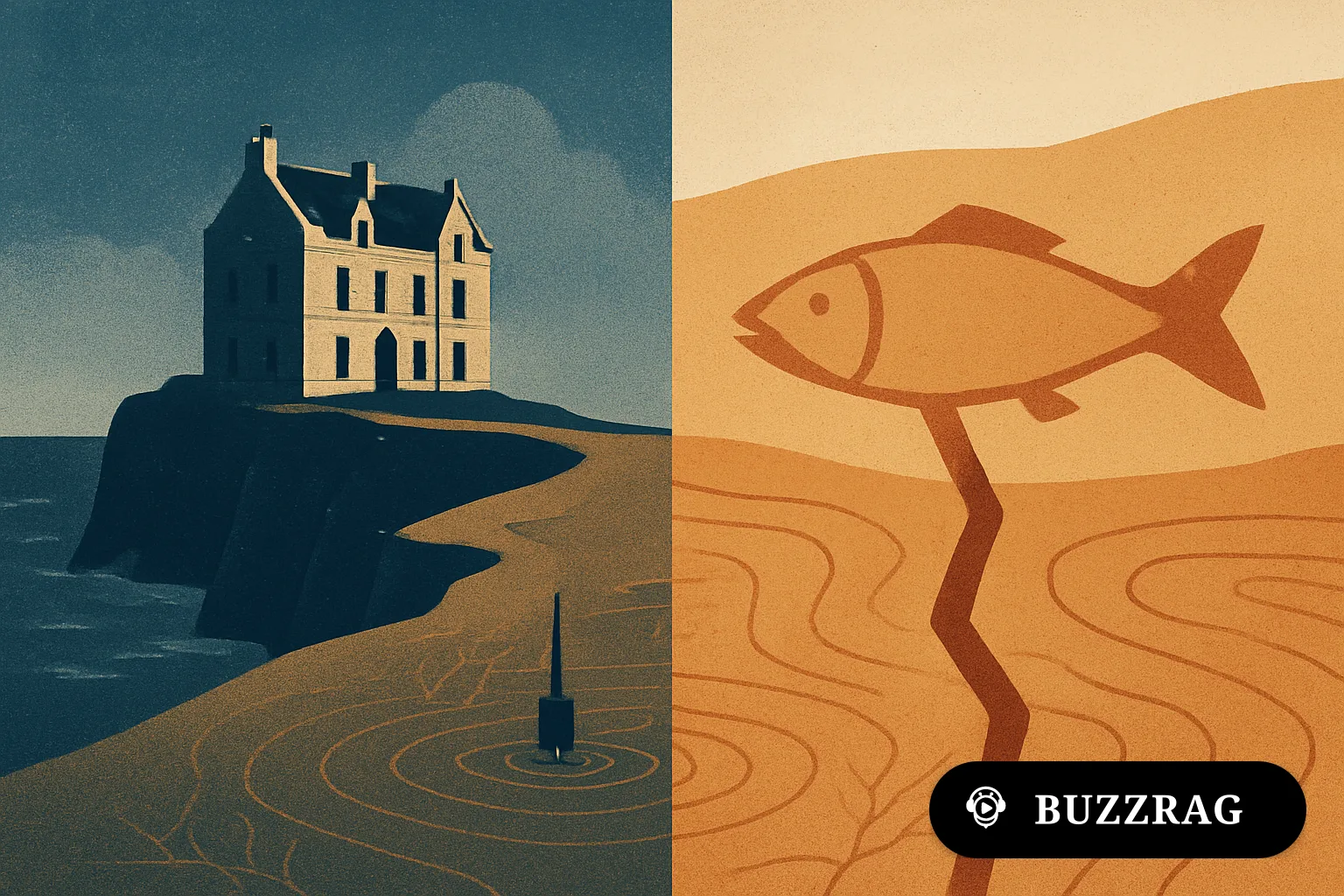
The Breakers and the Gilded Age’s Private World
The Breakers, the Vanderbilt family’s Newport mansion, made a striking distinction between public scale and private language: a 70-room residence, built at extraordinary expense, was described by its owners as a summer cottage. That understatement captures an era when America’s new fortunes sought to turn industrial wealth into lasting social authority—and seaside estates became stages for displaying it.
Cornelius Vanderbilt II commissioned the house in the 1890s, during the Gilded Age, when fortunes amassed through railroads and finance reshaped both cities and landscapes. The mansion’s grand architecture was not simply a matter of comfort; it made wealth visible, while the surrounding seasonal society helped its owners claim a place among established elites. Today, historic houses invite admiration for their craft while also prompting questions about the labor, economic concentration and social exclusions behind their splendor. The Breakers is best read as both an architectural achievement and a record of who had the means to define luxury.
A 6,500-Year-Old Desert Image Cut by Modern Construction
A report says construction in Arizona’s Sonoran Desert damaged the Las Playas Intaglio in April 2026, cutting a roughly 50-foot swath through a giant fish-shaped earthwork. The carving is attributed to the Tohono O’odham people and described as at least 6,500 years old—an age that would place it among traces of human life far older than Egypt’s pyramids. The damage turns a remote archaeological feature into a present-day question about what infrastructure projects are permitted to disturb.
Geoglyphs are made legible through the land itself: their scale and meaning can depend on viewing them in relation to terrain, not just on preserving a single object. For Indigenous communities, such places may also carry cultural significance that cannot be captured by dating alone. The report’s account raises urgent questions about consultation, site protection and the procedures used to assess cultural resources before construction begins. The long-term stakes are larger than one damaged image: once a landscape feature is cut apart, documentation can record the loss, but cannot restore the place or its relationships.
The Crimes Behind the ‘Casanova Killer’ Label
Paul John Knowles was responsible for a series of murders in 1974, killing at least 18 people over a period of roughly four months, according to the supplied account. The nickname “Casanova Killer,” built around descriptions of his appearance, offers a revealing example of how crime stories can turn an alleged killer into a character. That framing risks making notoriety the center of the story, rather than the people whose lives were taken and the communities left to reckon with violence.
The case belongs to a period when expanding news coverage helped notorious crimes travel rapidly across state lines and into popular culture. Retrospective accounts should distinguish established facts from claims about the total number of victims, and avoid allowing a catchy label to substitute for careful evidence. A history-centered telling asks not only how investigators connected crimes, but also how the victims are remembered, what vulnerabilities shaped their exposure to danger, and how sensational language influences public understanding of violence. That approach keeps the record grounded in human lives rather than in the mythology surrounding a perpetrator.
How Fast Nerve Signals Travel—and How We Learned to Measure Them
Some signals in the nervous system can travel at speeds approaching 268 miles per hour, but that figure describes the fastest pathways, not every message moving through the body. Signal speed varies with factors including the type and diameter of nerve fiber and whether it is insulated by myelin. The nervous system’s remarkable pace supports rapid movement and sensation, while other bodily processes rely on different kinds of signaling and timing.
The question of how quickly nerves conduct information has a long scientific history. In the nineteenth century, experiments by researchers including Hermann von Helmholtz helped show that nerve impulses were measurable physical processes rather than instantaneous actions beyond investigation. Modern measurements refine that insight, connecting microscopic structures to familiar experiences such as reflexes and touch. The popular headline number is useful only with that context: a body is not a single wire carrying one uniform signal. Understanding the range of speeds helps explain both the precision of neural communication and the limits of turning a complex system into one striking statistic.
The Seismic Pulse That Returns Every 26 Seconds
A small seismic pulse recurring about every 26 seconds was documented in the 1960s by researcher Jack Oliver at the Lamont-Doherty Geological Observatory. Too weak to be felt by people, it is nonetheless detectable by instruments, and its regularity made it an enduring puzzle for seismologists. The observation is a reminder that Earth’s background is not silent: instruments can reveal rhythms that human senses miss entirely.
The pulse has been associated with a source in the Gulf of Guinea, and ocean-wave activity acting on the seafloor is a leading explanation for how it may be generated. That is more informative than saying simply that nobody knows, but the details of how a recurring source produces the recorded signal remain a subject of scientific investigation. The history of the discovery also illustrates how patient monitoring matters: Oliver recognized a pattern in records gathered by instruments designed to register earthquakes. As seismic networks improve, researchers can compare signals across locations and test explanations more precisely, turning an apparent mystery into a question about the mechanics of ocean and Earth.
Michael Malloy and the Bronx Insurance Murder Plot
In the early 1930s, a group of men in the Bronx sought to profit from an insurance scheme by killing Michael Malloy, a homeless man known to frequent a local bar. Accounts of the case describe repeated failed efforts before Malloy was ultimately murdered. The story’s enduring nickname for him—“the Rasputin of the Bronx”—makes for memorable folklore, but it can also obscure the central fact: a person made vulnerable by poverty was targeted for financial gain.
The case sits at the intersection of urban hardship, insurance practices and the popular appetite for extraordinary crime stories during the Depression era. Retellings often emphasize the plot’s bizarre details, so responsible accounts should separate documented evidence from anecdotes repeated over time. Malloy’s circumstances matter: social isolation and homelessness helped make him exploitable, while insurance fraud gave the perpetrators a financial motive and a means to disguise murder. Looking beyond the macabre legend brings the focus back to how institutions, economic desperation and a lack of protection can converge around people with the least power.
Why Some Countries Restrict Civilian Camouflage
In several countries, civilians may be barred from wearing camouflage, a pattern whose everyday fashion use can be mistaken for military affiliation. The supplied examples include Antigua and Barbuda, the Bahamas and Barbados. Such restrictions reflect a broader concern: military clothing can blur the boundary between civilian and armed authority, particularly in places where governments seek to control who may appear to represent the state’s security forces.
The details are not uniform. Laws vary by country, and rules about camouflage may cover particular garments, apply to visitors as well as residents, or be enforced differently in practice. Their histories are tied to the authority of military institutions and to efforts to prevent impersonation or confusion—not simply to a dislike of a particular style. Comparing these rules with the widespread adoption of camouflage in civilian fashion shows how the same pattern can carry sharply different meanings. Before treating a travel-law list as universal advice, it is worth checking current local regulations and distinguishing formal restrictions from common practice.
The common thread is not simply survival of the past, but the power to interpret and protect it: a mansion can preserve a story of wealth, while a damaged landscape can make cultural memory harder to pass on. Watch how communities, researchers and public authorities balance construction, conservation and evidence—and whose histories their decisions leave visible.