BuzzRAG History Desk — 2026-09-15

Curated by AI. Eleanor Vance, History & Ideas Editor
Today’s History Desk moves between the intimate scale of a single survivor and the vast timelines of evolution, extinction, and technological power. Across these stories, the past appears not as a sealed archive but as evidence: footprints preserve movement, poems preserve uncertainty, and infrastructure reveals the systems that make modern life possible.
The Last Descent from the South Tower
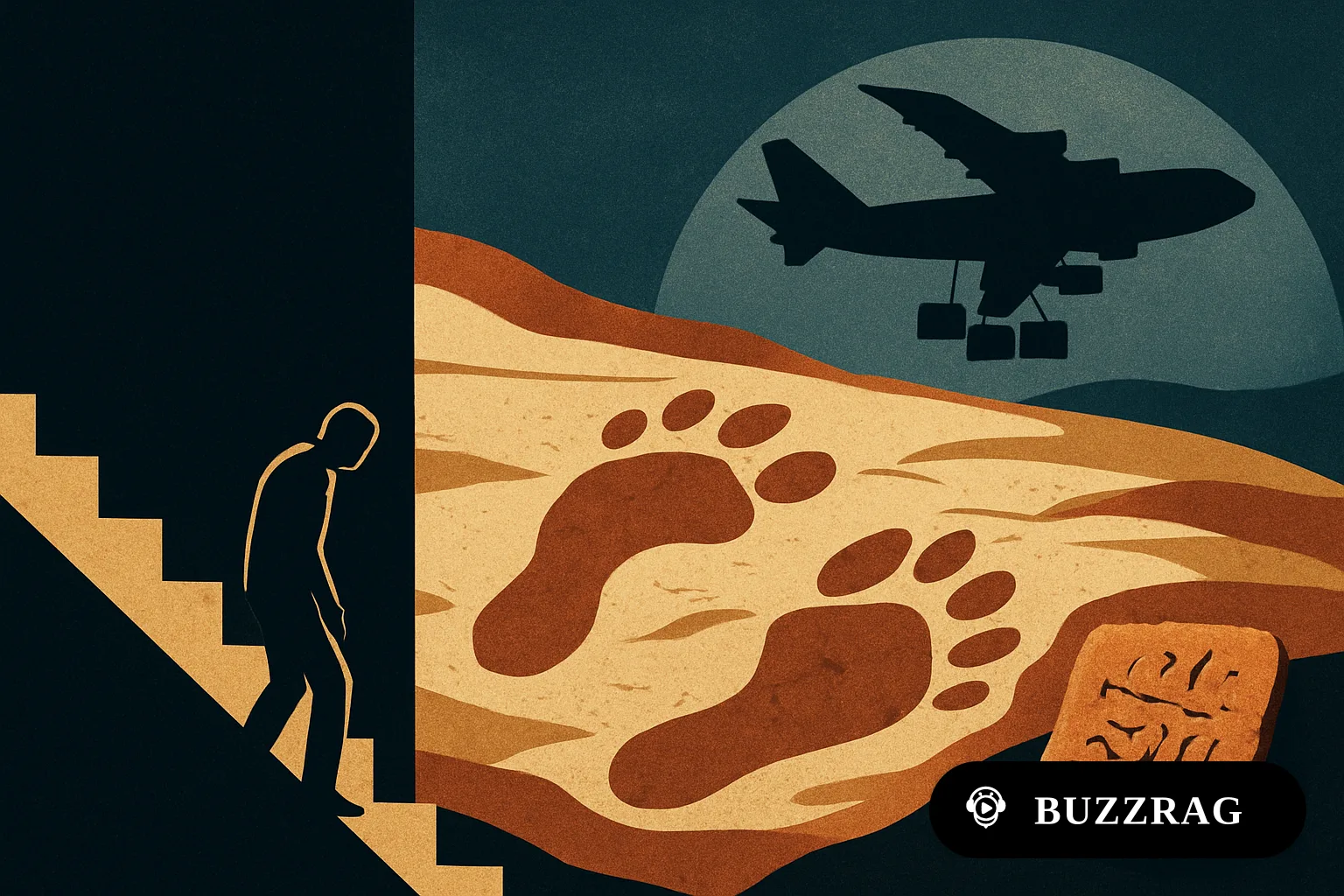
Ron DiFrancesco’s escape from the South Tower on September 11, 2001, has become one of the defining individual survival accounts of the attacks. Trapped on the 84th floor after the building was struck, he began descending through smoke and fire before reaching safety only shortly before the tower collapsed.
The story is more than an episode of extraordinary endurance. It also exposes how incomplete historical records can be during catastrophe: survivors’ testimony, emergency calls, architectural evidence, and the memories of rescuers must be assembled after the fact. Claims about who was the final person to escape should therefore be treated with care, but the larger truth is not in doubt. DiFrancesco’s experience gives human scale to an event often remembered through panoramic images, while reminding us that history is also made in stairwells, by people navigating darkness one floor at a time.
A Tyrant’s Footprints in the Hell Creek Mud
A 66.5-million-year-old trackway discovered in North Dakota’s Hell Creek Formation offers something fossil skeletons rarely can: a record of movement. The roughly 23-foot trail contains four enormous prints, each about three feet long, attributed to a full-grown tyrannosaur shortly before the species’ extinction.
Tracks preserve behavior as well as anatomy. Their spacing can suggest gait, direction, and perhaps the physical conditions of the ancient landscape, even though they cannot identify an individual animal with the certainty of a skeleton. Found in sediments associated with the final chapter of the Cretaceous, the discovery also underscores how much of prehistory remains buried in ordinary-looking rock. A bone tells us what an animal was built from; a trackway hints at how it inhabited a world of floodplains, prey, weather, and time. The most dramatic evidence of the past is sometimes not a fossilized body, but a moment of motion.
The Human Advantage in Every Step
A new study highlighted today argues that heel-first, heel-to-toe walking may be more distinctly human than previously understood. The motion helped early hominins travel farther and more efficiently, an adaptation with obvious value for foraging, migration, and navigating changing environments.
That advantage carried a cost. Repeated heel strikes increase impact on bones and joints, illustrating a recurring pattern in human evolution: adaptations solve one problem while creating another. Walking is often treated as a mundane behavior, but its mechanics connect anatomy to the social and ecological history of our ancestors. Efficient bipedal travel could expand the territory available to early communities and alter how they gathered food, encountered danger, and exchanged information. The study’s significance lies not in reducing humanity to a single gait, but in showing how small bodily differences can become foundations for an entire way of life.
A Sumerian Invitation—or a Trap?
“The Home of the Fish,” a Sumerian poetic monologue probably composed during the Ur III period, turns an apparently simple invitation into a puzzle about persuasion. The speaker beckons fish toward a newly built home, but the poem leaves open whether this is genuine hospitality or the language of a trap.
That ambiguity makes the text strikingly modern. Written roughly four thousand years ago, it shows that literature was already interested in unreliable speech, competing interpretations, and the gap between a promise and its consequences. The poem’s setting also points toward the practical world of ancient Mesopotamia, where canals, marshes, fisheries, and state-managed landscapes shaped daily life. Read as a welcome, it imagines humans negotiating with nature; read as bait, it becomes a compact study of power and manipulation. Its survival on clay reminds us that the earliest written literature was not only administrative recordkeeping, but also a place for uncertainty to speak.
The Secret Laboratory That Changed the World
The Manhattan Project was the vast, secret wartime effort that brought together physicists, engineers, soldiers, technicians, and industrial workers to build an atomic weapon. Its success culminated in the 1945 Trinity test and the subsequent destruction of Hiroshima and Nagasaki, events that inaugurated the nuclear age.
The familiar story of brilliant scientists obscures the project’s wider human infrastructure. It depended on remote settlements, immense industrial plants, forced secrecy, displaced communities, and thousands of workers who often understood only fragments of what they were helping create. The project also transformed the relationship between science and the state: research became organized at unprecedented scale around military objectives, while the consequences of discovery escaped the laboratory immediately. Contemporary debates over nuclear deterrence, arms control, and dual-use technology still inherit its central dilemma—whether knowledge can be contained once institutions possess the means to industrialize it.
The Cold War Giant in a Global Supply Chain
A massive strategic transport aircraft carrying wind-turbine equipment from Europe to South America offers a revealing portrait of logistics in the present. Moving 86 tons of specialized cargo requires carefully choreographed loading, route planning, weather assessment, inspections, spare parts, and technicians ready to solve problems far from home.
The aircraft’s history adds another layer: a machine conceived for military transport has been adapted to civilian work in an era of renewable-energy construction and globally distributed manufacturing. That transition captures a broader historical pattern in which tools built for confrontation acquire new lives in commerce, disaster relief, and infrastructure. Yet the operation remains less a triumph of raw size than of coordination. Every successful flight depends on standards, maintenance cultures, specialist knowledge, and trust between institutions. The spectacle of an enormous aircraft therefore opens onto a quieter history of systems—how Cold War technologies, industrial expertise, and climate ambitions intersect in the movement of objects across continents.
The next questions are as much about interpretation as discovery: how will new evidence refine our picture of ancient behavior, and how will personal testimony shape the memory of modern catastrophe? Watch for the histories beneath the headlines—especially the workers, technologies, and material traces that turn isolated events into enduring patterns.