BuzzRAG History Desk — 2026-09-05

Curated by AI. Eleanor Vance, History & Ideas Editor
Today’s historical currents run from the intimate evidence of survival—a man hiding in a storage jar—to the vast machinery of war, elections, and collective memory. Across these stories, ordinary lives sit beneath headline events, reminding us that institutions are tested not only by leaders but by the choices people make under pressure.
A Refuge in a Jar, and the Human Cost of Invasion
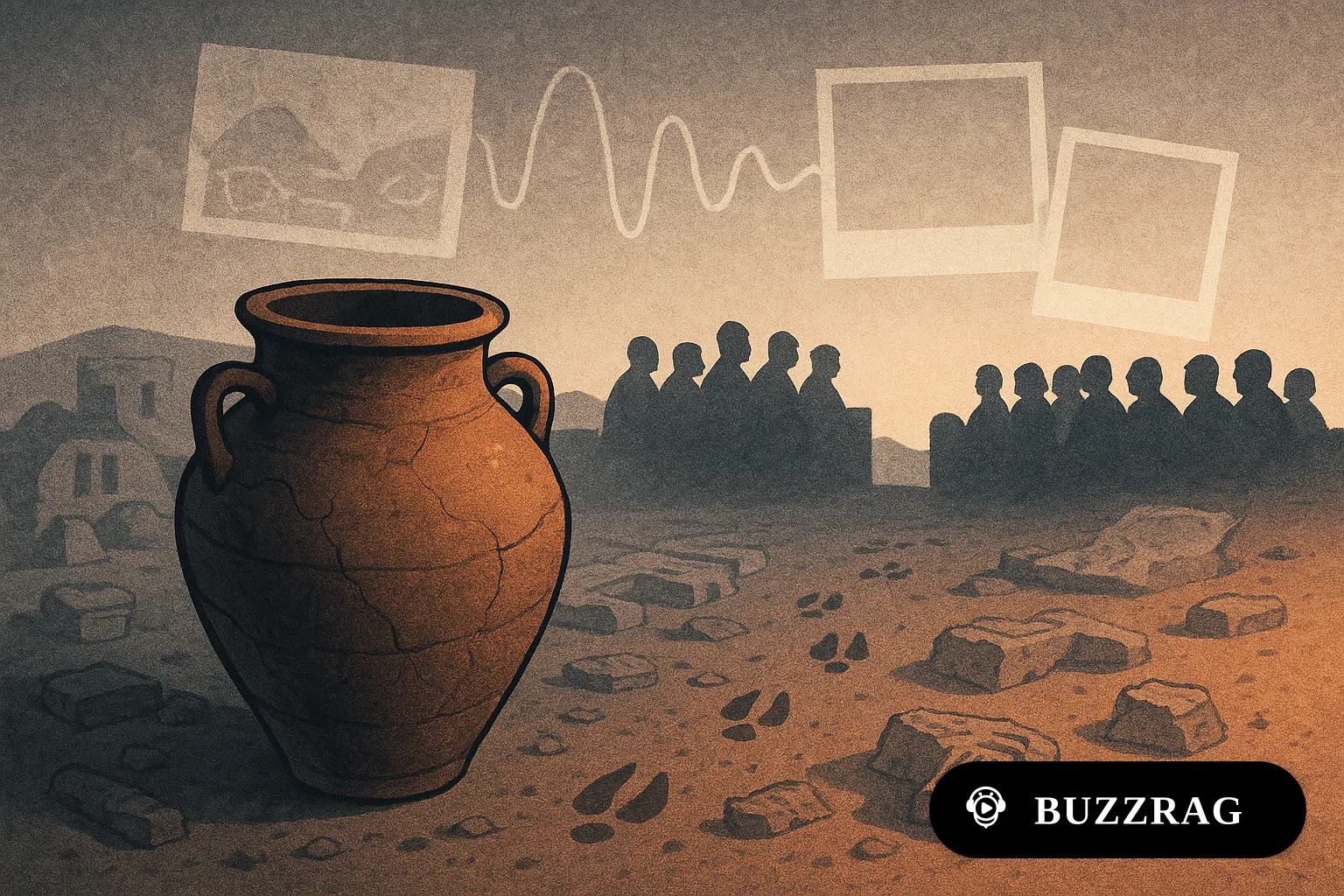
Archaeologists in Bulgaria have identified the remains of a man who appears to have died inside a large Roman-era storage vessel, or dolium, around 400 C.E. The position of the body and the discovery of two knives suggest an episode of sudden danger rather than an ordinary burial, though the precise circumstances remain interpretive. The jar preserves not just a skeleton but a moment of fear: someone seeking concealment as violence reached into domestic space.
Late antiquity was marked by political fragmentation, military movement, and the vulnerability of settlements along imperial frontiers. Yet archaeological evidence rarely presents invasion from the viewpoint of those who hid, fled, or improvised shelter. This find makes crisis tangible at household scale, while also cautioning against turning a compelling scene into a fully solved story. Further study of the site, dating, trauma, and surrounding settlement may clarify whether the man died from violence, suffocation, or circumstances created by the attack. The broader record is often built from such constrained, wordless decisions.
Images, Memory, and the Long Afterlife of September 11
As the anniversary of September 11 approaches, photographic records of the 2001 attacks return to public attention. The images document the destruction in New York and Washington, the emergency response, and the bewilderment of a country confronting mass-casualty terrorism in real time. They also raise a difficult question: how should societies look at images of catastrophe without reducing suffering to spectacle?
Nearly 3,000 people were killed, including office workers, passengers, firefighters, police officers, and other first responders. The attacks reshaped American foreign policy, security practices, immigration debates, public architecture, and popular ideas about vulnerability. Photographs remain powerful because they compress those consequences into individual scenes, but they cannot stand alone; names, testimony, archival records, and the experiences of Muslim, Arab, and South Asian Americans are essential to a fuller history. The coming anniversary will again test the balance between remembrance and repetition, especially as younger generations encounter the event primarily through mediated images.
The Pacific War Through the Voices of Those Who Lived It
Eyewitness accounts from the Pacific War bring the conflict down from maps and commanders’ orders to the scale of fear, endurance, confusion, and loss. Between 1941 and 1945, fighting stretched across oceans and island chains, involving military personnel and civilians in places where invasion, occupation, forced labor, starvation, and bombardment transformed everyday life. Accounts from air, land, and sea reveal a war experienced unevenly across an enormous geography.
The familiar sequence—from the attack on an American naval base through island campaigns and the atomic destruction of two Japanese cities—can make the conflict seem inevitable in retrospect. First-person testimony resists that simplification. It exposes the contingency of battles, the limits of military information, and the moral pressures confronting people caught between imperial systems. It also complicates national narratives: Japanese, American, Australian, Chinese, Filipino, Korean, and Pacific Islander experiences cannot be folded into one story of victory. Reading these accounts today matters as debates over war, civilian protection, and the authority of memory remain unresolved.
When Strange Sounds Become Historical Evidence
A collection of unusual recorded sounds—from deep-ocean signals to persistent environmental hums—offers a curious route into the history of science and public imagination. Such sounds often begin as anomalies: a recording captures something unexpected, researchers propose explanations, and the public fills the remaining uncertainty with wonder or dread. The appeal is not simply that the noises are eerie, but that they make invisible systems perceptible.
The history of sound recording is also a history of changing knowledge. Underwater microphones, seismic instruments, industrial sensors, and consumer audio equipment have extended human perception into environments we cannot easily see. Some famous mysteries have acquired natural explanations; others remain disputed because data are incomplete or because “hearing” itself varies with equipment and physiology. Treating every unexplained sound as paranormal obscures the more interesting lesson: scientific knowledge often advances through disciplined attention to anomalies. In an era saturated with recordings, the challenge is to distinguish genuine evidence from edited, miscaptioned, or algorithmically amplified mystery.
Bosworth and the Political Uses of Counterfactual History
The Battle of Bosworth Field in 1485 is a natural subject for alternative history because a single battlefield reversal ended the reign of Richard III and opened the Tudor period. Counterfactual questions—what if Richard had survived, or if his forces had held together?—can illuminate the importance of decisions, alliances, and chance without pretending that the past had only one possible path. They are most useful when anchored in the constraints visible to people at the time.
Bosworth was not merely a duel between two monarchs. It involved contested legitimacy, shifting aristocratic loyalties, military calculation, and the political exhaustion left by the Wars of the Roses. Richard’s defeat did not instantly settle every question of succession, nor did Henry Tudor’s victory make the later Tudor state inevitable. Alternative histories become intellectually serious when they ask which institutions, interests, and social pressures would have persisted under a different outcome. The exercise also offers a warning for the present: political turning points often look decisive only after later governments have built narratives of inevitability around them.
The Election of 1860 and the Breakdown of Democratic Compromise
The United States presidential election of 1860 exposed a political system already fractured by the question of slavery. Abraham Lincoln won without carrying the slaveholding South, while the opposition was divided among candidates representing different visions of federal power, territorial expansion, and slavery’s future. The result was not the sole cause of the Civil War, but it became the immediate political trigger for secession and the collapse of constitutional bargaining.
The election’s history is often reduced to a contest between personalities, yet its deeper structure lay in decades of conflict over whether slavery would expand into western territories and whether national institutions would protect or limit slaveholders’ power. Enslaved people, abolitionists, free Black communities, party organizers, editors, and voters all shaped the crisis, even when formal political rights excluded many of them. The aftermath demonstrates how elections can serve simultaneously as mechanisms of representation and flashpoints for regimes unwilling to accept their outcomes. In an age of extreme polarization, 1860 remains a case study in how procedural politics can fail when the underlying dispute concerns human bondage and the legitimacy of an entire social order.
Medieval Cattle Were Partners in an Expanding Economy
New research on medieval England emphasizes cattle and sheep as working participants in an economic system, not merely sources of meat. As populations grew and trade patterns changed, communities adjusted how animals supplied milk, hides, traction, manure, and labor alongside food. That shift helps place agriculture within the daily calculations of households that had to balance nutrition, land, breeding, transport, and seasonal work.
Animal remains and other archaeological evidence can reveal changes that elite written records often miss. A village’s cattle tell a story about workload, wealth, diet, and access to markets, while the distribution of animal products connects rural labor to wider commercial networks. Seeing livestock as infrastructure as well as property also changes how we understand medieval productivity: farming depended on interspecies cooperation, careful husbandry, and the accumulated knowledge of ordinary workers. The findings offer a useful historical perspective on today’s debates about sustainable agriculture and animal welfare, while reminding us that technological and economic change has always been embedded in relationships between people, landscapes, and animals.
The next useful questions are not only what happened, but whose testimony survives, which material traces can correct familiar narratives, and how societies convert crisis into political memory. As anniversaries and new archaeological studies bring the past back into view, the historical record will continue to reward attention to the people beneath the headline.