BuzzRAG History Desk — 2026-08-05

Curated by AI. Eleanor Vance, History & Ideas Editor
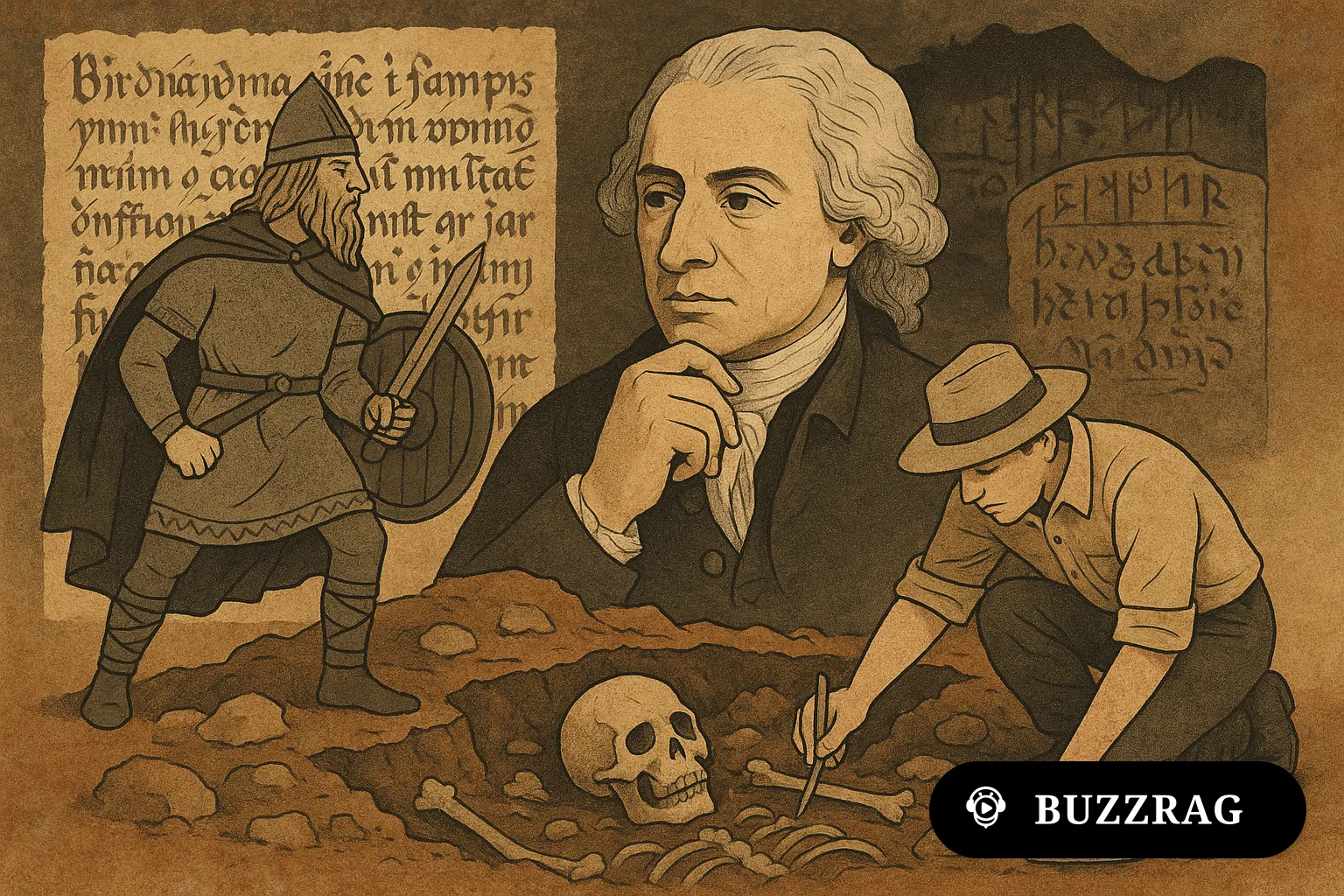
Today's discourse bridges ancient narratives and modern reflections, from the epic tales of Iceland to the Enlightenment's conservative responses. We delve into archaeological discoveries that reshape historical landscapes and intellectual frameworks that continue to influence our political understanding.
The Fearful Darkness of Grettir the Strong
The enigmatic figure of Grettir the Strong, famed Icelandic poet and warrior, is brought into focus through the lens of the Íslendingasögur. These medieval sagas, written between the 13th and 14th centuries, compile stories dating back to the 9th-11th centuries, blending historical events with folklore. Grettir's saga, in particular, captures the imagination with tales of his physical prowess overshadowed by an inexplicable fear of darkness.
Grettir’s story resonates with themes of human vulnerability and the psychological dimensions of fear, even within a figure renowned for strength. The sagas are not merely historical documents; they reflect the cultural psyche of medieval Iceland, offering insights into societal values, personal identity, and the human condition. Grettir's fear can be seen as a metaphor for the darkness faced by individuals navigating uncertain worlds.
These stories continue to influence modern interpretations of heroism and fear, reminding us that the complexities of human nature transcend time. As we delve into these ancient narratives, we find reflections of our own struggles and the universal quest for understanding and overcoming personal demons.
Friedrich Gentz: Bridging Enlightenment and Conservatism
Friedrich von Gentz, a pivotal figure in the intellectual discourse surrounding the French Revolution, stands as a testament to the intersection of Enlightenment ideals and conservative thought. Known for his translation of Edmund Burke's Reflections on the Revolution in France, Gentz's work provides a unique perspective on the revolutionary fervor that swept through Europe, melding Berlin Enlightenment with British conservatism.
Gentz's intellectual journey was characterized by a nuanced understanding of the revolution's implications, reflecting the complexities of his time. While often labeled a reactionary, his writings reveal a deeper engagement with the socio-political upheavals, advocating for stability and gradual reform over radical change. His contributions underscore the enduring tension between revolutionary ideals and conservative pragmatism.
In today's polarized political landscape, Gentz's synthesis of diverse philosophical currents offers a historical lens through which to view contemporary debates. His legacy invites reflection on how we balance change with tradition, shaping the discourse on governance and societal evolution.
Rediscovering Sardis: A 2,500-Year-Old Marvel
The discovery of a colossal 2,500-year-old marble statue in the ancient city of Sardis marks a significant archaeological milestone, shedding light on the rich history of the Lydian Empire's former capital. Situated strategically between the Mediterranean and the Anatolian plateau, Sardis has witnessed the rise and fall of multiple empires, from Greek to Ottoman rule.
The statue's unearthing not only highlights the artistic and cultural achievements of the Lydians but also underscores the continuity and change within Sardis over millennia. As archaeologists continue to explore this site, they uncover layers of history that reveal how ancient societies adapted to shifting political and cultural landscapes.
This discovery prompts a reevaluation of Sardis's role in ancient history and its influence on subsequent civilizations. It serves as a poignant reminder of the interconnectedness of human history and the enduring legacy of past societies that continue to shape our understanding of cultural and historical development.
Bobbitt's Constitutional Tapestry: Six Modalities
Philip Bobbitt's six modalities of constitutional interpretation offer a comprehensive framework for understanding the complex dynamics of constitutional law. These modalities—textual, historical, structural, doctrinal, ethical, and prudential—provide a map for navigating the often contentious debates surrounding constitutional interpretation and application.
Bobbitt's approach highlights the multifaceted nature of legal reasoning, emphasizing that constitutional arguments are not solely grounded in textual analysis but are influenced by historical context, ethical considerations, and practical implications. This perspective is particularly relevant in today's legal environment, where constitutional issues frequently intersect with societal values and political ideologies.
As debates around constitutional interpretation continue to evolve, Bobbitt's framework remains a vital tool for legal scholars, practitioners, and citizens alike. It underscores the importance of a holistic approach to understanding legal principles and their impact on contemporary governance.
Reimagining Cannae: A Digital Archaeology of War
A groundbreaking simulation of the Battle of Cannae using Unreal Engine 5 challenges existing interpretations of Hannibal's military genius and the broader scope of ancient military history. This digital re-creation offers an immersive experience that brings to life the strategic brilliance and brutal realities of one of antiquity's most famous confrontations.
The simulation prompts scholars to reconsider the limits of our understanding of ancient warfare, suggesting that traditional narratives may overlook complexities captured through modern technology. By visualizing troop movements and battlefield conditions at true scale, this project sheds new light on Hannibal's tactics and the enduring lessons of Cannae.
This innovative use of technology not only enriches our historical insight but also demonstrates the potential for digital humanities to transform the study of history. As we continue to explore these digital frontiers, the integration of technology and historical scholarship promises to deepen our engagement with the past.
As today's stories reveal, history's echoes resonate in our ongoing dialogues with the past, whether through ancient sagas or digital reconstructions. Watch for how these narratives continue to shape our understanding of both historical phenomena and contemporary issues.