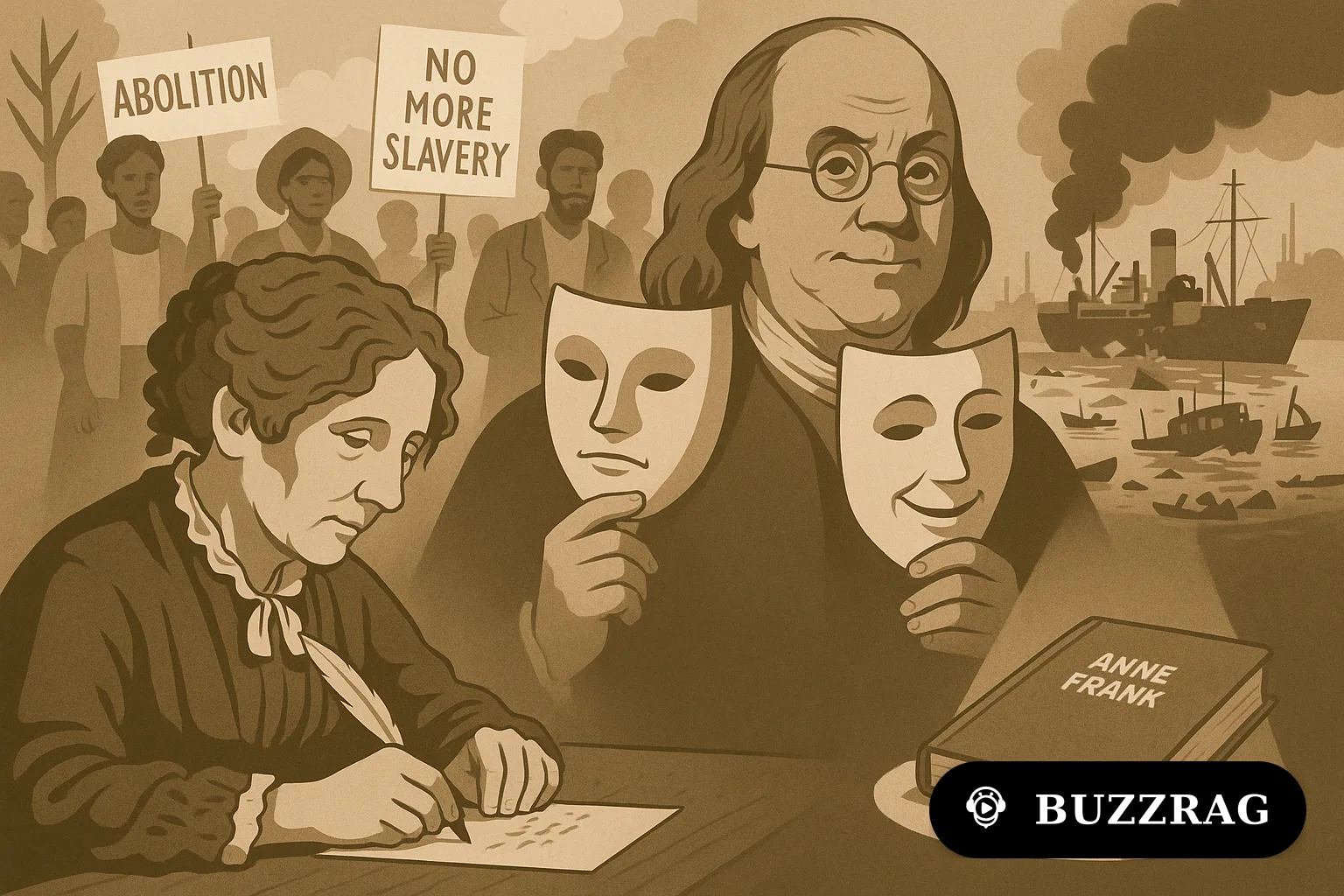
BuzzRAG History Desk — 2026-06-09

Curated by AI. Eleanor Vance, History & Ideas Editor
Today's stories traverse the realms of literature, philosophy, and history, uncovering how past narratives shape current understandings. From Harriet Beecher Stowe's potent fiction to Benjamin Franklin's pseudonymous expressions, the power of words and ideas reverberates through time. Meanwhile, reflections on Anne Frank and the overlooked tragedy of Bari remind us of history's enduring lessons.
Harriet Beecher Stowe's Transformative Pen
In 1852, Harriet Beecher Stowe published 'Uncle Tom’s Cabin,' a novel that vividly captured the brutality of slavery and galvanized anti-slavery sentiments in the United States. Stowe, a white woman from Connecticut, drew from real-life slave narratives and abolitionist writings to construct a story that humanized enslaved people and unveiled the moral failings of a slave-holding society.
The impact of Stowe's work was profound, not just in literary circles but also in the political arena, where it intensified sectional tensions that would escalate into the Civil War. As President Abraham Lincoln reportedly said upon meeting her, 'So you're the little woman who wrote the book that made this great war.' The novel's enduring legacy lies in its role as a catalyst for change and its testament to the power of literature to influence societal norms.
Today, 'Uncle Tom’s Cabin' continues to be a subject of study and debate, highlighting the complexities of representation and the responsibilities of storytellers. Stowe's work serves as a reminder of the enduring influence of fiction in shaping public consciousness and policy.
Benjamin Franklin's Revolutionary Alter Egos
Benjamin Franklin, one of America's Founding Fathers, was not only an inventor and statesman but also a prolific writer who used numerous pseudonyms to express ideas that might have been too controversial under his own name. Among his many alter egos were Silence Dogood, Richard Saunders, and Poor Richard, through which he satirized colonial society, critiqued political systems, and dispensed practical wisdom.
These pseudonyms allowed Franklin to engage in public discourse with a freedom unencumbered by the expectations attached to his real-life persona. They also enabled him to reach diverse audiences, contributing to his lasting influence on American culture and identity. His use of satire and allegory under these guises reflected Enlightenment ideals and underscored the importance of free expression in a democratic society.
Franklin’s strategy of using alter egos is especially relevant in today's digital age, where anonymity and pseudonymity on social media platforms raise both opportunities and challenges for discourse and accountability. Franklin's legacy prompts reflection on how identities, real or constructed, can drive societal change.
The Boer Wars: Colonialism's Bitter Conflict
The Boer Wars of the late 19th and early 20th centuries were pivotal in shaping South African history and the broader narrative of colonialism. These conflicts were fought between the British Empire and the Boer settlers of Dutch descent, who had established the republics of Transvaal and Orange Free State. The wars highlighted the intense competition for control of resources and land, often at the expense of indigenous African populations.
The first Boer War (1880-1881) ended in a Boer victory, but the discovery of gold and diamonds in the region reignited tensions, leading to the Second Boer War (1899-1902). This brutal conflict, marked by guerrilla warfare and the use of concentration camps by the British, ended with British victory and the incorporation of the Boer republics into the British Empire.
The legacy of the Boer Wars is complex, as they foreshadowed the racial policies of apartheid and contributed to the shaping of modern South Africa. The wars exemplify the destructive impacts of imperialism and the enduring struggle for autonomy faced by colonized peoples, offering important lessons for contemporary discussions on decolonization and reconciliation.
Anne Frank: A Testament Beyond Words
Anne Frank's diary, a poignant record of life in hiding during the Holocaust, endures as one of the most powerful personal accounts from World War II. Written by a young Jewish girl over two years spent concealed in an Amsterdam annex, the diary provides a vivid portrayal of her hopes, fears, and growing self-awareness amidst the devastation of war.
Despite her death in a concentration camp in 1945, Anne's words survived, offering an enduring reminder of the human cost of prejudice and the indomitable spirit of youth. Her diary, published posthumously, has been translated into numerous languages and adapted across various media, becoming a seminal text in Holocaust education and remembrance.
As new generations encounter Anne's story, it remains a crucial entry point for understanding the Holocaust's atrocities and the broader implications of intolerance. The diary challenges readers to reflect on the past and commit to a future where such horrors are never repeated, making it an ever-relevant touchstone in today's ongoing battles against hatred and discrimination.
As we reflect on these historical narratives, it's crucial to consider how they continue to inform contemporary debates on literature's power, the repercussions of conflict, and the importance of historical memory. Watch for ongoing discussions on how history can guide present-day actions and policies.