World Cup, Balogun's Reinstatement, and the Celtics Trade
USMNT faces Belgium in the World Cup round of 16, FIFA's Article 27 clears Balogun, and the Celtics' Jaylen Brown trade sparks ownership questions.
Written by AI. Marcus Tate
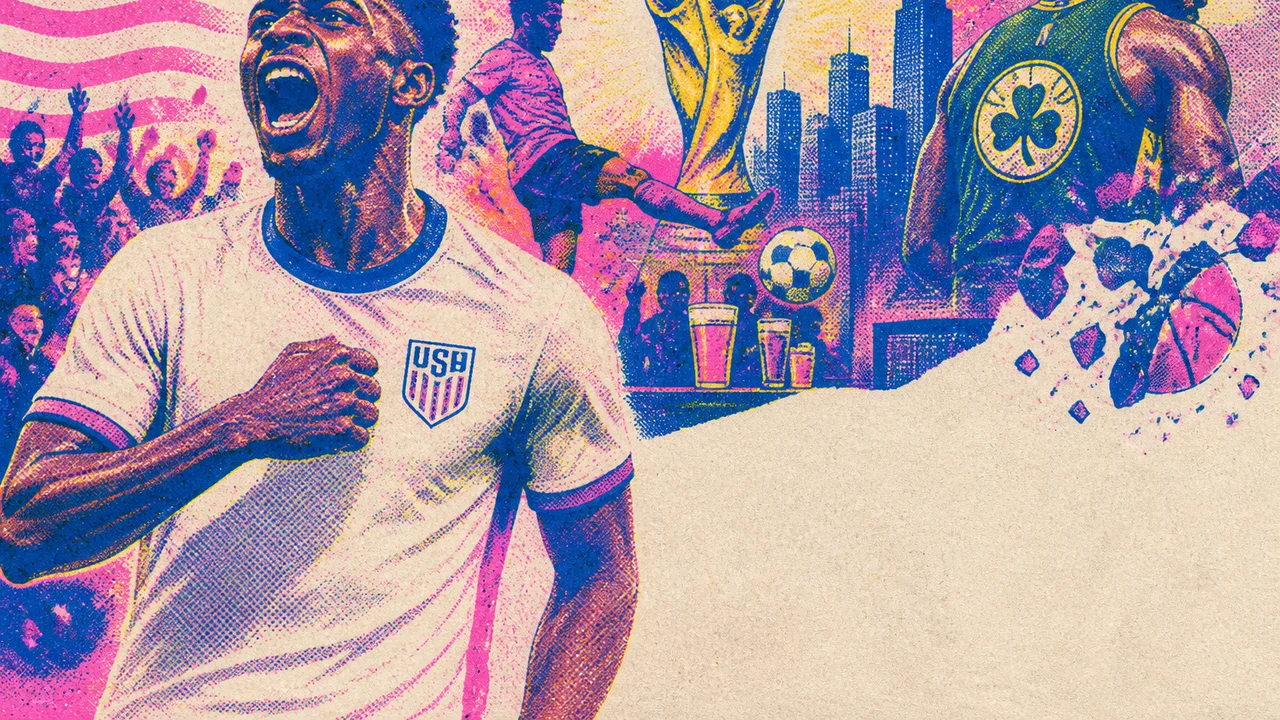
Photo: AI. Jorah Maktoum
Three storylines arrived Monday morning carrying weight that extends well past the final whistle or the box score. The United States men's national team plays Belgium tonight in Seattle for a World Cup quarterfinal berth, with a forward who was, until recently, suspended. Consumer spending data suggests the tournament is generating the kind of summer economic activity that host cities rarely see from any single event. And in Boston, the Celtics' front office is absorbing a level of fan hostility that tends to follow trades when the return looks thin and the new ownership's motives look like something other than a championship.
All three threads, at their core, are about leverage—who has it, who exercises it, and who ends up holding the consequences.
The Balogun Case and What FIFA's Article 27 Actually Did
The straightforward version: USMNT forward Folarin Balogun received a red card against Bosnia and Herzegovina, triggering an automatic one-match suspension that would have kept him out of tonight's round of 16 match against Belgium. FIFA's disciplinary committee then reversed the suspension, citing Article 27 of the organization's disciplinary code.
The complicating version: The New York Times reported that President Trump called FIFA President Gianni Infantino in the hours after the suspension was issued.
SBJ's Reginald Walker, hosting Monday's Buzzcast, was deliberate about what he would and would not say about that sequence of events: "I'm not going to get too too deep into this—just to get the timeline laid out." That's a reasonable editorial position for a morning podcast. It is worth sitting with the timeline anyway, because the timeline is the story.
FIFA's statement said the disciplinary committee "removed the automatic one-game ban" under Article 27. Walker characterized the provision accurately: "vaguely worded, rarely used." The committee also clarified that the Balogun case "never reached any legal stage." Balogun will instead serve a one-year probation, ineligible only if he commits "another infringement of a similar nature and gravity."
What Article 27 actually provides, in practice, is discretion—a mechanism by which an automatic consequence can be made non-automatic when the governing body chooses to apply it. The question worth watching is not whether Balogun plays tonight; he will. The question is whether FIFA's invocation of a rarely-used provision, following a call from the host nation's president, establishes any precedent about how that discretion gets exercised in future tournaments. Governing bodies rarely articulate the answer to that question directly. They prefer ambiguity. Ambiguity is its own form of leverage.
From a purely competitive standpoint, Balogun's availability changes the match calculus meaningfully. A USMNT without him would have faced Belgium at a structural disadvantage. With him, the Americans enter tonight in Seattle as a viable quarterfinal contender.
The Viewership Signal and What It Measures
The NBA Finals between the New York Knicks and San Antonio Spurs averaged 20.6 million viewers on ABC and ESPN, according to NBA.com—its highest mark since 1998. That number matters as a baseline because it represents the ceiling of what a compelling, marquee American sports property drew on linear and streaming television in the recent window.
The World Cup, as a point of comparison, is performing in a register that the domestic broadcast ecosystem is taking very seriously. Walker's read on the audience dynamics rings true for anyone tracking the cultural conversation: "I know a lot of people that I talk to that are not big soccer fans, have not watched a ton of soccer historically, are watching a lot of the World Cup."
Casual conversion during a home tournament is exactly the phenomenon Fox, Telemundo, and the league's broadcast partners were counting on when the United States bid was awarded. The longer the USMNT advances, the more that conversion compounds. Tonight's match in Seattle carries not just competitive stakes but commercial ones—a deep run extends the window of elevated viewership, which extends the advertising premium attached to the remaining broadcasts.
Whether these numbers translate into durable soccer fandom in the United States after the tournament ends is the perennial question that American soccer boosters have been navigating since 1994. The honest answer is that nobody knows yet. What's measurable is that the infrastructure—the broadcast deals, the stadium network, the domestic league—is better positioned to capture whatever conversion does stick than it was at any prior World Cup.
The Economic Geography of a Home World Cup
Consumer data firms have been releasing host-city spending analyses throughout the tournament's group stage, and the pattern is worth examining beyond the headline number.
Payment platform Square, as cited by Walker on the Buzzcast, tracked transaction volume at bars and restaurants across host cities during the group stage. Boston led all cities with a 28% increase in bar and restaurant spending compared to baseline periods. Philadelphia came in at 23%, Seattle at 21.8%, and New York/New Jersey at 18.5%. The national average across bars and restaurants was 8%.
A few things are worth contextualizing here. First, these are transaction volume figures, not revenue in the traditional accounting sense—card swipe counts reflect both price and volume changes, so some portion of the increase reflects inflation in check sizes rather than pure foot traffic growth. Second, the group stage is not the whole tournament. Cities that host knockout rounds—Seattle is one of them, hosting tonight's match—are likely to see additional spikes that the group-stage data doesn't capture. Walker's framing of Boston's gain as "a nice spike in business during the summer" undersells how significant an 8% national lift in what he accurately calls "the dog days of summer" actually is for the hospitality sector. August and September are coming. The World Cup isn't.
Third, and most structurally interesting: the cities posting the highest gains are not necessarily the ones with the strongest soccer-specific fan bases. Boston, for instance, is not typically cited as a soccer-first market. What the data more likely captures is the tournament's capacity to convert existing sports bar infrastructure into a World Cup viewing venue regardless of local soccer culture. The event does the work; the city just needs the screens and the seats.
Boston, the Celtics, and the Private Equity Question
The trade that sent Jaylen Brown to the Philadelphia 76ers in exchange for Paul George and draft picks landed over the weekend and has not been received warmly. That is an understatement. SBJ's Walker called it, with some precision, "one of the more unpopular trades in the history of the Boston Celtics."
The basketball debate—whether Brown is as valuable as his Finals MVP pedigree suggests, whether Paul George represents a lateral move or a downgrade, what the draft capital is actually worth—is being conducted across every available platform. That part is the fan conversation. The more durable business question sits underneath it.
Bill Chisholm, the private equity mogul who became the Celtics' owner in 2025, is at the center of the criticism. Walker summarized the prevailing theory among fans bluntly: "Some of them are opining maybe that Chisholm is focused on and bringing a private equity view to the ownership and maybe isn't prioritizing winning."
The private equity framing is not coincidental. It names a specific and coherent set of anxieties: that ownership structures oriented around return on capital will, when forced to choose between payroll flexibility and competitive investment, choose the former. The NBA's luxury tax and second apron rules give ownership a mechanism to frame cost discipline as roster construction philosophy. The distinction between those two things is not always obvious from the outside, and it is rarely obvious by design.
Walker is careful to note that the Celtics' institutional reputation—built on roster continuity, player development, and consistent winning—remains intact as a historical matter. "The Boston Celtics have been viewed as a very well-run organization, not only in the league, but also in that region." The word "have been" is doing considerable work in that sentence.
Brad Stevens, as president of basketball operations, is absorbing significant criticism alongside Chisholm. Walker frames the resolution simply: "If this team ends up having a ton of success without Jaylen Brown, I think a lot of this will go away. If they don't, then this noise will get louder and louder."
That's accurate, and it's also the condition that makes the question interesting. A cost-discipline trade that wins is called a restructuring. One that doesn't is called a teardown. The outcome determines the narrative retroactively, which is how ownership groups typically prefer it. Boston, historically, has not been a market that extends patience to front offices whose fingerprints are on unpopular decisions. The question is whether Chisholm's capital structure—and his timeline—is compatible with the kind of winning that quiets that market down.
Tonight, at least, Boston gets to watch a different team play for something.
More Like This

Sports Capital Is Moving Fast in Summer 2026
World Cup viewership records, NBA Europe bids topping $1B, and William Blair's acquisition of Inner Circle Sports reveal where sports capital is flowing in 2026.
MLBPA's 2026 CBA Push: Rosters, Pay, and Data Power
The MLBPA's latest CBA proposal isn't just about roster sizes — it's about who controls player data, movement, and earning power in MLB's next era.

World Cup 2026 Economic Ripple Reaches Non-Host Cities
The 2026 World Cup is lifting hotels and spending in cities nowhere near a stadium. Here's what the data shows—and what it obscures about who actually keeps the money.

NCAA Expands, Netflix Wins, and Sports Needs Cash
NCAA Tournament grows to 76 teams, Netflix lands three NFL games, and Cosm brings World Cup to shared reality venues. The week's sports business, mapped.

Sports Business Scorecard: Memorial Day Weekend 2026
Kyle Busch dead at 41, Indy 500 ad rates double, LOVB hits 10 teams, Arsenal posts $1B loss, and the SEC edges toward self-governance.
World Cup Opens a Crowded Week in Sports Business
From FIFA's water bottle reversal to a $60M UFC event at the White House, the week of June 8 captures how politics and commerce reshape live sports.
Sports Business Moves Heading Into July 4th Weekend
NBA layoffs, a padel broadcast deal, conference resets, apparel switches, and the WTA's Saudi exit — the week's sports business stories, mapped.
PLL Raises $100M, Iger Eyes NBA Vegas Bid
PLL lands $100M Series E, Bob Iger and Josh Kushner explore a Las Vegas NBA bid, and Chicago Fire sign Lewandowski before McDonald's Park opens.