Why the US Joined X's Fight Over EU Tech Enforcement
The DOJ wants into X's appeal of a €120 million EU fine. The case could define how far Brussels can reach through US tech groups and their owners.

Written by AI. Zara Chen
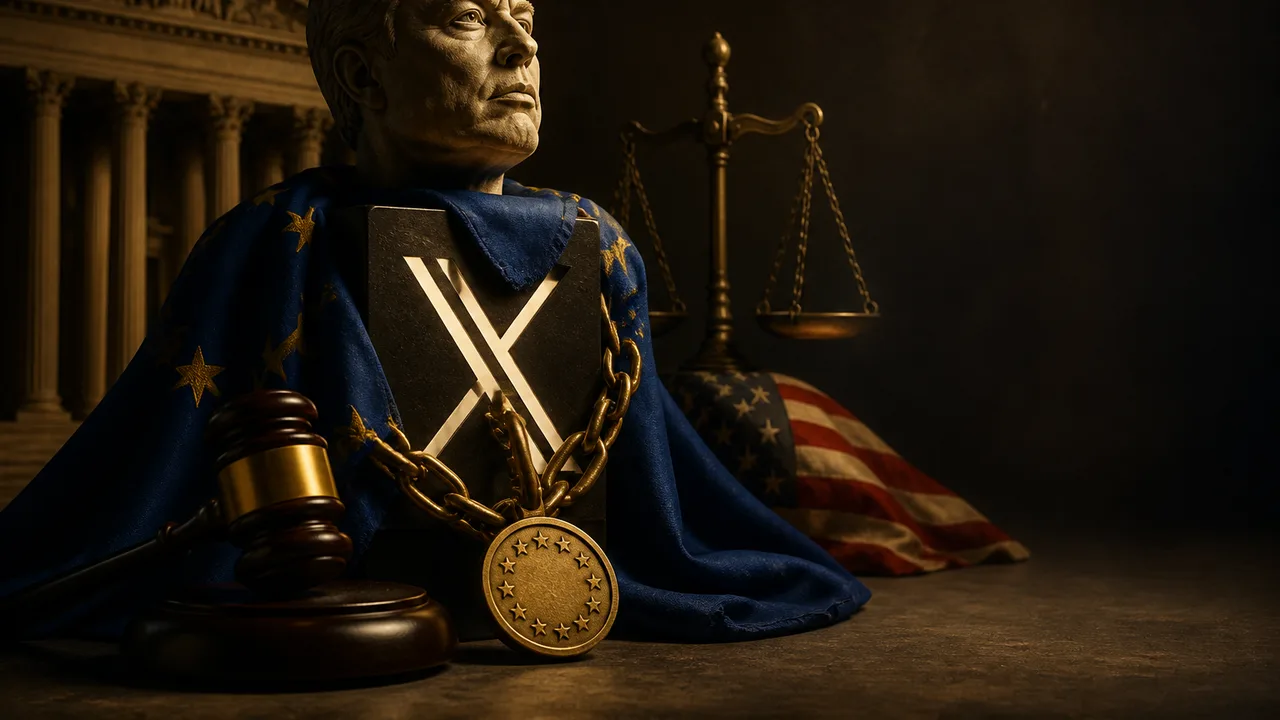
The US Justice Department asked on Thursday to join Elon Musk and X's challenge to a €120 million European Union fine, putting the weight of the American government behind a fight that could shape how Brussels pursues other US tech groups.
The application concerns two cases brought by Musk and X to annul the European Commission's December 2025 decision. The EU's General Court in Luxembourg will decide whether the US may intervene before it considers the underlying challenge, Ars Technica reported.
That procedural sequence is easy to lose amid the Musk of it all. The US hasn't entered the case yet, and the court hasn't ruled on whether the fine or the Commission's legal reasoning was valid. For now, Washington has requested a seat at the table.
The request also reaches beyond a dispute about blue checkmarks. The Justice Department is challenging how the Commission identified the provider of X's service, connected corporate entities to Musk and used worldwide group turnover when imposing the penalty. In other words, this is a fight over where a platform ends and its wider corporate empire begins. Corporate org charts have entered the chat. 📊
What the EU Fined X For
The Commission's first official non-compliance decision under the Digital Services Act covered three transparency failures. Regulators found that X's paid blue checkmarks could deceive users because buyers received “verified” status without equivalent identity checks. They also found that its advertising repository lacked required information and that the platform placed obstacles between researchers and public data.
Those findings followed Musk's 2022 purchase of Twitter and his replacement of its identity-based verification system with a subscription product. A symbol that once communicated that Twitter had authenticated an account became available through payment without equivalent verification. The Commission treated that design choice as a consumer and platform-transparency issue rather than accepting the checkmark as harmless branding.
The EU's position, as described by executive vice-president Henna Virkkunen, is that the rules protect users from deceptive verification, opaque advertising and restrictions on research. The Commission has also denied targeting companies based on nationality, the BBC reported.
X and Musk appealed in February. They called the investigation “incomplete and superficial,” described the Commission's interpretation of the DSA as “tortured” and argued that their rights of defence had not been respected. In July, the Commission accepted X's plan to fix the advertising-repository and researcher-access problems, with six months allowed for implementation.
That produces an unusual split screen. Some compliance work is moving forward while the penalty and the legal theory behind it remain under challenge. Fixing an ad database doesn't settle whether Brussels used the right corporate entities or financial base when calculating liability.
Why Washington Sees a Bigger Target
Assistant Attorney General Brett Shumate said the Commission had “inappropriately attempted to expand its regulatory authority” to American companies outside its jurisdiction. The Justice Department's more consequential argument concerns corporate separateness.
Detailed reporting on the filing says the US objects to the Commission extending scrutiny to Musk personally and implicating other US companies under his control. According to the DOJ's account, the Commission imposed joint and several liability and calculated the fine using the worldwide turnover of the corporate group ultimately controlled by Musk.
That framing explains why the government says the outcome could affect “very large online platforms” whose parent companies are based in the US. Meta's Facebook and Instagram, Google's YouTube and Microsoft's LinkedIn all operate under the DSA's large-platform framework, although the facts and corporate structures in any future case could differ.
The logic runs like this: if the General Court approves a broad method for defining the service provider and looking across a corporate group, the Commission may have a stronger enforcement template for other sprawling platform businesses. If the court narrows that method, Brussels could retain authority over services offered in Europe while facing tighter limits on which parents, owners or affiliates it can pull into a penalty.
That is an inference from the DOJ's objections, not a forecast of the judgment. The available accounts do not include the Commission's full response to the US application, and the court could resolve X's appeal on narrower grounds without issuing a sweeping rule for every platform.
A Political Argument Becomes a Court Argument
The filing also gives institutional form to a dispute that had been escalating in public. President Donald Trump has called overseas digital penalties “overseas extortion” and threatened tariffs against countries implementing rules he said discriminate against American technology. Vice President JD Vance has characterized DSA content-moderation rules as “authoritarian censorship.” Secretary of State Marco Rubio described the X fine as an attack on American platforms and people.
The Commission's case against X concerned checkmarks, advertising transparency and researcher access, rather than a finding that particular American speech had to be removed. That doesn't dispose of broader US concerns about European platform regulation, but it narrows what this fine actually addressed. The political language has centered censorship; the cited violations in this decision centered transparency.
Washington's move therefore converts a broad sovereignty complaint into questions a court can evaluate: Who provided the regulated service? Which entities may share liability? How far can EU regulators reach through a corporate group? What connection to European operations is sufficient?
Under the Statute of the Court of Justice of the EU, a state seeking to intervene must establish an interest in the result. The DOJ says the possible effect on US-headquartered digital services gives it that interest. The General Court still has to agree, so calling the US a participant rather than an applicant would skip a procedural level.
The Australia Comparison, with Limits
Musk raised a related jurisdiction argument in July against information-gathering demands connected to Australia's under-16 social-media ban. He described those powers as invasive and said they interfered with international law. Julia Hörnle, a professor of internet law at Queen Mary University of London, told Wired that Australian regulators could require disclosures connected to a company's operations in Australia.
Both disputes ask how a government regulates a global platform with local users. The comparison stops there. Australia's demand involved information tied to operations in that country; the X appeal concerns an EU penalty, group-level worldwide turnover, corporate liability and scrutiny reaching Musk personally. One legal expert's assessment of Australian disclosure powers cannot answer the EU questions.
Still, the comparison reveals the recurring pressure point. Platforms operate across borders through layered corporate structures, while laws remain territorial and regulators need information or financial leverage to enforce them. A rule restricted to the smallest local entity may be easy for a multinational group to absorb or route around. A rule that treats an owner and every affiliate as one regulated actor risks sweeping past ordinary corporate separateness. Courts end up drawing the line because the internet never volunteered to respect a map.
The General Court could uphold the Commission, narrow its reasoning or annul the decision. It could also deny the US permission to intervene before reaching any of those possibilities. Until the judges act, the €120 million figure is the headline, but the durable question sits underneath it: when a global platform serves Europeans, how much of the global company enters Europe with it?
More Like This

EU Tells Meta to Fix Addictive Instagram Features
The EU is threatening Meta with fines up to 6% of global revenue over infinite scroll and autoplay. Here's what that actually means for your Instagram experience.
AI Safety Pledges Meet the Limits of Self-Regulation
AI leaders say frontier models should slow while opposing binding oversight. Musk's stance, a rejected regulator plan and state action reveal the policy gap.
Elon Musk's Problem-Solving Methods, Examined
Eric Jorgenson spent five years studying Elon Musk. Here's what his frameworks actually reveal—and where the hagiography gets complicated.
Could Space be the Future for AI Deployment?
Elon Musk predicts AI deployment in space within 36 months, but is this vision realistic?
Grok's AI Controversy: Where's the Accountability?
Grok's AI capabilities spark debate on legality, ethics, and tech accountability. Who's responsible for moderating this digital wild west?
AI's Leap in Math and Defense: Grok 4.20's Impact
Grok 4.20's AI advancements in math and defense pose critical regulatory challenges. Can policy keep pace with innovation?

GNU Coreutils Now Run Natively on Windows
Microsoft has ported GNU Coreutils to Windows as native binaries. Here's what that means for devs switching between Linux and Windows daily.

iOS 27 Beta 1 Hands-On: Cool Features, No Siri
iOS 27 Beta 1 is here with Photos AI tools, Liquid Glass tweaks, and Wallet upgrades — but the new Siri everyone wants? Still on a waitlist.