Why Even Zeta Values Yield While Odd Ones Resist
Euler's method explains every even zeta value, while odd values need different tools. Apéry's proof shows how mathematical certainty is earned over time.

Written by AI. Amelia Nwofor
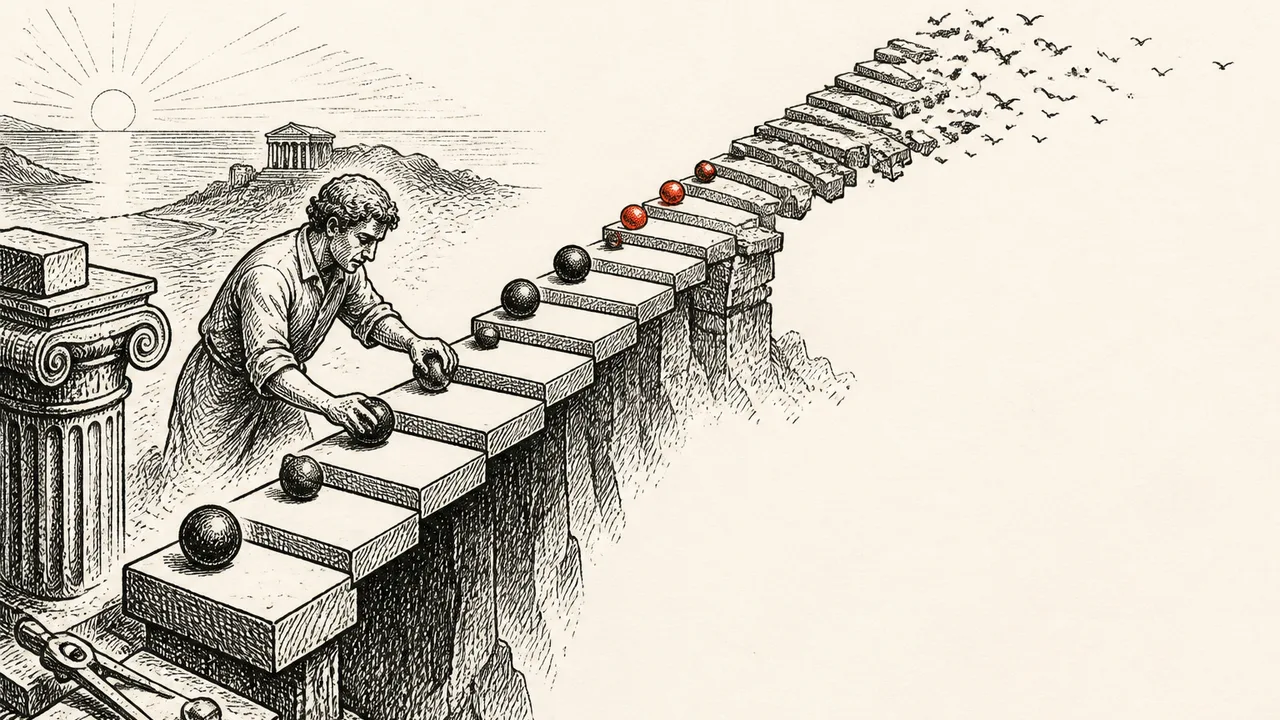
Leonhard Euler’s formulas turn the sums of reciprocal squares, fourth powers and sixth powers into π²/6, π⁴/90 and π⁶/945. Replace the exponent with 3, however, and the corresponding sum is approximately 1.2020569, a number now called Apéry’s constant. No analogous formula expressing it as a rational multiple of a power of π is known.
This split invites a misleading picture: perhaps mathematicians solved the easy half of one pattern and got stuck on the hard half. The mathematics says something sharper. Euler’s machinery contains an even-number filter. It produces formulas for even zeta values because its symmetry gives those values coefficients to occupy. The odd values are absent from that mechanism.
That absence does not prove that odd zeta values lack formulas, nor does it explain everything about their arithmetic. It identifies the boundary of one successful method. Mathematics often advances by finding such boundaries, then resisting the urge to rename them impossibility.
Where the Even Values Come From
For a real number greater than 1, the zeta function can be introduced through
$$ \zeta(s)=\sum_{n=1}^{\infty}\frac{1}{n^s}. $$
Euler’s work on the Basel problem established the celebrated value of ζ(2) and led to a general formula for ζ(2n). The formula combines powers of π, factorials and Bernoulli numbers, a sequence of rational numbers generated by the expansion of $x/(e^x-1)$.
The cotangent derivation explained by Quantia exposes the mechanism especially clearly. The expansion of $x\cot x$ contains only even powers of $x$. A second representation, built from the poles of cotangent at the integers, brings in sums of reciprocal even powers. Match coefficients, and ζ(2), ζ(4), ζ(6) and the rest fall out.
The familiar denominators 6, 90 and 945 are therefore outputs of a common structure, rather than a numerical sequence waiting to be guessed. Cotangent supplies the integer-spaced poles; Bernoulli numbers supply the rational coefficients; symmetry restricts the expansion to even powers.
ζ(3) has no coefficient in that comparison. The calculation gives no failed equation for the cubes and no contradictory result. It simply never asks about them. This is the key inference: the long resistance of odd zeta values cannot be diagnosed solely as greater computational difficulty. The successful even-value method has no slot for them.
Plenty of digits can still be calculated. Numerical accessibility and arithmetic classification answer different questions. A decimal expansion can approximate ζ(3) with extraordinary accuracy while leaving open whether it relates to π or other familiar constants through an exact identity.
How Euler’s Sum Became Riemann’s Function
The historical shift from a family of sums to a central object in number theory came in 1859. In his nine-page paper on prime counting, Bernhard Riemann adopted the letter ζ for a function Euler had studied, extended it beyond the region where the defining series converges and connected it to the distribution of primes. The account of Riemann’s paper records both that analytic continuation and the functional equation.
That history changes the scale of the odd-value problem. ζ(3), ζ(5) and their relatives are values of a function woven into prime number theory, rather than isolated curiosities generated by recreational sums. Even so, the famous questions about the zeros of the zeta function should not be collapsed into the questions about its positive odd-integer values. They belong to the same function but ask for different information.
The first decisive result for an odd value arrived in 1978. Roger Apéry announced that ζ(3) is irrational. In plain terms, it cannot equal a ratio of two integers. Irrationality is weaker than a π-based formula and much weaker than transcendence, but before Apéry even that classification had resisted proof.
The announcement did not glide directly into the canon. A history of Apéry’s theorem, drawing on the published mathematical literature, recounts that his June 1978 presentation was sketchy enough for many listeners to dismiss it. Henri Cohen, Hendrik Lenstra and Alfred van der Poorten reconstructed and checked the argument. Two months later, Cohen presented full details.
That episode offers a useful model of mathematical acceptance. Novelty raised scrutiny; it did not settle validity in either direction. Apéry supplied the core argument, while other mathematicians made its steps inspectable and confirmed that they held together. A proof became community knowledge through successful reconstruction.
More is Known About the Odd Values than One Slogan Allows
The frontier did not stop with Apéry. Work associated with Tanguy Rivoal and Wadim Zudilin established that infinitely many numbers in the sequence ζ(3), ζ(5), ζ(7) and onward are irrational. Related work shows that at least one member of the set ζ(5), ζ(7), ζ(9) and ζ(11) is irrational.
Those are substantial theorems with an awkward limitation: they do not identify which member of that four-number set carries the property. Irrationality of each named value remains a stronger demand than irrationality somewhere within an infinite family.
Attempts to transplant Apéry’s method also reveal how uneven this terrain is. Researchers searched for a ζ(5) identity shaped like the series Apéry used for ζ(3). The documented search did not produce a suitable simple constant. Under stated algebraic assumptions, any candidate of the desired type would require coefficients at least as large as $10^{383}$. That result restricts one extension of Apéry’s route; it leaves other possible methods untouched.
So the current picture has three layers. Every positive even value has an Euler-style formula involving a rational number and a power of π. ζ(3) is individually known to be irrational. Broader theorems guarantee irrationality among infinitely many odd values without classifying each one. “Nothing is known” erases the second and third layers; “the odd case is solved” would erase the open identities.
A Fresh Claim and an Old Standard of Proof
On September 3, 2026, Zhi-Wei Sun posted a 20-page arXiv preprint claiming a proof that Catalan’s constant is irrational. Catalan’s constant is
$$ G=1-\frac{1}{3^2}+\frac{1}{5^2}-\frac{1}{7^2}+\cdots, $$
and its irrationality has long been open. The abstract says the proposed proof uses “suitable weights.” The posting is primary evidence that Sun has made the claim. It is not independent verification that the proof is correct.
Catalan’s constant provides a comparison with Apéry’s 1978 announcement, although the two constants and proposed arguments should not be treated as interchangeable. Both cases concern a familiar infinite series whose irrationality had resisted proof. Both also show why the appearance of a manuscript is the opening of evaluation rather than its endpoint.
Apéry’s precedent gives readers a practical standard for assessing Sun’s claim. The relevant next developments would include specialists checking every estimate and identity, reconstructing the argument without relying on unstated assumptions, and producing either a confirmation or a precise objection. The available preprint page establishes a submission, an author and a claimed result. It does not document that later process, so the responsible description remains “claims to prove.”
Silence over a short interval would carry little information. Apéry’s proof needed two months merely to reach a detailed public reconstruction, and modern circulation through arXiv can make a claim visible much faster than specialists can check it. Speed of distribution has changed. The logical standard has not.
Odd zeta values have resisted a uniform formula because Euler’s most productive apparatus selects even powers at the outset. Apéry showed that another route could still extract one exact arithmetic fact from ζ(3). The next breakthrough may classify another individual constant or reorganize the whole family, but its decisive moment will come when other mathematicians can make the proof work line by line.
More Like This
Why Apéry's Constant Defies Explanation
Apéry's constant, zeta(3), remains a mathematical enigma, connecting arithmetic, geometry, and quantum physics in unexpected ways.
Intelligence Beyond the Brain: Michael Levin's Radical Rethink
Biologist Michael Levin argues intelligence exists on a continuum reaching down to cells and molecules. Here's what the evidence actually supports—and where it gets murky.

The Messy, Brilliant History of Divergence and Curl
How Hamilton's quaternion obsession, Maxwell's electromagnetism, and a self-taught telegraph operator gave us the vector calculus we use today.