Why Coffee Health Advice Changes With the Brewing Method
Coffee advice changes because brewing, dose and timing change exposure. The history of cholesterol scares explains how to read today's health claims wisely.

Written by AI. Kira Yoshida
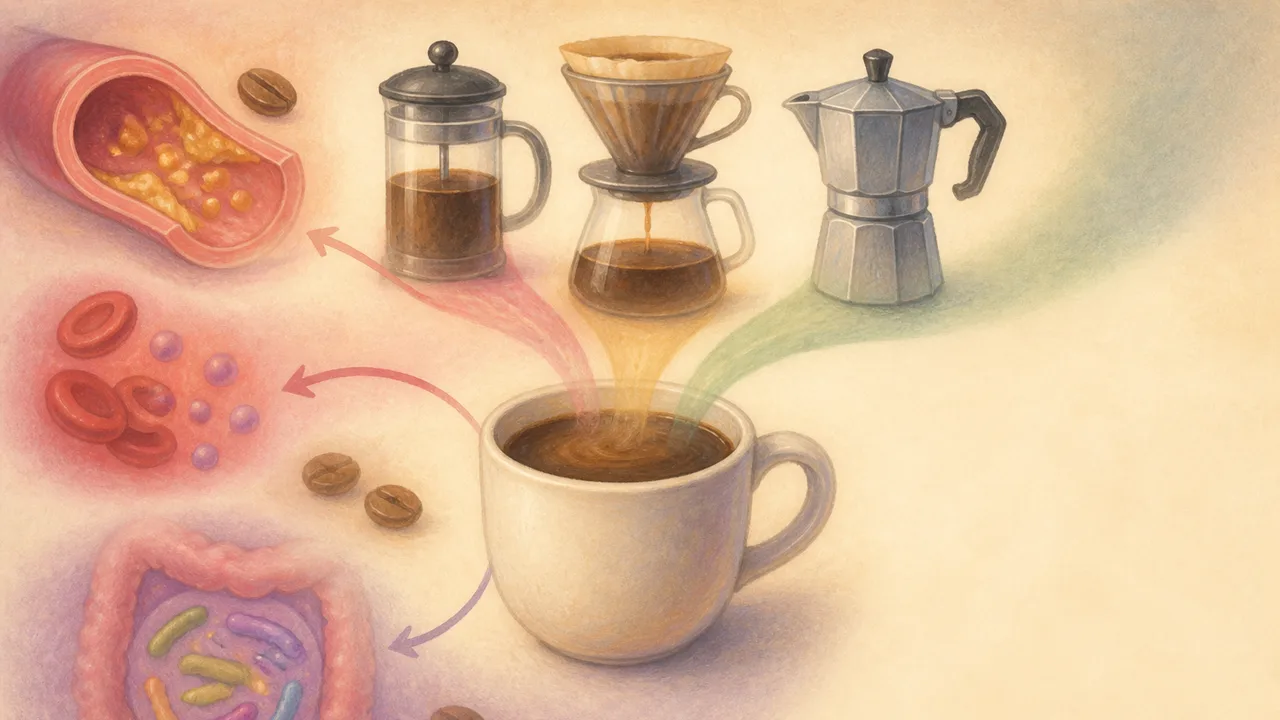
In 1983, Thelle and colleagues linked coffee consumption with higher total cholesterol and triglycerides, launching a research question that would eventually shrink from “Is coffee unhealthy?” to “What was in the cup?”
That second question is less headline-friendly. It is also much more useful.
Coffee is a plant extract containing hundreds of biologically active compounds. Caffeine gets top billing because alertness is easy to feel, but cafestol, kahweol, polyphenols, melanoidins and other compounds can affect cholesterol, nutrient absorption, medications and gut microbes. Brewing method changes which compounds reach the mug. Timing changes what they encounter once swallowed. Dose changes whether a small effect deserves practical attention.
This explains why coffee guidance can sound inconsistent without the science necessarily contradicting itself. Researchers may be studying different preparations, compounds, outcomes or time frames under one extremely roomy noun: coffee.
The Boiled-Coffee Scare Became a Brewing Question
A review of cafestol and kahweol research traces the cholesterol story to the 1983 finding. Subsequent evidence identified those two diterpenes as the main compounds responsible for the cholesterol-raising effect of unfiltered coffee.
The review reports that taking 10 milligrams of cafestol daily for four weeks was associated with a 0.13 mmol/L rise in serum cholesterol. Kahweol at the same dose was associated with a smaller 0.02 mmol/L rise. The review separately notes that LDL accounts for roughly 80% of elevated serum cholesterol. Those figures come through a review that draws on mixed underlying research, so they describe estimated responses under studied conditions, not a guaranteed result for every French press devotee.
Brewing method helps explain how a beverage associated with higher cholesterol in one setting can look different in another. Commenting on later Tromsø research, nutrition researcher Tom Sanders said boiled coffee and cafetière coffee contain higher diterpene levels, while instant coffee contains low levels. He also noted that Dutch dietary guidance favors filtered coffee. The Science Media Centre’s expert commentary cautioned that the later Tromsø study was observational, relied on self-reported consumption and lacked a standard espresso definition.
So the history did not erase the cholesterol concern. It gave the concern an address. Someone drinking several cups of unfiltered coffee has a different exposure from someone drinking paper-filtered or instant coffee. Cup size and preparation vary across countries and kitchens too. “Four cups” is a wobbly scientific unit when one person means tiny espresso cups and another means vessels with their own gravitational field.
The practical inference is conditional: brewing method deserves attention when coffee intake is high or LDL cholesterol is already a concern. That does not establish how much any individual’s LDL would change after replacing a cafetière with paper-filtered coffee. A clinician can interpret that change alongside the rest of a person’s health, medication and preferences. Coffee need not become a morality play conducted beside the kettle.
Timing Can Matter More than the Regular-Versus-Decaf Label
The same compound-level approach clarifies coffee’s interactions with medication and nutrients. A researcher-written overview of coffee physiology reports that coffee can reduce absorption of levothyroxine and alendronate. It also reports that caffeine can slow the metabolism of clozapine, while the antibiotic ciprofloxacin can slow the body’s breakdown of caffeine.
Those interactions run in different directions. Coffee can affect how much medication enters the body, caffeine can alter the handling of a drug, and a drug can make an ordinary coffee linger longer than expected. The common feature is timing and co-exposure, rather than a universal command to abandon coffee.
Anyone taking one of these medicines should follow its instructions and ask a pharmacist or prescriber how coffee fits into the schedule. The published overview supports the existence of the interactions, but it does not supply one timing rule that safely covers every drug, dose and patient. Wellness culture loves a laminated commandment. Pharmacology keeps handing it a calendar.
Iron introduces another timing question. Coffee polyphenols can bind non-heme iron in the digestive tract and reduce its absorption from a meal. Non-heme iron is found mainly in plant foods and fortified foods, so this may deserve more attention from people who already have low iron stores or depend heavily on plant sources. Caffeine is not identified as the main mechanism, which means decaf cannot automatically be treated as an iron loophole.
Tea Shows Why a Mechanism is Only the Beginning
Tea offers a useful comparison because its polyphenols also bind non-heme iron. A 2026 review of diet and iron overload discussed a trial of 18 people with hereditary hemochromatosis. Participants assigned black tea with every meal accumulated about one-third less stored iron over a year than those drinking water, but the between-group difference was not statistically significant. Chance could not be ruled out.
A later crossover study involving 14 adults tested extracts of black tea, cocoa and grape juice. The supplement reduced non-heme iron absorption from one meal and drink by about 40%. That result demonstrates an immediate absorption effect. It cannot show that the intervention reduced long-term iron accumulation, treatment needs or illness.
Evidence involving people with iron overload is stronger for tea than coffee, according to that review. Even the tea evidence remains small and outcome-limited. Coffee and tea share a plausible mechanism, but shared chemistry does not give them identical clinical evidence. This is where supplement advertising often takes a flying leap from “interacts with a biological pathway” to “improves health.” The landing has not been built.
Longer-term research adds another wrinkle. A review of 37 tannin studies found a mismatch between short-term bioavailability experiments and studies of iron status over time. Many people consuming tannin-rich diets had normal iron status, and animal and clinical evidence suggested repeated exposure could blunt reductions in iron availability. The authors said adaptation remains poorly understood, including whether effects seen in single-meal studies produce consequential changes in iron status.
This supports proportionate advice. Coffee with a meal can reduce non-heme iron absorption, but one breakfast experiment cannot predict somebody’s long-term iron status. People with diagnosed iron deficiency, hereditary hemochromatosis or transfusion-related iron overload have different problems and should receive individualized guidance. Diet can complement treatment for iron overload; it cannot replace blood removal or iron-chelating medication when those are prescribed.
The Microbiome Has Entered the Chat, Carrying Adjectives
Coffee’s latest reinvention is as potential microbiome fuel. Some chlorogenic acids, complex carbohydrates and roasting products reach the colon, where microbes may metabolize them. That biological plausibility has encouraged the “prebiotic coffee” idea, a phrase practically born wearing premium packaging.
A Nature Communications study published in April 2026 found differences in fecal microbiome composition between coffee drinkers and non-drinkers. Coffee drinkers had a higher relative abundance of Cryptobacterium and Eggerthella species. Some metabolome changes reversed during coffee abstinence, and reintroducing coffee produced acute microbiome changes that appeared independent of caffeine.
Those results show that coffee consumption and microbial composition can move together, including through non-caffeine components. They do not demonstrate that the changes improve health. The study’s reported outcomes included microbial composition, metabolites and cognitive measures, rather than a proven reduction in disease. Its abstract also does not provide enough design detail to judge from that summary alone how broadly the findings apply.
Calling coffee a prebiotic therefore outruns the demonstrated outcome. “Changes the microbiome” is especially vulnerable to wellness inflation because change can sound beneficial before anyone has established its direction, durability or clinical consequence. Your gut microbes are an ecosystem, not a tiny customer-loyalty program awarding points for artisanal beans.
Coffee guidance makes more sense once the cup is unpacked into compound, dose, preparation, timing and outcome. The 1983 cholesterol signal became more precise when researchers identified diterpenes and examined brewing methods. Iron studies separate immediate absorption from long-term status. Microbiome research can identify compositional changes before knowing whether those changes help anyone.
When the next coffee headline arrives, the useful questions are already waiting: Which compound, in what dose, delivered by which brewing method, measured against which outcome, and for how long?
More Like This

Why Proving 1+1=2 Took Mathematicians 362 Pages
Whitehead and Russell spent 362 pages proving 1+1=2. Their story is about what happens when you actually audit the axioms everyone told you were obvious.

How Your Circadian Rhythm Controls Morning Wakefulness
Your body already knows how to wake up naturally. Here's what sleep science says about training your circadian rhythm to stop dreading mornings.