Why Britain Chose Coal While the Dutch Burned Peat
Britain's coal rise and the Dutch peat economy show how canals, prices, industry and land use shaped energy transitions beyond fuel chemistry alone.

Written by AI. Margaret "Maggie" Holloway
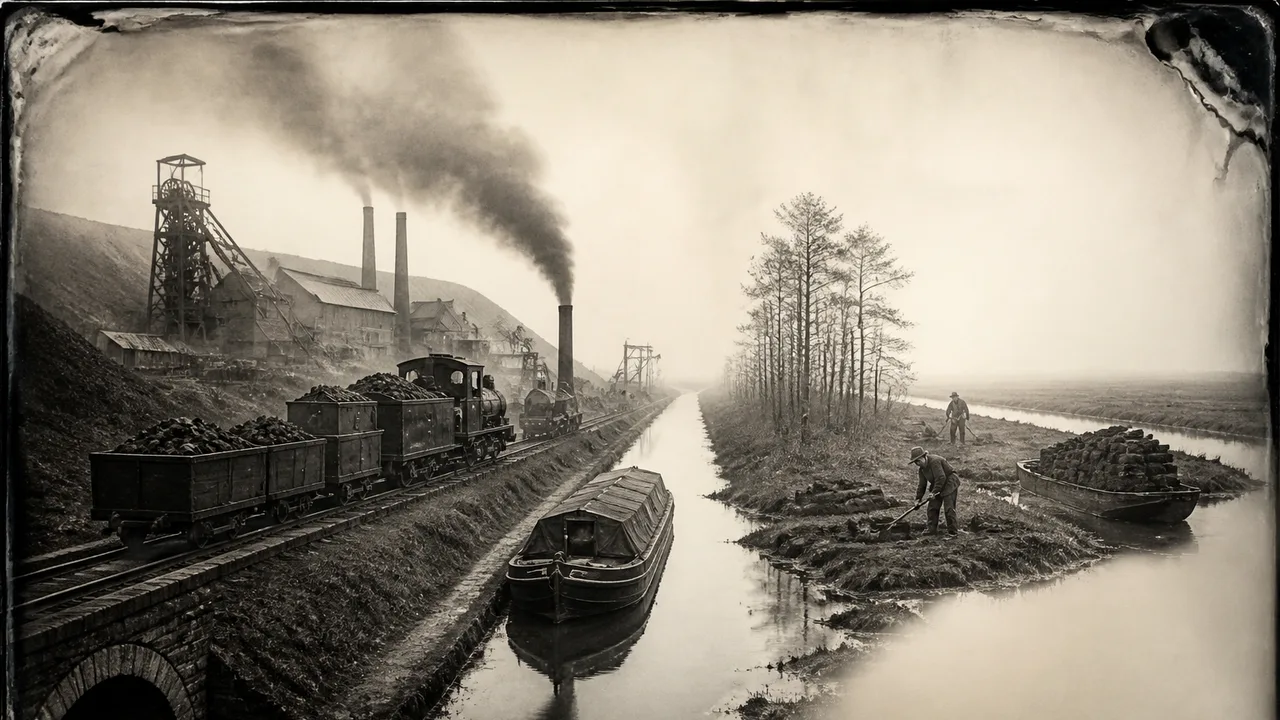
By 1650, Dutch peat may have supplied twice as much energy per person as coal supplied in England. The estimate, cited by economic historian Davis Kedrosky, puts a sod of half-decayed marshland where the coal lump usually sits in histories of industrial energy.
Britain eventually followed the more consequential path. Between 1700 and 1850, its energy use per person more than tripled, while coal's share rose from 49.7 percent to 92 percent, Kedrosky writes. Those figures can make the outcome look ordained by geology: Britain had coal, coal held more energy, and industry burned it.
The Dutch comparison spoils that tidy sequence. The seventeenth-century Netherlands supported an urban, energy-hungry economy without domestic coal seams. Its breweries, brickworks, salt pans, sugar refineries and ceramics factories consumed peat. Windmills numbered between 3,000 and 4,000, but kilns and furnaces required heat that sails could not provide.
Britain and the Dutch Republic therefore offer a useful pair of cases. Each had commercial cities, industries with large appetites for heat, and waterways capable of carrying bulky fuel. They arrived at different energy systems because the useful fuel was the fuel that could reach a furnace at an acceptable cost. Chemistry set constraints. Mines, canals, markets and land use decided what happened within them.
A Fuel that Arrived by Water
Peat contains less energy than coal. Kedrosky gives peat an energy density of 15 to 17 megajoules per kilogram, compared with 24 for coal. Anton Howes, writing about Britain's coal transition, cites estimates that dry peat provides roughly half as much heat by weight as coal and about one-sixth as much by volume.
A Dutch merchant did not buy a laboratory kilogram, however. He bought fuel delivered to a salt pan, brewery or kiln. The Netherlands had perhaps 275,000 hectares of peat before commercial exploitation, much of it close enough to the water table for canals to connect the digging grounds with urban customers. One estimate cited by Kedrosky suggests that replacing this water transport with carts would have required 110,000 horses and one million hectares of supporting land, about one-third of the country's surface.
That counterfactual is an estimate rather than an observed event, but its scale exposes the machinery behind cheap fuel. Peat was bulky and comparatively weak. Dutch waterways stripped away much of that disadvantage. Cheap carriage allowed an inferior fuel to sustain industries as varied as Delft ceramics, northern breweries and Amsterdam sugar refining. Kedrosky's account of the peat economy describes canals as production infrastructure, not decorative blue lines between picturesque towns.
The scholarly lineage of this interpretation reaches back at least to J. W. de Zeeuw's 1978 article, “Peat and the Dutch Golden Age: The Historical Meaning of Energy-Attainability”. The Wageningen University record identifies it as a peer-reviewed article in AAG Bijdragen. Its title supplies a better diagnostic question than simple resource abundance: could people obtain the energy where and when production required it?
The Forest Story Gets Turned Around
Britain's coal transition is often explained as an escape from dwindling woodland. The strongest version of that account has substantial contemporary evidence behind it. Howes notes that patent petitioners in the late sixteenth and early seventeenth centuries promoted coal or peat as ways to conserve firewood and lower its price. He also quotes an account of London obtaining wood from places that required 12 miles of overland carriage. Urban shortages and high transport costs were part of the period's lived economy.
Howes nevertheless argues that these local pressures do not establish a national timber exhaustion that forced Britain into coal. His history of the coal conquest draws on scholarship about managed woodland and industrial fuel. Woods supplying charcoal could be coppiced, cut on a cycle that produced another crop rather than cleared once and abandoned.
His sharper claim reverses the usual causal arrow: cheap coal could encourage woodland loss by removing the commercial reason to keep land under managed trees. Western Cornwall around 1600, he notes, retained coppices where charcoal was needed for tin smelting even though the region otherwise depended heavily on coal and had few trees. In that reading, industrial demand sometimes protected woodland because a standing cycle of trees had value.
This is an argument from a specialist synthesis, not proof that every English wood disappeared for the same reason. Soil, agricultural prices, ownership and local industries could change the fate of a wood. The narrower conclusion is sturdier: evidence of expensive firewood in a city cannot, by itself, demonstrate that Britain had exhausted its national timber supply. Delivered price and physical scarcity can produce the same complaint at the hearth while describing different landscapes beyond it.
The Dutch Dug Lakes Where Bogs Had Been
Peat carried its own long ecological invoice. Local extraction began in Holland's low-lying districts in the fifteenth century. As demand and prices rose from 1480 to 1530, the baggerbeugel, a tool for raising peat from below the water table, allowed diggers to reach deposits that had previously been inaccessible.
The excavated ground lost agricultural value. Kedrosky recounts how large lakes formed in exhausted bogs, eroded the surrounding countryside and sometimes swallowed villages. Dutch pumping and polder reclamation repaired some of the damage during the seventeenth century. Higher peatlands required another layer of infrastructure: consortia bought land, dug canals and hired workers, while larger sluices and deeper channels connected Friesland, Groningen and Drenthe to urban markets.
The two transitions altered land in different directions. Cheap coal could reduce the value of English fuel woods, making conversion to other uses more attractive. Cheap peat converted Dutch wetlands into an industrial reserve, then sometimes into open water. In each case, the energy system rearranged the landscape that supplied it. The environmental consequence followed from the whole chain of extraction, transport and competing land values.
That synthesis also explains why energy density alone is a poor predictor of adoption. Coal offered more heat per kilogram and far more per boatload, yet Dutch peat remained formidable because canals delivered it cheaply to established users. Britain had accessible coal and industries that could build demand around it. Resource quality contributed to the outcome; infrastructure converted geological possibility into an operating system.
History offers no controlled experiment here. The Netherlands and Britain differed in their mineral deposits, land, industries and later economic trajectories. The evidence available here also cannot assign a precise share of either transition to transport costs, wages, regulation or demand. It supports a framework rather than a universal formula.
That framework is useful whenever an energy technology is described as an obvious winner. Ask how it reaches the user, what equipment already consumes its rival, which landscapes acquire new value, and which costs remain outside the quoted price. Seventeenth-century fuel buyers did not choose between abstract units of heat. They chose between cargoes that arrived by canal, cart or coastal ship, and the map changed behind every load.
More Like This

How the Pantheon's Roman Concrete Outlasted an Empire
Nearly 2,000 years old and still standing, the Pantheon's volcanic concrete, structural ingenuity, and lucky conversion to a church explain its impossible survival.
What Ancient Engineering Actually Tells Us
From Sacsayhuamán to Roman harbors, ancient construction raises real questions about lost knowledge—and what we assume about pre-industrial capability.