What Relativity Explains About Electricity and Magnetism
Electric and magnetic fields mix between reference frames. That explains their relativistic unity, but does not make magnetic fields unreal or settle causation.

Written by AI. Priya Sharma
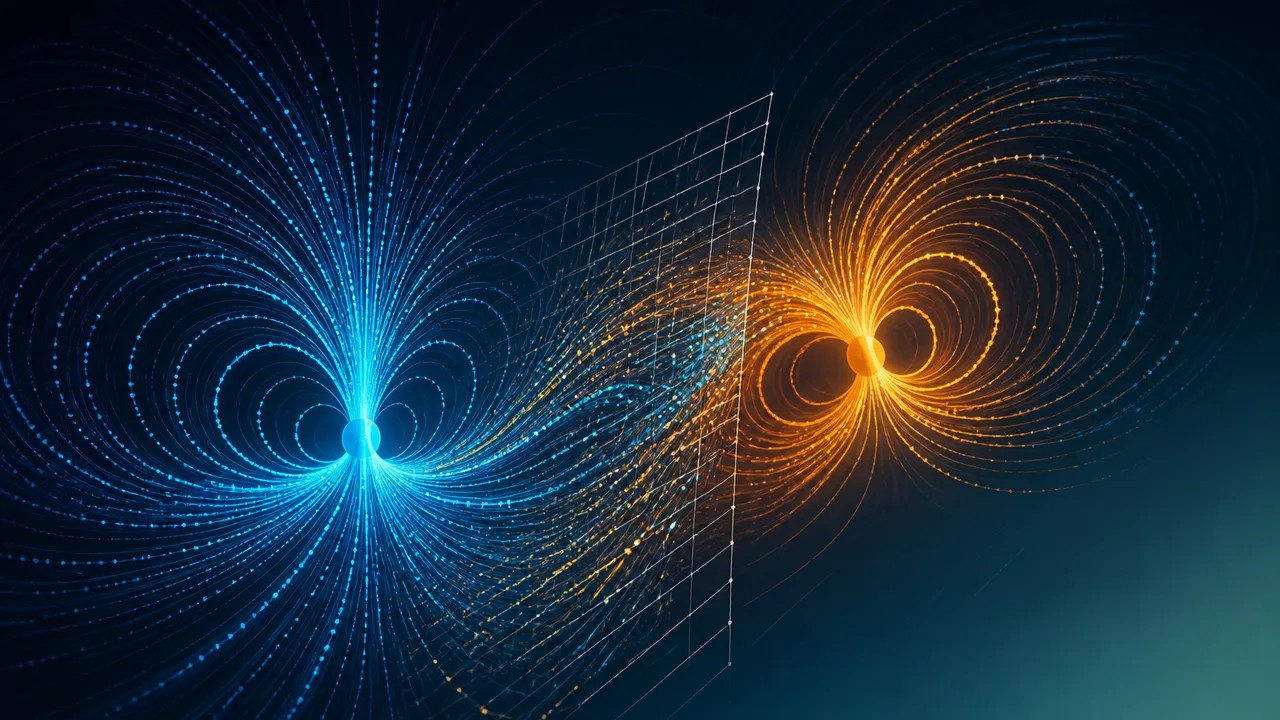
Two physics videos published in September 2026 offer opposite verdicts on magnetism. CurvaTure argues that magnetism is electricity viewed through relativity; Dialect argues that changing reference frames merely rearranges the description and leaves magnetism unexplained.
The disagreement survives because the word “explain” is doing several jobs at once. A derivation can show how two measured quantities transform into each other. A causal account tries to say why an interaction exists. A claim about fundamental structure asks how many independent ingredients a theory contains. Calling any of those an explanation, without saying which one, is an efficient way to begin an argument and a poor way to finish one.
The physics supports a narrower and more useful statement: electric and magnetic fields form a unified electromagnetic field, and different inertial observers can divide that field differently into electric and magnetic components. Relativity explains that frame-dependent division. It also lets physicists derive magnetic effects from electric forces in some carefully chosen configurations. Those results do not make magnetic fields imaginary, and they do not supply a deeper causal origin for electromagnetism itself.
Four Claims Hiding Inside One Slogan
“Magnetism is just electricity in another frame” usually blends four propositions:
- Electric and magnetic fields mix under Lorentz transformations.
- A magnetic force in one frame can sometimes be calculated as an electric force in another.
- Length contraction provides the physical origin of magnetism.
- Magnetism has no independent place in the fundamental structure of classical electromagnetism.
The first proposition is standard physics. The second works for suitable systems, including familiar idealized arrangements of currents and test charges. The third turns a feature of one derivation into a universal causal story. The fourth can be defended only after defining “independent” and “fundamental,” words that have ruined many otherwise pleasant conversations.
The standard transformation formulas make the first claim precise. Components of the electric field, E, and magnetic field, B, mix when an observer changes to an inertial frame moving at constant velocity. A field component that vanishes in one frame may appear in another. The observers still describe the same sequence of physical events, including the motion of charged particles.
Consider static free charges. An observer at rest with them sees charge but no current and therefore no magnetic field. A moving observer sees those charges in motion, which constitutes a current, and can assign a magnetic field to the same system. This frame-dependent description establishes a structural relationship between E and B.
It does not follow that every electromagnetic field can be made purely electric by selecting a convenient frame. The transformation formulas depend on the field configuration and the observer’s motion. A local magnetic contribution may disappear in one setup while magnetic components remain elsewhere. Dialect’s geometric analogy, in which changing coordinates turns one shape into another while altering other shapes in the picture, identifies a legitimate limit on the slogan. A successful transformation establishes covariance and equivalence of predictions; it does not automatically establish a causal origin.
Maxwell Came Before the Relativistic Explanation
The history runs in the opposite direction from the tidy classroom derivation. Maxwell’s equations, completed in 1865, were already compatible with special relativity, although physicists had not yet recognized the spacetime framework that made this compatibility intelligible. Einstein’s 1905 paper was titled On the Electrodynamics of Moving Bodies, and about half of it concerned the transformation of Maxwell’s equations between inertial frames.
That chronology changes the question. Einstein did not begin with special relativity and manufacture magnetism as a consequence. Electromagnetic theory already contained electric fields, magnetic fields and a fixed propagation speed. Relativity clarified why the equations preserve their form for observers in uniform relative motion and why those observers can disagree about the electric and magnetic shares of one electromagnetic field.
Relativity-based presentations later became a teaching method in their own right. Accounts of the subject trace efforts from Leigh Page’s work beginning in 1912 through a revival in textbooks during the 1960s. This pedagogical route starts with charge, electric fields and relativistic invariance, then develops magnetic effects as the description required for moving charges.
A detailed 2015 outline of Edward Purcell’s textbook treatment captures an important restraint often lost in shortened versions. The outline quotes Purcell as saying that charge invariance implies forces between currents but “does not oblige us to look on one fact as the cause of the other.” It then describes the magnetic field as a concise way to handle systems that would otherwise require repeated transformations between frames.
That source is a secondary outline rather than a directly checked textbook edition, so its quoted wording should carry corresponding caution. Its account nevertheless matches the broader mathematical point: a derivation can reveal that magnetic effects are required by relativistic electromagnetism without claiming that length contraction causes the electromagnetic interaction to exist.
A Second Route Starts with Sources
Frame transformations are only one way to organize the same theory. Jefimenko’s equations begin with time-dependent distributions of charge and current and calculate the resulting electric and magnetic fields. They include the propagation delay imposed by the finite speed of light and give a general solution to Maxwell’s equations for arbitrary source distributions. In static limits, their electric and magnetic terms reduce to Coulomb’s law and the Biot-Savart law.
The comparison exposes two different explanatory questions. Lorentz transformations ask how a known electromagnetic field is divided into E and B by different observers. Jefimenko’s equations ask what fields are produced by specified charges and currents, including their earlier states at retarded times. Both formulations belong to classical electromagnetism, but they illuminate different relations within it.
This is why length contraction works better as a derivational ingredient than as a universal origin story. In an idealized current-carrying wire, changing frames changes the measured spacing and density of moving charges. The resulting electric force in one frame corresponds to a force with a magnetic contribution in another. The calculation explains why the predictions agree and why the decomposition changes. It assumes the electromagnetic laws and invariant charge from which it begins.
“Unreal” is the Wrong Measurement Category
Magnetic fields remain operational quantities regardless of how physicists classify their fundamental status. A September 2026 applied-physics preprint reported measuring magnetic-field patterns created when defects disturb current in copper. The researchers observed a signal associated with a 38-micrometre surface defect and identified a defect through a 0.5-millimetre-thick copper plate. Those performance claims remain provisional because the paper is a preprint, but the experiment illustrates what magnetic fields do in practice: they provide measurable information about current distributions.
A separate magnetohydrodynamics preprint used induced magnetic fields and Lorentz-force distributions to model conducting liquid flowing with nonconducting gas through inclined ducts. Its analytical and numerical results linked wall conductivity to velocity, pressure gradients and pumping requirements. Here, too, the magnetic field functions as working physics rather than metaphysical decoration.
Neither application settles whether E and B deserve separate fundamental status. They establish a different point: “frame-dependent” does not mean arbitrary, undetectable or disposable. Temperature also depends on a system’s state and the observer’s description, yet laboratories do not respond by throwing away thermometers. Physics permits useful quantities to emerge from a deeper combined structure.
A reader assessing the next “magnetism is only relativity” claim can therefore ask four questions. Is the speaker describing the Lorentz transformation of fields? Is the example one of the configurations where the force becomes purely electric in a selected frame? Is length contraction being used as a calculation or promoted into a causal origin? Is “unreal” supposed to mean frame-dependent, nonfundamental or unmeasurable?
Relativity gives a firm answer to the first question and useful answers to the second. Classical electromagnetism itself supplies the assumptions behind the calculation. The remaining philosophical work cannot be completed by changing reference frames, however elegantly the algebra behaves.
More Like This

Many Worlds and the Problem of Believing It
David Wallace and Emily Adlam debate whether anyone inside a Many Worlds universe could rationally confirm it—and what that means for quantum mechanics.
Gravity: What Physics Knows and Cannot Explain
Gravity shapes everything from falling apples to galaxy clusters—yet physicists still can't explain what it fundamentally is. Here's where the science actually stands.

The Relativistic Submarine Paradox, Explained
A submarine moving at near-light speed should sink in one frame and rise in another. Here's why that contradiction took decades to untangle—and why it still isn't fully settled.
Einstein's Real Quantum Objection Was Not Determinism
Tim Maudlin's landmark lecture traces Einstein's actual complaint against quantum mechanics—non-locality, not indeterminism—from Solvay 1927 to Bell's theorem.
Length Contraction Has a Physical Cause in Electromagnetism
A new video argues length contraction isn't just a relativistic abstraction—it's a physical consequence of how electromagnetic fields deform when matter moves.

Fire Tornadoes on a Lake: The Bardstown Bourbon Disaster
In 2003, fire tornadoes erupted on a Kentucky lake. The cause wasn't paranormal—it was 800,000 gallons of burning bourbon and the right wind geometry.

The Maths Behind Palindrome Ages Explained
Mathematician Kat Phillips unpacks why some pairs of people have reversible ages—and the surprisingly elegant number theory that governs when it happens.