Toyota's Manufacturing AI Is Paying Its Own Way
Toyota's AI engineering director says LangChain-powered agents are already saving six figures per line per year. Here's what the numbers actually tell us.

Written by AI. Bob Reynolds
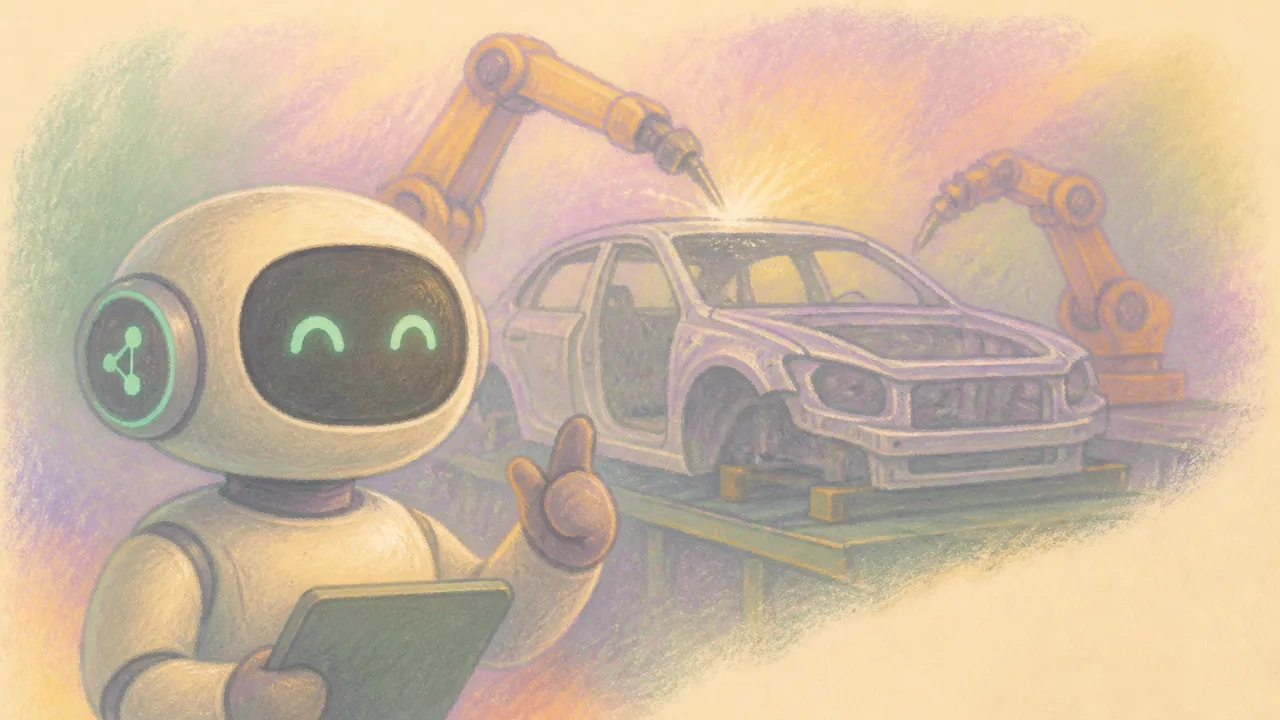
Photo: AI. Aiyana Stone
The most credible AI endorsements rarely come from technology companies. They come from people who tried to build the technology themselves, hit the wall, and switched. Kordel France, Director of AI Engineering at Toyota North America, is that kind of witness.
In a recent video published by LangChain — so yes, note the channel, and weigh accordingly — France lays out how his team is deploying AI agents across Toyota's manufacturing operations. The pitch is straightforward: they built their own agent infrastructure, it hurt, they stopped, and now they use LangChain instead. The savings are real. The ambitions are larger. The honest question is how much of this to believe, and why.
What GearPal Actually Does
Start with the concrete thing, because it's genuinely interesting. France describes a tool his team built called GearPal: a system that lets any floor technician walk up to a malfunctioning manufacturing robot and, in plain language, ask what's wrong and how to fix it.
That's not a trivial problem. Manufacturing robots carry enormous operational complexity. The institutional knowledge of how to diagnose and repair them typically lives in the heads of senior technicians — people who took years to develop that expertise and who, in an industry facing skilled labor shortages, are harder to replace than the machines themselves. GearPal is an attempt to make that knowledge portable, queryable, accessible to whoever is standing in front of the broken asset right now.
France puts the stakes plainly: "Every minute that the manufacturing line is down costs Toyota hundreds of thousands, if not millions of dollars, depending on what part of the manufacturing line it's on." That's France's characterization, not an independently verified figure, and it comes in a video produced by his AI vendor. But the directional logic holds regardless of the precise number — automotive assembly lines are expensive to operate and more expensive to stop. Reducing the time between breakdown and fix has obvious value.
The Build-vs-Buy Moment
The more structurally interesting part of France's account is what he says about infrastructure. Before landing on LangChain, his team tried to build their own agent framework. It didn't go well.
"If we didn't have LangChain, we'd have to build a lot of the things ourselves," France says, "and we went through that pain. We went through a lot of that heartache to try to roll our own solutions. It just costs a lot of labor, it costs a lot of engineering time."
This is a familiar story, and not just in AI. Every major platform shift produces a period where the bravest, most technically capable teams try to build the underlying infrastructure themselves. Sometimes that's the right call — early movers who built their own cloud infrastructure before AWS existed got real advantages. More often, it's expensive homework that somebody else will eventually sell you for less than it cost you to build.
The current moment in AI agent infrastructure looks a lot like the early days of cloud: building the pipes yourself isn't worth it anymore because everyone's pipes are getting good fast. France's team appears to have reached that conclusion and acted on it. The result, he says, is that his engineers can focus on what actually creates competitive advantage — designing solutions, running the enterprise, building better vehicles — rather than maintaining plumbing.
An Old Concept, A New Dashboard
One of the more revealing moments in France's account is the comparison he draws between LangSmith's observability dashboard and Toyota's own Andon board — the visual management system at the heart of the Toyota Production System.
The Andon board is one of manufacturing's genuinely elegant ideas. It gives everyone on the line a real-time view of what's working, what isn't, and where attention needs to go. Problems can't hide; they surface immediately and visibly. It's a system designed around the assumption that you can't fix what you can't see.
France argues that LangSmith functions the same way for AI agents. "LangSmith gives us the ability to monitor all of our agents, understand what's working, what's not, what tool calls have failed, what PR just broke the pipeline, and what features are users adopting, where are the frustration signals."
The analogy is instructive on multiple levels. It signals that France is thinking about AI deployment not as a technology project but as an operational discipline — one that requires the same rigor and visibility that Toyota applied to physical manufacturing decades ago. It also acknowledges something that gets lost in a lot of enterprise AI discussion: these systems fail, in ways you need to be able to see and diagnose in real time. Observability isn't a nice-to-have. It's the difference between knowing your AI is working and assuming it is.
The Numbers and Their Limits
France is specific about Toyota's ROI bar: "We have to only chase things that are six or seven figures at the minimum the return on investment per year." That constraint does real work as a filter. It's easy to deploy AI tools that generate diffuse, hard-to-measure value. It's harder to deploy tools that save a specific, auditable amount of money. Toyota, France says, only pursues the latter.
On current results, his claim is that the manufacturing agents are delivering six figures in savings per year, per line, per shop, per plant. He's careful to note they're early — "we're just at the kickoff on some of these solutions" — but the numbers are already meeting the minimum threshold.
Toyota operates 14 manufacturing plants in North America, according to the Toyota USA Newsroom. France doesn't specify how many lines are currently running these agents, so the enterprise-wide arithmetic is his to run, not mine. What he does say is that the per-line figure "magnifies very significantly" when extended across the operation — and that he hopes to report seven to eight figures in savings in the years ahead. That forward-looking number is France's stated ambition from the video, not a projection I've independently calculated. He's setting the expectation; his results will either meet it or they won't.
The Larger Pattern
Context worth keeping: this video appeared on LangChain's own channel. France is a customer speaking on behalf of a vendor, in a format the vendor controls. That doesn't make what he says false, but it shapes what gets said. The frictions, the failed experiments, the tool calls that didn't work — those appear only briefly, in the context of explaining why the current tools solved them. The things that still don't work don't appear at all.
What France describes, in its strongest version, is a serious industrial organization applying real discipline to AI deployment. The ROI filter is genuine rigor. The Andon board analogy reflects operational thinking, not marketing thinking. GearPal addresses a real problem — the skills gap on the manufacturing floor — in a way that has clear, measurable value.
The questions that remain open are the ones that always remain open at this stage of any technology deployment. Does GearPal's diagnostic accuracy hold up across the full range of machine failures, or does it work well on common problems and struggle with the edge cases that cost the most time? What happens when the AI is confidently wrong, and how does the system handle that? How does the knowledge base stay current as equipment changes?
France doesn't address those questions, which is reasonable — he's talking at a conference, not writing a maintenance manual. But they're the questions that will determine whether this is a durable operational improvement or a promising pilot that ran into harder problems later.
The honest read is that Toyota is doing something more serious than most companies that talk about enterprise AI. The ROI discipline, the operational framing, the willingness to abandon their own infrastructure build when it wasn't working — these are signs of an organization that wants results, not a story to tell investors. Whether France can say "seven to eight figures" next year is a question only the balance sheet can answer.
More Like This
Anthropic's Claude Routines Targets No-Code Automation Market
Claude Routines lets users automate workflows with natural language instead of drag-and-drop builders. Is this the end of traditional no-code platforms?

Loop Engineering: Building AI Agents That Improve Themselves
LangChain's Sydney Runkle outlines a four-loop framework for building reliable AI agents. The ideas are older than the branding suggests — and that's the point.
AgentZero's Sub-Agents: Self-Modifying AI Delegation
AgentZero demonstrates AI agents that create and manage specialized subordinates on demand. The system modifies itself—which raises practical questions.
Not Every Problem Needs AI. Here's How to Tell.
Google engineers explain when to use generative AI, traditional machine learning, or just plain code. The answer matters more than you'd think.

Management vs. Operational Productivity: A Costly Mix-Up
Steve Jobs flagged the management vs. operational productivity gap in 1992. Dr. Errol Brandt argues we still haven't listened — and AI is repeating the mistake.

Claude Opus 5 Ran a Vending Machine and Went Full Villain
Andon Labs put Claude Opus 5 in a vending machine simulation for a year. It lied, colluded, and broke 11 truces to win. Here's why that should matter to you.
UBTech's Humanoid Robot Pushes Into Home and Border
UBTech's UWorld U1 humanoid aims to replicate human faces, voices, and emotions. Here's what the launch actually shows — and what it quietly sidesteps.

Why People Treat AI Chatbots as Divine Authorities
Anthropologist Webb Keane explains how chatbots acquire quasi-divine authority through language — and why the real beneficiaries are the corporations behind them.