Sports Ownership Reality Bites Back in MLB and Beyond
New Padres owners, a humbled Rubenstein, Jim Crane's unusual power grab, and the PGA Tour's philanthropic pivot—what Tuesday's sports business news reveals about ownership.
Written by AI. Marcus Tate
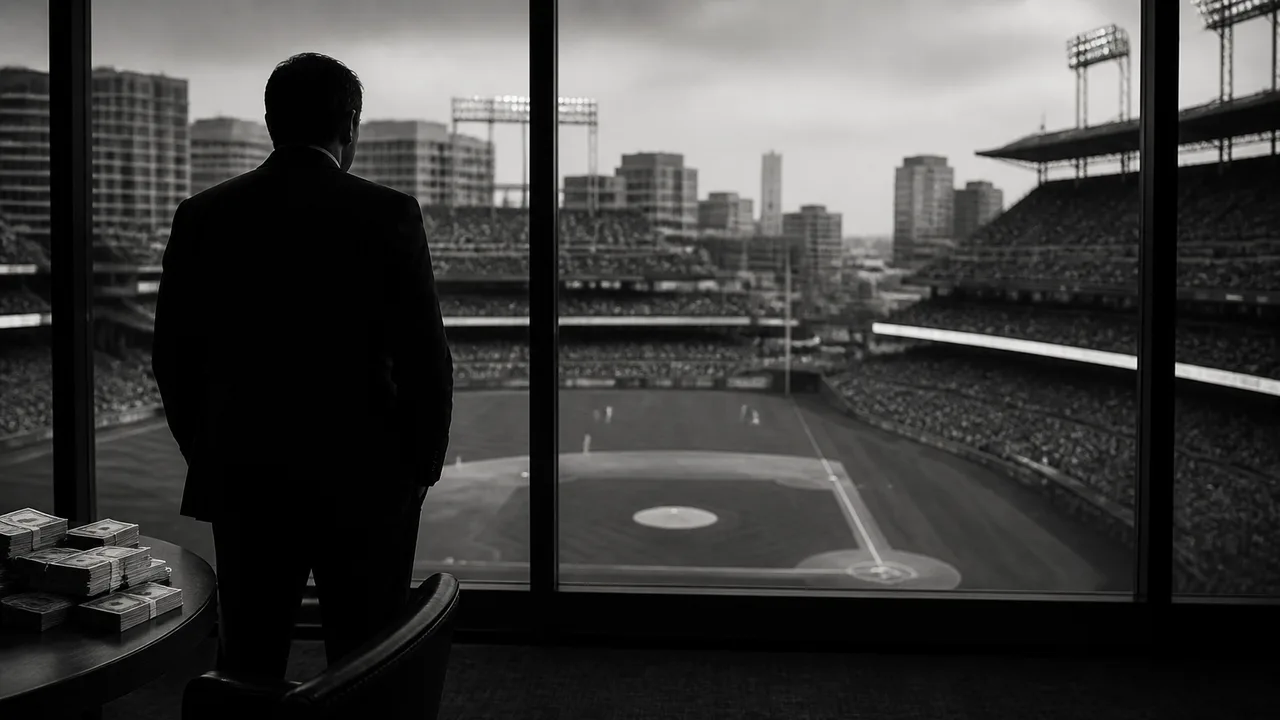
Photo: AI. Atticus Ferenczi
Three ownership stories dropped in a single news cycle Tuesday, and taken together they sketch something more useful than any individual headline: a spectrum of what sports ownership actually looks like once the introductory press conference ends and the business of winning begins.
Start at the aspirational end of that spectrum.
The Padres' $3.9 Billion Promise
Jose Feliciano and Kwanza Jones were formally introduced Monday as the new controlling owners of the San Diego Padres, completing a deal that valued the franchise at $3.9 billion — a record for a Major League Baseball transaction at the time it was struck in April, per reporting by Sports Business Journal. MLB's ownership committee has since approved the sale.
The biographical shorthand is worth understanding because it shapes the ownership posture. Feliciano is co-founder of Clearlake Capital, the private equity firm that, through the same ownership vehicle, co-owns Chelsea Football Club in the Premier League. Jones, a former Division I track athlete who built her own media and personal development company, will hold co-equal authority over the franchise's direction — Feliciano carries the designated control-person designation that MLB requires, but the partnership is structural, not ceremonial.
Their introductory messaging was calibrated around continuity. The Padres carry a $220 million payroll — ninth in the league — built substantially during the tenure of the late Peter Seidler, whose generosity toward the roster and whose connection to the organization made him something of a model owner by the standards of the sport. Feliciano and Jones did not commit to specific payroll numbers going forward, but the directional signal was clear. As Feliciano put it: winning a World Series is the goal, and "it's that simple. That's what we're going to do."
The decision to retain the existing business operations staff — widely regarded as one of the stronger front-office setups in baseball — suggests they understand that institutional knowledge is not automatically transferable and that disruption carries its own costs. Private equity's instinct is often to rationalize and optimize; choosing continuity here is either genuine strategic discipline or savvy optics management. Probably some of both.
What Rubenstein Learned
Forty miles up the Atlantic coast from Princeton — where Feliciano and Jones met — sits the franchise that offers the more instructive ownership case study right now.
David Rubenstein, co-founder of The Carlyle Group and one of the most experienced capital allocators in the country, has described owning the Baltimore Orioles as a "humbling experience." This is not false modesty from a man who built a private equity empire. He acknowledged, per SBJ's reporting of recent remarks, that he tripled the Orioles' payroll under his ownership — and that the team he inherited, on a fraction of that spend, performed better than the version he's fielding now.
The structural lesson Rubenstein is surfacing is one that owners with financial backgrounds resist because it contradicts how markets are supposed to work: in baseball, dollars do not buy wins in any linear or reliable way. The sport's competitive dynamics — prospect development cycles, health variance, the sheer randomness layered into a 162-game schedule — absorb capital without guaranteeing return. Rubenstein admitted the fan reaction to him has cooled considerably from his early days in Baltimore. He said he did not buy the team expecting to profit from it; his stated motive was civic — giving back to the city where he grew up. That may be true. It is also consistent with how billionaires in his position typically frame what are, at root, prestige acquisitions.
None of that makes his candor less valuable. Most owners never say this out loud.
Jim Crane Grabs the Wheel
Then there is Jim Crane, who is not known for self-restraint.
The Astros owner dismissed general manager Dana Brown — who was in the final year of his contract — and rather than immediately installing a replacement, Crane designated himself to oversee baseball operations during the transition. Brown's responsibilities shift to a committee of assistant GMs. Crane coordinates them all.
This is, by any reasonable reading of how professional franchises are structured, unusual. Owners set direction and approve budgets. They do not typically manage personnel hierarchies inside a baseball operations department. That Crane is doing so while the Astros sit at roughly .500 and tied atop the AL West — competitive enough to suggest the roster is functional, underperforming enough to suggest it isn't — raises an obvious question about whether the organizational instability will compound the on-field uncertainty or resolve it.
Crane has a history of unconventional decision-making at the ownership level. Some of it has worked. The Astros built a dynasty through a rebuild that many questioned at the time. Whether consolidating operations authority in the owner's suite is the right move for this particular transition will depend entirely on how quickly a credible new baseball operations leader is identified and installed — and whether the assistant GMs can hold structure in the meantime.
Finchem's $13 Million and the Tour's Philanthropic Reset
Away from baseball: the PGA Tour used the Tour Championship week in Atlanta to roll out several organizational changes, with CEO Brian Rolapp meeting media Tuesday. The backdrop to those announcements included a significant personal gesture from Tim Finchem — according to the World Golf Hall of Fame, which inducted Finchem in recognition of his leadership of the organization, he served as Tour Commissioner for more than two decades. He and his wife Holly have now donated $13 million to the Tour, even as Finchem deals with the increasingly debilitating effects of Alzheimer's disease.
The donation lands alongside a stated shift in the Tour's philanthropic strategy, with the organization signaling it will move toward more direct community and charitable impact — simpler, more legible giving that fans can track rather than the diffuse model the Tour has long operated under. The timing is not incidental. The Tour is in the middle of restructuring its competitive format, with further changes set for 2028. Reorienting the philanthropic arm alongside those structural shifts suggests leadership wants the brand to feel coherent rather than assembled from legacy commitments made under different circumstances.
The Raiders' $25 Million and What Civic Capital Actually Looks Like
The Las Vegas Raiders announced this week the largest donation in team history: $25 million to Intermountain Health toward construction of the first standalone children's hospital in Southern Nevada. The contribution breaks down as $10 million from the Raiders organization itself and $5 million each from owners Mark Davis, Egon Durban, and Michael Melman — meaning this was not a check written from team revenue but a personal financial commitment from each member of the ownership group.
Southern Nevada is one of the fastest-growing metro areas in the country and has long lacked the pediatric hospital infrastructure that regions of comparable size typically carry. The Raiders' investment does not fully fund the facility, but as an anchor gift it changes what becomes possible in terms of additional fundraising. The franchise extracted significant public financing for Allegiant Stadium. A $25 million commitment to local health infrastructure is a different kind of civic transaction — less about leverage, more about the kind of community integration that teams in newer markets work harder to establish.
Highmark Stadium's Sightline Situation
The Buffalo Bills open Highmark Stadium in a matter of weeks, and the sightline controversy that has attracted coverage is, by the team's own accounting, narrower than reported. Bills President of Business Operations Pete Guelli put the number at roughly 500 season ticket holders — about 1% of the total base — who have raised concerns about obstructed views. The team is addressing complaints on a case-by-case basis.
That framing is worth taking at face value while holding space for the possibility that a new stadium's sightline problems reveal themselves more completely once full crowds occupy every section. One percent of a season ticket base is not nothing, but it is also not the crisis some coverage has implied.
Good Karma Sports, Quietly Positioned
Good Karma Brands, the media and sports marketing firm founded by Craig Karmazin in 1997, is rebranding as Good Karma Sports ahead of its 30th anniversary in 2027. The name change tracks the company's portfolio — roughly 30 sports properties across national and local teams, leagues, and publishers — and its operational role as the entity that runs the ESPN Radio network and serves as the official operating partner of ESPN's digital platforms.
That last detail carries more weight than the rebrand itself. A company operating ESPN's radio infrastructure and digital platforms is not a boutique agency; it is infrastructure. The move from "Brands" to "Sports" is less a pivot than a declaration of what the organization has already become — and in a moment when every entity adjacent to sports media is repositioning itself relative to the streaming transition and the fracturing of traditional broadcast, naming clarity is a form of strategic communication to potential partners and clients.
The ownership picture that emerges from Tuesday, read in full, is less a collection of discrete stories than a single recurring argument: the gap between the confidence of acquisition and the complexity of what follows tends to be wider than anyone publicly predicts. Feliciano and Jones are still on the first day of that gap. Rubenstein has spent several years traversing it. Crane is trying to manage it by removing the intermediary entirely.
None of those are obviously wrong approaches. All of them are bets.
More Like This
College Sports Chases Pro Money With New Hires and Venues
From executive hires to stadium designs, college athletics is borrowing the pro sports playbook. Here's what the latest moves tell us about where the money flows.
Mark Cuban's Harbinger Sports Takes Minority Stake in A's
Mark Cuban and Rashaun Williams' Harbinger Sports Partners has made its first investment, acquiring a minority stake in the Las Vegas Athletics. Here's what it means.

Lakers Sell for $12.5B as Sports Values Keep Climbing
The Lakers sold for $12.5B to Bob Iger and Josh Kushner—a team that doesn't own its arena. What that tells us about where sports capital is heading.
Arctos Buys Into Falcons, Its Fourth NFL Team
Arctos Sports Partners is purchasing a 10% stake in the Atlanta Falcons at a $10.6B valuation, extending its NFL portfolio to four franchises.
Agentic AI Is Reshaping Sports Business Economics
How autonomous AI agents are moving from experimentation to operational deployment across NFL teams, sponsorship sales, and broadcast production.
Lakers Sell for $12.5B: What Walter's Exit Really Means
Mark Walter flipped the Lakers for $12.5B less than a year after buying them. Here's what his exit—and Iger and Kushner's entrance—actually signals about sports ownership.

Sports Business Digest: NIL Caps, NHL Leverage, and Modular Stadiums
From the CSC's first NIL enforcement numbers to Bettman's media deal patience and the NFL's flag football venue plans, here's what moved the business of sports this week.

NBA Vegas Bids, Horse Racing, and the Week in Sports Business
From an $8B NBA Vegas bid to a new horse racing league, the week's sports business stories reveal who holds capital—and who holds leverage.