Spain vs. France: The Sound of a World Cup Semifinal
How FOX's audio engineers will capture, mix, and transmit the Spain vs. France World Cup semifinal from AT&T Stadium to 11pm living rooms worldwide.
Written by AI. Theodore "Teddy" Ashworth III
There is a moment in a stadium goal celebration — the exact 200 milliseconds between the net moving and the crowd registering what it just saw — where the audio environment does something strange. The ambient noise drops. A collective inhale. Then the room explodes.
Mikel Merino scored in the 88th minute against Belgium on Thursday, and according to BBC Sport, it sent Spain through to the World Cup semifinal. What the scoreline doesn't capture is what that moment sounded like inside the stadium, or — more to the point — what it sounded like on the other side of FOX's broadcast chain, reproduced through a TV speaker in Madrid at 11 at night. Those are two entirely different audio experiences, separated by a signal chain of extraordinary complexity. And that chain is about to be stress-tested again on Tuesday, when Spain faces France in Arlington, Texas.
Let me tell you what a sports columnist won't.
Inside AT&T Stadium: The Acoustics Problem Nobody Mentions
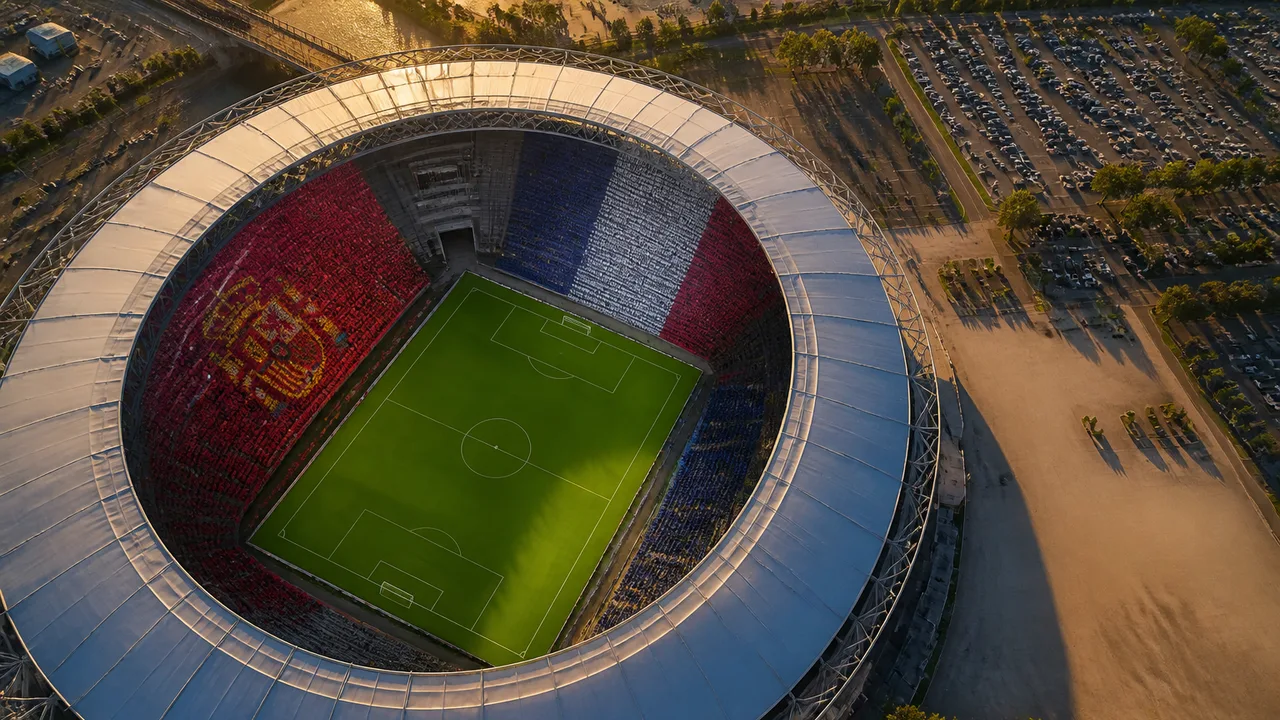
AT&T Stadium in Arlington is a particular kind of engineering challenge. The retractable roof structure — which makes it one of the most visually dramatic sports venues in North America — creates an acoustic environment that broadcast engineers have to fight against rather than work with. Hard surfaces, a cavernous interior volume, and a crowd capacity north of 90,000 combine to produce reverberation times that would make a recording engineer wince. When 93,000 people are responding to a last-minute winner, you're not dealing with sound anymore; you're dealing with pressure.
FOX's production truck handles this by deploying what's typically a multi-layered microphone strategy. Parabolic microphones at pitch level capture the close-sound of boots on ball, goalkeeper commands, and the low thud of a shot hitting the post — sounds that give a broadcast its physical texture. Crowd mics positioned at various heights around the bowl capture the ambient roar. The problem is that in an environment like AT&T Stadium, those crowd mics are also capturing huge amounts of reflected energy — the same sound bouncing off the roof, the sideline walls, the lower tier overhangs. A broadcast mix engineer has to decide how much of that diffuse reverb to keep, because the right amount makes the crowd sound massive and real, and too much makes everything sound like it was recorded in a parking garage.
The mix that lands in your living room is a constructed artifact. It's not what the stadium sounds like. It's what the broadcast team decided the stadium should sound like, within the constraints of the medium.
The Commentary Split: Two Audiences, Two Signal Chains
For a Spain-France semifinal, FOX faces a production reality that doesn't apply to most domestic sports events: they're serving at minimum two distinct language audiences simultaneously, and the commentary approach for each is going to be sonically and editorially different.
English-language commentary runs on the primary FOX broadcast feed. The Spanish-language feed — essential for a match of this cultural weight, broadcast to viewers in Spain via RTVE and globally through services listed by Business Insider including BBC iPlayer in the UK, SBS On Demand in Australia, Rai Play in Italy, and ZDF in Germany — carries a commentary team with a completely different emotional register and pacing. Spanish football commentary is not English football commentary with a different language applied on top. The two traditions treat silence, exclamation, and crowd integration differently.
What this means in production terms: you're running parallel audio buses from the same source material. The crowd stems, the ambient pitch audio, the effects tracks — those are shared infrastructure. But the commentary sits on top as a separate layer, and the mix decisions around how loud the crowd sits relative to the voice are made independently for each feed. A Spanish commentator riding a Merino winner at full emotional velocity needs a different dynamic relationship with the crowd bed than an English commentator who might let the stadium do more work in that moment.
That's not a small decision. It's the difference between a viewer feeling like they're in the room and feeling like they're watching it from a hotel corridor.
The Hydration Break as Broadcast Disruption
One of the stranger production challenges at this World Cup has been the mandatory hydration breaks introduced to deal with summer heat across North American host cities. NPR has reported on the ongoing frustration these breaks are causing, and The Paris Review Blog has characterized this as definitively "the hydration-break World Cup."
From a broadcast production standpoint, these breaks are a specific kind of chaos. Live sports audio is managed in a rhythm — the natural flow of play creates predictable tension and release that broadcast engineers and commentators learn to ride. Hydration breaks snap that rhythm at irregular intervals. The crowd energy drops. The ambient noise shifts. Players are standing around, which means the pitch-level microphones are suddenly capturing conversations and instructions that were previously masked by crowd noise and movement.
For the commentary team, it's an unscripted pause that needs filling. For the audio engineer, it's a moment when the carefully maintained balance between all those mic feeds suddenly needs recalibrating. And for the ad inventory team, it's an awkward opportunity that doesn't map cleanly onto the advertising architecture designed around halftime and natural stoppages. The whole production has to flex around a variable it didn't previously have to accommodate.
Merino and the Sound of a Comeback
When Merino came off the bench against Belgium and scored in the 88th minute, he was doing something he apparently does with notable regularity. The Guardian has reported on his happy knack for scoring late winners, and the broadcasters covering Tuesday's semifinal will be well aware of that narrative thread. That awareness shapes commentary preparation, which shapes how the audio around those moments gets handled.
A commentator who knows a substitute has form for late drama will be more poised to ride a goal moment without stepping on it. They'll have rehearsed some version of the line. The mix engineer knows to expect a crowd spike and has probably already notched up the crowd bus in anticipation of extra-time scenarios. The production is, in a genuine sense, a collaboration between what's happening on the pitch and what the truck has prepared for.
According to NPR, Spain's win sets up an all-European semifinal with France — a team that carries significant tournament pedigree into this match. Surprisesports.com's record of France's World Cup history shows they've reached four finals total and won twice, including consecutive final appearances in 2018 and 2022, which means Tuesday's production teams are dealing with a fanbase that has been in these emotional moments before. That's not just sports context — it's audience context. Experienced supporters make different sounds at different moments. They're harder to read.
How Tuesday's Match Reaches You
The primary broadcast is on FOX, with streaming available through the Fox Sports app, as Yahoo Sports confirms. International audiences have access through a range of national broadcasters — RTVE in Spain, BBC iPlayer in the UK, SBS On Demand in Australia, Rai Play in Italy, ZDF in Germany, and Tabii in Turkey, per Business Insider's breakdown.
Each of those broadcast paths has a different final delivery format with different dynamic range handling. A compressed digital stream going to a BBC iPlayer viewer on a laptop is not the same listening environment as a FOX broadcast received on a home theater system. The same production, transmitted differently, sounds different at the end. The broadcast truck at AT&T Stadium is mastering for an average, knowing that the actual listening conditions vary by orders of magnitude.
That's the quiet irony at the center of major broadcast sports audio: the most technically sophisticated capture in the world ends up reproduced through a 40-dollar soundbar because that's what's in the room. The crowd noise from 93,000 people, carefully mixed and transmitted across international signal chains, finally arrives as a slightly thinned approximation of itself through two small drivers mounted under a television.
The goal still sounds good, though. Merino's goals tend to.
More Like This

Bryne, Norway and the Haaland World Cup Economy
Erling Haaland's World Cup run is drawing global attention to Bryne, Norway. What does superstar proximity actually mean for a town of 13,000?

World Cup 2026 Is Reshaping US Tourism's Global Image
The 2026 World Cup is reversing a slump in international visits to the US—but the real story is what travelers are discovering beyond New York and LA.

Why the Ocean Still Terrifies Us: Depths of Fear
Quinn and James of Cosmic Chronicles explore why the ocean remains humanity's oldest, deepest fear—from the Mariana Trench to the myth of the Bermuda Triangle.

Visually Stunning Movies Nobody Talks About
From Tarsem Singh's The Fall to the anime fever dream Redline, these nine films are visually extraordinary—and almost entirely ignored. Here's why that matters.

Telemundo's World Cup Ratings Win Beyond Spanish Speakers
Non-Spanish speakers are tuning into Telemundo's World Cup coverage in surprising numbers. Here's what the ratings reveal about how Americans want to watch soccer.

Enola Holmes 3 and the Sound of Franchise Fatigue
Enola Holmes 3 is competent, charming, and quietly exhausted. What the score and Millie Bobby Brown's voice reveal about a franchise losing its internal momentum.

Moana 2's Villain and His Polynesian Mythic Roots
Moana 2's storm god Nalo draws from real Polynesian myth. A look at Tāwhirimātea and Whiro reveals how deep those roots actually run.

Danny Goler's Laser Experiment and the Code of Reality
Danny Goler turned a cheap red laser and DMT into a years-long experiment on the nature of reality. Here's what he found—and what remains genuinely unresolved.