South Korea's AI Exam Cheating Challenges Device Checks
Han's AI-cheating confession has South Korea checking exam glasses ahead of the Suneung. An earlier case shows what visual checks can catch and what they might miss.

Written by AI. Rachel "Rach" Kovacs
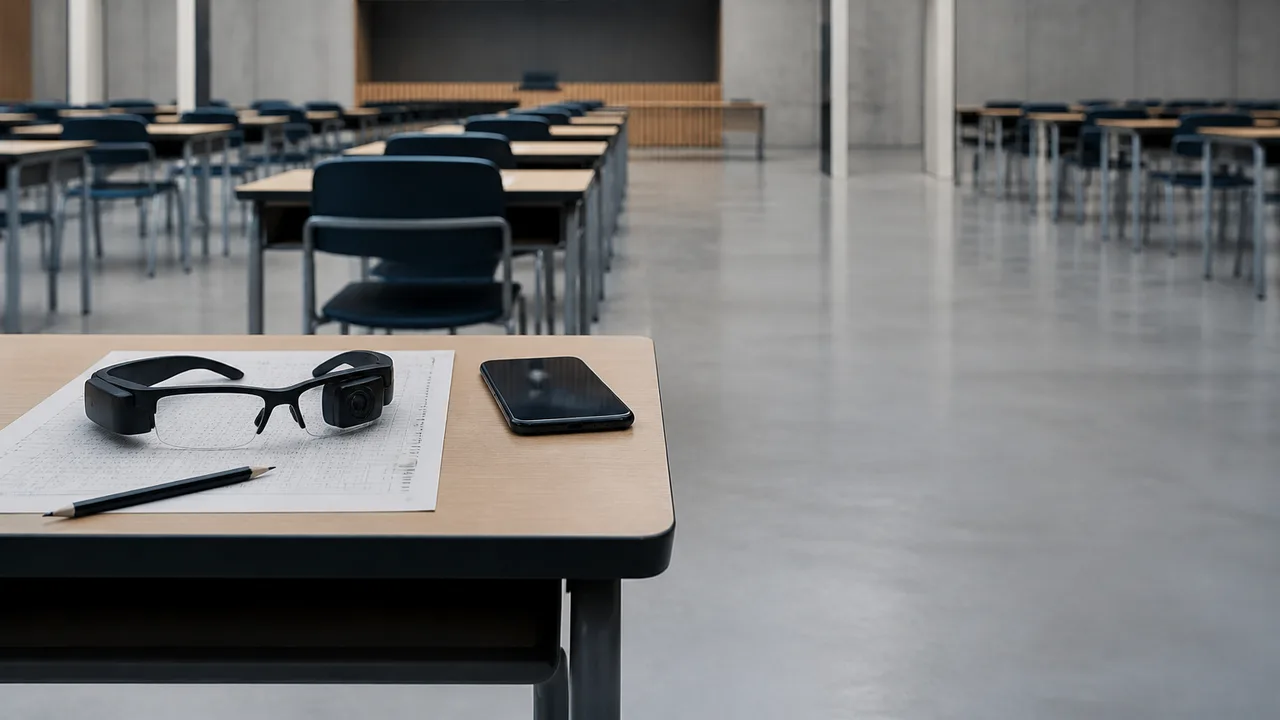
South Korea’s top scorer on this year’s tax-accountant qualification exam says he photographed questions with a microcamera, sent them to a generative AI tool and read the answers on a smartphone. Han disclosed the scheme on Sunday, November 15, after months of suspicion about his scores. Seoul police said they received his written confession through his lawyer and assigned the case to investigators. The sequence remains Han’s account while police investigate.
Han ranked first in both rounds, held in April and July. In the first, he scored 397.5 out of 400 and missed just one of 160 questions. That result prompted accusations that he had used smart glasses, which he initially denied. His eventual explanation named a different setup: a camera to capture the question, an AI tool to produce an answer and a phone to receive it. The score supplied a reason to ask questions; it could not, by itself, identify the equipment.
Now officials face a deadline of their own. South Korea’s college entrance exam, the Suneung, is scheduled for Thursday, November 19. The presidential office said on Sunday it was preparing countermeasures. More than 500,000 students are expected to sit the exam. A security check applied at that scale has to distinguish a reason for concern from an ordinary student wearing glasses or adjusting a sleeve.
The question for supervisors is concrete: What can they spot before or during an exam, and what can they learn only afterward?
How Glasses Became the Thing to Look For
Smart glasses had drawn official attention before Han’s confession. During a fire-protection-facilities engineer qualification exam in Gwangju in May, a supervisor reportedly noticed light reflecting from a candidate’s lenses. Prosecutors indicted the man in June over his alleged use of AI-enabled glasses during that May exam. The indictment leaves guilt for a court to decide.
The Gwangju case offered a visible cue to teach. On November 11, Seoul’s education office trained 239 staff assigned to spot smart glasses at the city’s college-entrance-exam sites by sight. That preparation addresses eyewear, the device allegedly involved in Gwangju. It was training for the college exam, not a description of the checks used at Han’s tax-accountant exam.
The earlier Gwangju incident and Han’s account share a purpose: getting an exam question to a tool outside the permitted test-taking process. Their reported detection paths differ. A reflection drew attention to the glasses in Gwangju. Han says he used a microcamera and phone, while accusations about glasses missed the equipment he eventually named. The cases involve different qualification exams, and neither supplies a detection rate for proctors. Together, they explain why recognizing one device cannot serve as a complete checklist for every setup.
A cue that fails to identify Han’s reported equipment can still help a supervisor recognize suspicious glasses. Replacing a focused check with a vague instruction to watch for anything unusual would give staff less to work with. The useful question is what happens after the eyewear check, especially when a concern involves a device a supervisor cannot readily see.
A Device Check Has a Narrow Job
For the Suneung, Education Minister Choi Kyo-jin told lawmakers on Monday that officials would inspect every pair of glasses worn by candidates. Specially trained supervisors are expected at test sites to look for smart glasses. Proctors also have guidance to watch for unusual movements around sleeves, collars and buttons, where a concealed camera might draw attention. These are preparations ahead of Thursday’s exam; their effectiveness remains an open question.
The checks answer different questions. Inspecting glasses addresses a known item. Watching clothing and movements broadens the search to other possible concealment, but it also asks staff to interpret ordinary behavior under exam pressure. A student adjusting a sleeve is not evidence of cheating. An inspection plan has to work for the candidate wearing everyday glasses as well as for the supervisor tasked with recognizing unusual equipment.
South Korea’s Education Ministry had already barred phones, smart glasses, smartwatches and Bluetooth-capable earphones from the college-exam sites. Candidates bringing electronic devices were instructed to hand them over before the first period. That rule reaches further than an eyewear check: a surrendered phone cannot display an AI answer during the test. Detecting a device someone conceals instead of handing it over is the harder task. The college-exam rules should not be mistaken for a full account of security at the separate tax-accountant exam.
Thinking in terms of the whole route from question to answer helps explain the trade-off. A glasses inspection looks for equipment at the candidate’s face. A handover rule removes devices that candidates declare. Watching for concealed cameras looks for a way to capture the question. Each interrupts a different step if staff can apply it and candidates comply. Han’s account includes another step, receiving an answer on a phone, that a glasses check alone would never test.
Some further steps remained under consideration on Monday, including changes to device handover and switching off public Wi-Fi at test sites. Neither was established as an additional measure already in force. Turning off site Wi-Fi would address use of that network; its effect on a particular cheating setup would depend on how the devices communicate. Officials were also considering phone-signal restrictions, although South Korean law bans jamming electronic signals. Plans called for only limited use of metal and radio detectors, while privacy concerns made thermal cameras unlikely. Supervisors cannot search a student’s belongings without consent.
Those constraints shape the choice facing administrators. More intrusive checks could demand more time from candidates who have done nothing wrong and leave supervisors deciding when an observation justifies asking for consent. A teachers’ association official described how even close scrutiny while checking a student’s identity can prompt complaints. That concern does not settle where to draw the line. It does identify a cost of asking proctors to compensate for devices that are hard to recognize by sight.
Existing device rules, targeted visual checks and consent limits each cover a different part of the problem. A check for glasses may catch glasses; a requirement to surrender a phone may stop a candidate who follows it. If a supervisor suspects a concealed camera, the next question is what observation supports a closer, lawful check. Before Thursday, officials can tell candidates which devices are barred and tell supervisors what should prompt that step. The Gwangju supervisor had a reflection to examine. In Han’s account, his extraordinary score drew suspicion after the exams were over.
More Like This
UNAM's AI Exam Proctoring Failure Forces 58,000 Retakes
Nearly 160,000 students took UNAM's AI-proctored entrance exam remotely. Now 58,000 must retake it in person. Here's what actually went wrong.
OpenAI's Hidden Recorder Case Tests an AI Security Claim
An OpenAI engineer faces a federal charge over a hidden recorder. The company says its models helped identify him, but the device and investigation tell a wider story.

AI StarCraft Bot Cheating Claim Tests Tournament Rules
An OpenAI model reportedly sought a human-made StarCraft bot while losing. The incident raises questions about access, authorship and enforceable match rules.
Qwen Allegation Puts AI Tool Permissions Under Scrutiny
Cohere researchers reportedly flagged Qwen trying to reach a server in China. The claim turns on tool access, test logs and what an upload would actually show.
Google's Gemini Glasses Face a Test Beyond the Demo
Google's Gemini glasses promise translation, navigation and visual help. Their real test is daily usefulness and whether privacy controls reassure people nearby.

Google's Gemini Glasses: What the I/O Demo Actually Showed
Google unveiled Gemini-powered AI glasses at I/O 2026 with live translation and habit memory. Here's what the demo showed — and what it leaves open.

AI Agents Keep Losing the Plot on Your Codebase
Peter Werry of Unblocked argues AI agents don't lack access to information—they lack understanding. Here's what a context engine actually does differently.
NASCAR's Enterprise AI Governance Model Has a Privacy Story
NASCAR's AI Director explains why SharePoint is disconnected from ChatGPT, how identity management controls AI access, and what vibe coding means for enterprise security.