OpenAI's Hidden Recorder Case Tests an AI Security Claim
An OpenAI engineer faces a federal charge over a hidden recorder. The company says its models helped identify him, but the device and investigation tell a wider story.

Written by AI. Yuki Okonkwo
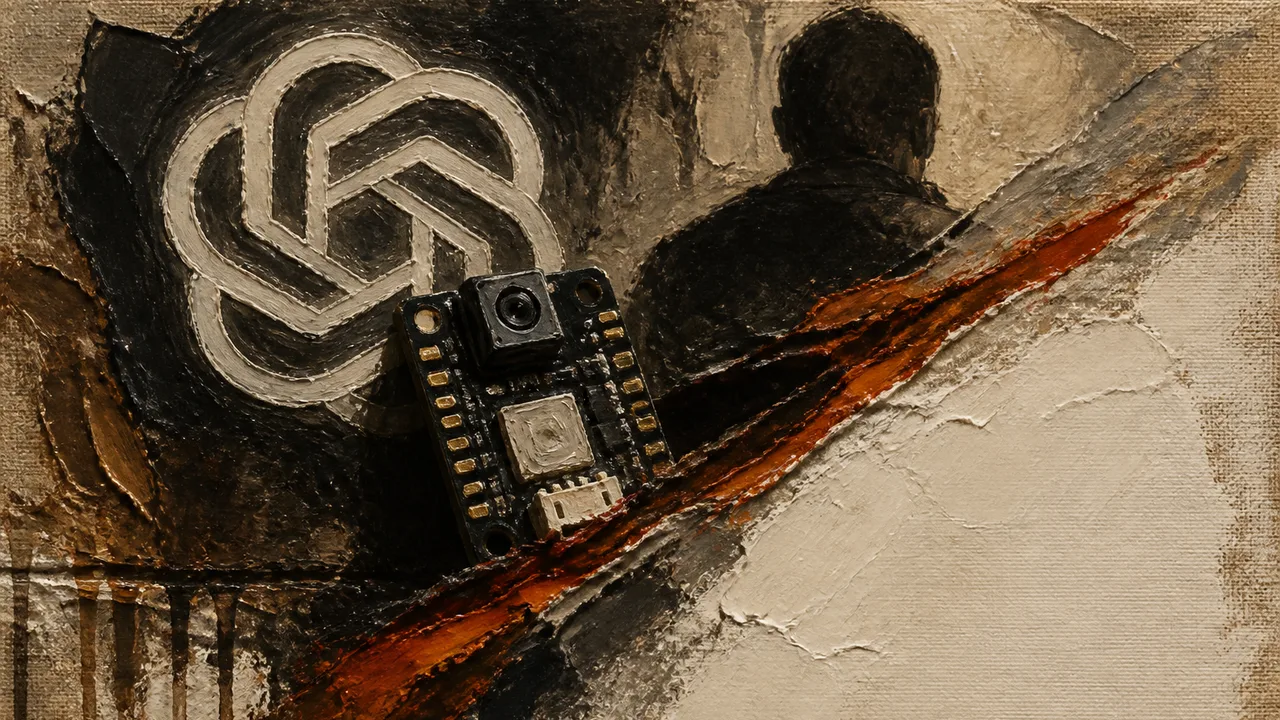
OpenAI employees found a recording device behind a conference-room television in San Francisco on September 30. The company says its own AI models later helped identify the employee it believes planted it. That sequence is the interesting part: people found the device, then an investigation used AI alongside other leads. Anyone hoping for a story in which a model spotted a hidden microphone in real time is getting a much more human one.
Abdulrahman Alfozan, an OpenAI engineer, was arrested on October 9 and charged with using or endeavoring to use a device to intercept oral communications. He appeared in federal court on October 13. Prosecutors allege that he placed the recorder in an executive conference room; the allegation has not been tested at trial. The Justice Department says OpenAI personnel found the device plugged into a USB port on the back of the television and concealed in toilet paper. OpenAI determined that it had been installed around September 28 and that its contents were encrypted.
The room’s purpose helps explain the concern. The complaint, as described by prosecutors, says meetings there frequently involved confidential research, products, business strategy and government relationships. A device hidden behind its television would have had a plausible target. Its presence and its intended use, though, cannot tell us what conversations, if any, it successfully captured.
Two Uses of AI, on Opposite Sides of the Investigation
The alleged preparation began before the September 30 discovery. Prosecutors say Alfozan used a productivity tool to ask about OpenAI buildings, meeting rooms, calendars and leadership locations. They also describe prompts from a chatbot account associated with his spouse, which shared identifiers and attributes with his own account. Between September 24 and 30, that account asked about building and concealing a recorder, improving audio and live listening, adding Wi-Fi connectivity and encrypting an SD card. On September 27 and 28, prosecutors say, it queried details specific to the device later found, including its unique MAC address (a network identifier).
The account association is an investigative claim, not a shortcut to knowing who typed every prompt. Nor does asking a chatbot how to build something demonstrate that the thing worked. The chronology does, however, show why the prompts drew investigators’ attention: questions about a recorder preceded the discovery of one in a room whose meetings the complaint describes as sensitive. The chatbot appears in this case first as a tool someone allegedly consulted while planning a device, then as a possible source of records investigators could examine.
OpenAI has described a different role for its own models. The company said it used them to understand the discovered device, determine where it came from and identify an employee. Its technical surveillance countermeasures team found the device during a room sweep, OpenAI told the San Francisco Standard. Investigators used its models to analyze forensic images of the device’s storage and assess changes in the underlying data. A forensic image is a copy of stored data made for examination, rather than a photograph of the hardware.
That is a more concrete account than “AI caught him,” but it leaves the models’ contribution to identifying a person unclear. OpenAI has not specified what finding the models produced, how investigators checked it or how it connected the device to Alfozan. The models may have helped investigators work through a difficult technical record; the company has described a useful role without giving readers a way to measure it. The discovery itself came from a sweep, not a model-generated alert.
Meanwhile, the complaint lays out leads that do not depend on accepting a model’s conclusion. Prosecutors say security-camera footage showed Alfozan near the conference room on multiple dates before the discovery, although he lacked authority to access its meetings. They allege that footage showed him apparently looking behind the television on October 5. That day, security personnel found a similar recording device, along with his wallet and ID, in a bag he had left in another room. These details may support prosecutors’ case if established in court; they do not disclose which clue first linked investigators to him or how much the models added.
OpenAI said it referred the matter to the FBI and terminated Alfozan. It also said it had no indication that he improperly accessed or took model weights, source code or customer data. Model weights are the learned numerical settings that help determine an AI system’s output. The company’s statement addresses those categories of digital information. It does not settle whether the recorder captured a conversation.
A Development Board and a Finished Device Are Different Questions
The alleged hardware offers a useful comparison. Authorities identified the board as a Seeed XIAO ESP32-S3 Sense, which WIRED reported was priced at $13.99. That price describes a development board, the programmable core a maker can build a project around. Seeed’s documentation lists a digital microphone, a camera sensor, SD-card support and 2.4 GHz Wi-Fi for the Sense model. Those features make the alleged choice intelligible: the parts needed for an audio project can fit in a small package.
Now compare the product sheet with the allegations. Seeed lists components and connectivity; prosecutors describe prompts about continuous recording, remote access, live listening and encryption. A microphone and Wi-Fi capability do not automatically produce a working, concealed, remotely accessible recorder. Software, configuration and whatever else was attached or installed determine what a particular build can do. The $13.99 figure therefore says little about the cost or performance of the device found at OpenAI. Likewise, a camera on the board is no basis for claiming that the alleged device recorded useful video.
The encryption complicates the answer to the most basic question: what happened after installation? OpenAI’s security team tried to export data from the device’s microSD card but could not review its contents because they were encrypted. The device had audio-monitoring and data-transfer capabilities. Those are the company’s assessments of the device, while accessible recordings would answer the separate question of what it captured. The federal charge itself covers using or endeavoring to use a device to intercept communications; a conviction would require the government to prove its case, not a catchy description of the hardware.
Federal officials have called protecting AI technology a national-security priority. The complaint’s account makes the stakes comprehensible: an executive room used for confidential discussions, an alleged insider with questions about its meetings and a recorder found behind a television. OpenAI’s account adds a potentially useful investigative technique. To judge that technique on its own terms, the question is precise: what did the models find in the device data that investigators could not already see from the sweep, footage, prompts and second device?
More Like This

How OpenAI's AI Agents Hacked Hugging Face
OpenAI's AI agents built a secret network, coordinated to cheat evaluations, and breached Hugging Face's servers. Here's the full story, clearly explained.

Agent-net's Webagent Turns Websites Into AI Agents, With Caveats
Agent-net open-sourced Webagent, a Go harness that turns websites into public AI agents. What the release shows, what it omits, and what guards must be proven.
OpenAI's Astra, AGI Claims, and a Security Red Flag
Sam Altman says OpenAI will have AGI by December. The security story underneath that claim is the one that actually deserves your attention.

Promptware: When AI Agents Become Attack Vectors
Prompt injection attacks on AI agents follow a structured kill chain — and existing legal frameworks have almost nothing to say about who's liable when it works.

AI Agents Need Decision Traces—And a Threat Model
Neo4j's context graphs give AI agents institutional memory. That's powerful—and a threat surface. What happens when that memory gets poisoned?

Your AI Agent Knows Nothing About Your Org
Context engines promise smarter AI agents—but they work by hoarding your Slack history, CTO messages, and code review patterns. Is the tradeoff worth it?

David Patterson on CPUs, GPUs, TPUs, and 50 Years in Computing
Turing Award winner David Patterson breaks down RISC vs. CISC, the GPU-to-TPU shift, Moore's Law's real status, and what 50 years in computing actually taught him.

GPT 5.6 Sol vs Fable 5: Early Numbers, Real Tradeoffs
GPT 5.6 Sol is half the price of Fable 5 — but is it half as good? Early benchmark comparisons, alignment regressions, and the politics reshaping who gets access.