Sapporo Moves Non-Alcoholic Beer Production to the US Over Tariffs
Sapporo will shift some non-alcoholic beer production from Canada to the US as tariffs change factory economics. A close look at what the move costs and signals.

Written by AI. Alex Volkov
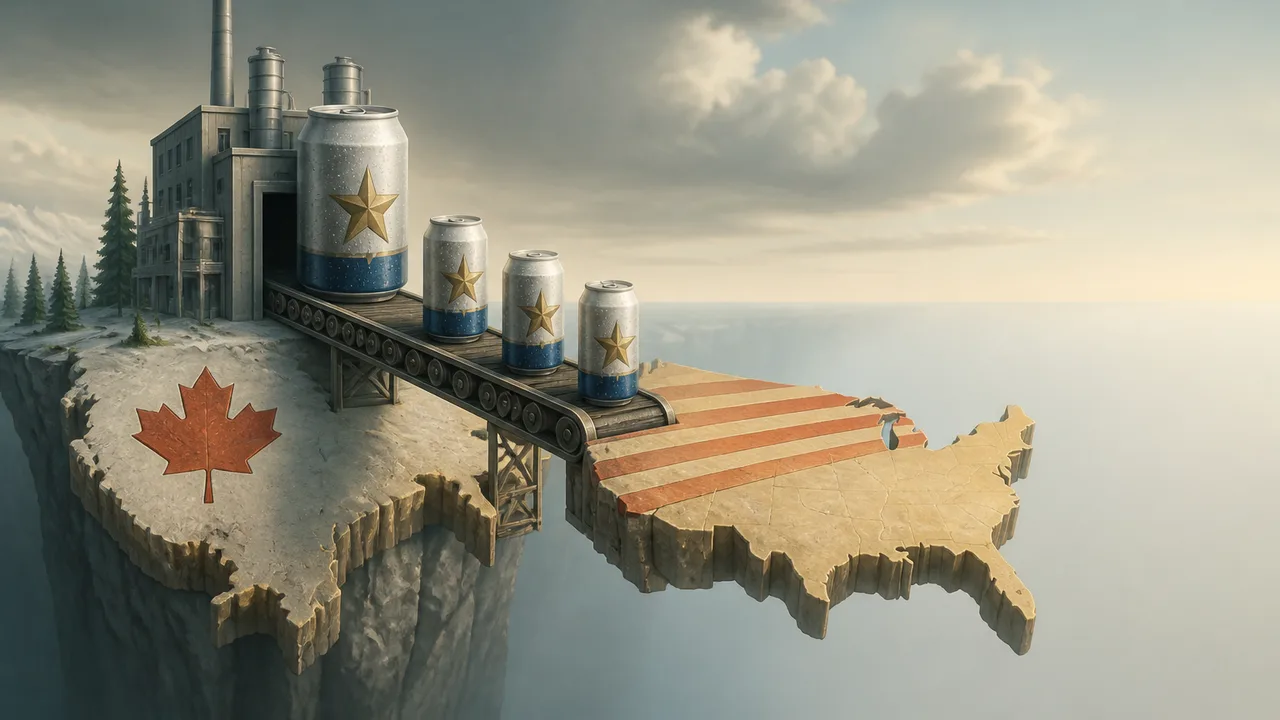
Sapporo plans to move some of its non-alcoholic beer production from Canada into the United States, citing tariffs that have raised the cost of serving the North American market, according to BBC News.
The specifics: a Japanese brewer, making beer in Canada, largely for American drinkers, moving the line south because of trade policy. Beer is about as local as consumer supply chains get. Water, malt, hops, cans. Almost none of it crosses an ocean. And yet a tariff schedule just redrew a factory map.
That is why this case is useful even if you never touch a Sapporo product. It shows how tariffs now work on companies that did everything "right" by the old rules of regional manufacturing.
The Economics the Headline Skips
Relocating production reduces tariff exposure. It also creates a bill of its own: new equipment, new labor, new logistics, new regulatory compliance, and the risk of running facilities below efficient scale. According to the BBC report, the company is weighing exactly that trade-off for one product category rather than its whole portfolio.
In practice, this math lands on a spreadsheet long before it lands in a press release. A plant manager runs something like this: tariff cost per case at current volumes, minus incremental unit cost of producing in the new location, minus the utilization hit on the facility being partially abandoned. Utilization is the ugly term. A brewhouse designed for full-capacity runs gets expensive per unit the moment you siphon volume elsewhere, because fixed costs spread across fewer units. That is the piece of tariff policy nobody puts in a press release, and it usually decides these calls before the tariff line does.
Then the residual costs get distributed. The company absorbs some in margin. Suppliers lose volume commitments. Workers face shifted hours or, in the worst case, redundant roles at the underused facility. Consumers see some of it in price. None of those costs vanish; they get reallocated. Economists call the phenomenon cost incidence, and it is the unglamorous core of every tariff debate: the party who writes the check and the party who bears the cost are usually different parties.
The BBC reporting lays out this trade in those terms: lower tariff exposure on one side, relocation costs and sub-scale risk on the other, with the burden shared across company, suppliers, workers, and consumers.
Why One Product Category First
Sapporo is starting with non-alcoholic beer rather than its core lager, per the BBC. The strategic logic is legible even without inside information. Non-alcoholic beer runs on smaller volumes than a flagship lager, so the fixed costs of moving it are lower and the downside is capped. It is the product line where a company can run a live experiment in reshoring without betting the flagship.
Market context supports the choice: non-alcoholic beer has been one of the faster-growing beer segments in developed markets in recent years, a trend widely reported across beverage industry coverage, though volume figures vary by market and I would treat any single growth claim with caution. Growth segments attract exactly this kind of capacity jockeying, because being tariff-disadvantaged in a rising category compounds over time.
The site-selection question follows. Modern manufacturers score locations on a weighted matrix: labor cost and availability, energy, freight-to-customer, tax treatment, and, increasingly, tariff exposure on both inbound inputs and outbound finished goods. Sapporo's move suggests tariffs have moved up that weighting, at least for North American capacity decisions.
What the Record Does Not Tell Us
Some caveats before anyone extrapolates. The available reporting does not specify which facilities are involved, the timeline, the investment size, or whether any Canadian jobs will be lost or merely repurposed. The BBC article describes the plan at the category level; the operational detail is not yet public.
Nor do we know the counterfactual. Sapporo might have shifted production anyway for logistics reasons. Tariffs may be the trigger, the accelerant, or the convenient justification. Companies rarely publish that decomposition, and the reporting does not settle it.
The Broader Pattern to Track
The open question is whether this stays a one-off or becomes a template. If other brewers and beverage makers with Canadian or Mexican capacity start US-ifying their footprints, tariff policy will have accomplished what decades of tax incentives mostly failed to do: made cross-border production arbitrage expensive enough to unwind, costs be damned.
Three signals would tell you it is generalizing. First, other multinationals filing similar capacity-shift announcements for small product lines, the same beachhead strategy Sapporo appears to be using. Second, contract manufacturers and co-packers in the US adding capacity specifically to catch this demand, which would show up in capex announcements before it shows up in trade data. Third, Canadian provincial governments offering retention incentives to keep existing plants running above threshold utilization, because a half-empty brewery is a political problem before it is an economic one.
Of those, the co-packer buildout is the cleanest signal.
A tariff is a price on a border crossing. A factory move is a decade-long bet on where that price is heading. When brewers start paying the second cost to avoid the first, tariff policy has stopped being an accounting item and started being a map.
More Like This

Supreme Court Blocks Trump's Bid to Fire Fed's Lisa Cook
The Supreme Court's 5-4 ruling blocking Trump's firing of Fed Governor Lisa Cook is a win for central bank independence—but a narrow, provisional one.
Trump's Generic Drug Tariffs: Reshoring or Price Shock?
Trump plans 100% tariffs on generic drug imports from 2028, rising to 200% in 2029. What that means for drug prices, supply chains, and India's pharma industry.

MIT's Blockchain Course Asks the Questions VCs Won't
MIT economist Robert Townsend's new blockchain course asks what distributed ledgers actually solve—a question the startup world has largely avoided answering.

Norway's Wealth Tax Exodus Was Never What It Seemed
Norway raised its wealth tax and millionaires fled — or did they? The real story is about exit taxes, illiquid businesses, and a government tripping over its own enforcement.
How to Hire for Roles You've Never Done
Ryan Deiss paid a $200K CFO who was really a bookkeeper. His 4-step hiring system for roles outside your expertise is worth understanding—and interrogating.
Neros Plans to Build One Million Drones a Year
Neros CTO Olaf Hichwa on scaling drone production to 1M units annually, building for operators not bureaucrats, and why the US is losing the manufacturing race.

Verda Raises €124M to Build European AI Cloud
Helsinki's Verda has stacked €124M in funding across two raises to build AI cloud infrastructure on clean Nordic power. Here's what the capital structure signals.

Quaise Energy Is Vaporizing Rock to Reach Geothermal Heat
Quaise Energy has raised $234M to drill geothermal wells using fusion-derived energy beams. Here's what's real, what's unproven, and what's at stake.