Sal Khan on MIT OpenCourseWare and Free Education
Sal Khan reflects on how MIT OpenCourseWare inspired Khan Academy—and makes a case for open education as one of society's highest-leverage investments.
Written by AI. Ellis Redmond

Photo: AI. Saskia Aaltonen
Around 1999 or 2000, a guy working at a San Francisco startup came across a press release. MIT, he read, was going to record its lectures, digitize its problem sets, and just... give it all away. No tuition. No degree program. No for-profit partner taking a cut. Just: here's what we know, world. Take it.
That guy was Sal Khan, and he hadn't yet become the Sal Khan. He was just an MIT alum at a startup, reading something that apparently stopped him cold.
Khan recently sat down with MIT OpenCourseWare as part of their documentary The Courage to Be Open, and the extended interview footage is worth spending time with—not because it's a feel-good origin story (though it is that), but because it surfaces some genuinely interesting questions about what "free education" actually costs, what it can and can't do, and whose interests it ultimately serves.
The Fork in the Road That Nobody Took
Khan's recollection of the late-'90s internet is useful context. The technology to distribute educational content online existed. Universities knew it. What they chose to do with it, though, was almost universally the same: monetize. Partner with for-profit institutions. Sell online degrees for tens of thousands of dollars.
That was the obvious move. It made sense. It still makes sense, if you're running a university with operating costs and a board.
What MIT did instead was stranger. Khan describes it as an institution choosing to act on principle—recording everything and releasing it free, at its own expense. "MIT, on its own dime, on principle, is just going to record all of their lectures, all their problem sets, and share them with the world on principle," he says. The repetition of "on principle" isn't accidental. It's the part that got him.
The open education movement has always been a little philosophically awkward. Knowledge, the argument goes, shouldn't be a commodity—it should flow freely, like water, like air. But of course someone has to dig the wells and lay the pipes. MIT OpenCourseWare has operational costs. Khan Academy, as Khan is careful to note, is not actually free to run: "our budget is not a joke now, it's approaching a hundred million dollars." His comparison is pointed—that's roughly what a single large American high school costs to operate, for an organization with, as he puts it, "the charter of educating humanity."
The tension here is real. Free-at-the-point-of-use isn't the same as free to produce. Both MIT OpenCourseWare and Khan Academy run on philanthropic funding, which raises its own questions: whose priorities get funded? Which subjects? Which languages? Which populations? Philanthropy is not neutral. It has a direction.
The Origin Story, With a Good Joke in It
One of the more charming moments Khan describes is his early attempt to simply donate Khan Academy to MIT OpenCourseWare. He was an alum. It seemed logical. Their response: you're not a professor here.
It's a funny anecdote—and also quietly illustrative of how institutional structures work, even in open-education contexts. The impulse was "let's merge this with the bigger thing that inspired it." The reality was: these are different organizations with different governance, and that's not how any of this works.
What happened instead is that Khan turned down venture capital—and he's explicit that the money was available—specifically because of the OpenCourseWare example. "If MIT could stand on this principle that certain things should just be free and available to the world, I want to stand for that same principle." Khan Academy incorporated as a nonprofit. Whether that decision has constrained or enabled what the organization can do is an interesting question that the interview doesn't fully explore, but it's sitting there underneath the surface.
The "Hidden Einstein" Argument
The most philosophically loaded part of Khan's interview is what I'd call the hidden Einstein argument. He's made a version of this claim publicly before, and it's become something of a cornerstone belief in the open education movement:
"For every Albert Einstein that we knew about, I guarantee you there were 50 that never got invested in and could have cured a disease or pushed the frontiers of physics, but that potential was lost."
It's a compelling frame. And it's probably true in some meaningful sense—human potential is almost certainly not distributed according to who has historically had access to good education. The correlation between "people who changed the world intellectually" and "people who had access to elite institutions" is more about the institutions than the people.
But the argument also does some work that's worth noticing. It reframes the case for free education away from pure altruism—helping people because people deserve help—and toward enlightened self-interest. We should invest in educating orphans in Mongolia and incarcerated people in the United States not just because it's the right thing to do, but because one of them might cure cancer.
Khan says this directly: "This isn't just an altruistic thing. I think it's in all of our best interest."
That framing is strategically shrewd—it speaks to donors and policymakers who might not be moved by pure equity arguments but respond to ROI. But it also quietly subordinates the value of a person's education to their potential future contribution. A kid in rural Alaska getting access to calculus has intrinsic value whether or not they go on to revolutionize physics. That case doesn't quite get made.
What Khan Got Right About Leverage
Whatever you think of the framing, Khan's underlying intuition about education as a leverage point is hard to argue with—and his teenage reasoning about it is surprisingly sophisticated.
He describes standing at a crossroads at MIT, weighing whether to pursue research versus teaching. His logic: the odds of him personally discovering the next major theorem were low. But if he could teach enough people well enough, "one of them will for sure cure a disease or come up with some new theorem." It's a multiplier argument, and it's the kind of thinking that actually drives the math on impact.
The scale numbers he points to for open education are genuinely staggering. MIT OpenCourseWare and Khan Academy, combined, reach hundreds of millions of people. The marginal cost of reaching the hundred-millionth user is effectively zero once the content exists. That's a fundamentally different economics than a classroom, or even a textbook.
The question that doesn't get fully answered—here or generally—is whether access to content is the same thing as access to education. Watching a lecture from an MIT professor is not equivalent to sitting in their class, doing problem sets with feedback, getting office hours, having peers who challenge you. The research on what actually drives learning outcomes is messier than the democratization narrative sometimes acknowledges. Access is necessary. It's not sufficient.
Khan's account of MIT OpenCourseWare's influence is genuine—you can hear it in how he tells the story, the specificity of the memory, the slightly nervous energy of someone recounting something that actually mattered to them. And the through line he draws is real: an institution making a principled choice, a young engineer noticing, an organization built in its image.
What's worth sitting with is the size of the claim underneath all of it. Free access to world-class educational content is, by any reasonable measure, a good thing. But the problems Khan lists—war, hunger, racial disparities, women's rights—are not primarily problems of insufficient access to information. They are problems of power, resource distribution, and political will. Education is a lever, but levers need somewhere to stand.
Fifty hidden Einsteins is a haunting idea. It's also worth asking what happens to the other billions of people who don't cure diseases—and whether their education matters just as much anyway.
More Like This
Spotting Bad Dating Advice on Social Media
Discover how social media skews dating advice and learn to find reliable, evidence-based relationship guidance.
The Power of Starting Conversations with 'What'
Discover how asking 'what' instead of 'why' can transform communication and influence.
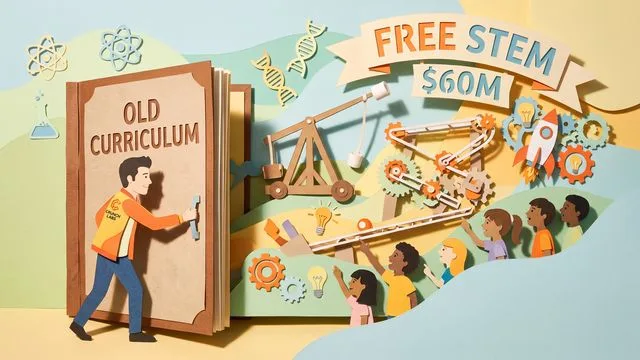
Mark Rober's $60M Free Science Curriculum Bet
Mark Rober is spending $60M to give free STEM curriculum to every teacher in America. The education bet is the headline. The business story underneath it is what caught my eye.
Linear Algebra Finally Explained Without the Gatekeeping
A DIBEOS video makes linear algebra intuitive for adults who bounced off it in college. Here's what it gets right — and one thing worth questioning.
Thoughtful Leadership: Stoute's Key Principles
Explore Steve Stoute's three principles of leadership: core values, embracing conflict, and fearlessness.

How Optimization Powers Modern AI and Engineering
From training ChatGPT to imaging black holes, optimization is the hidden engine behind modern AI and engineering. Steve Brunton's lecture explains how.

How to Stop Losing Time Without Realizing It
Not a time management overhaul—just a clearer look at where your hours actually go, and what's worth doing about it.

Healing After Betrayal: The Psychology of Shame and Recovery
Being scammed or betrayed triggers shame, not just anger. Here's what the psychology of betrayal recovery actually looks like—and why self-blame is the wrong starting point.