Ray Gunn Turns Social Allegory Into a Detective Story
Brad Bird’s animated noir gives Metropia rules for aliens and a pop star caught in a corporate machine. Its sharp details raise harder questions than its mystery answers.

Written by AI. Devon Quincy
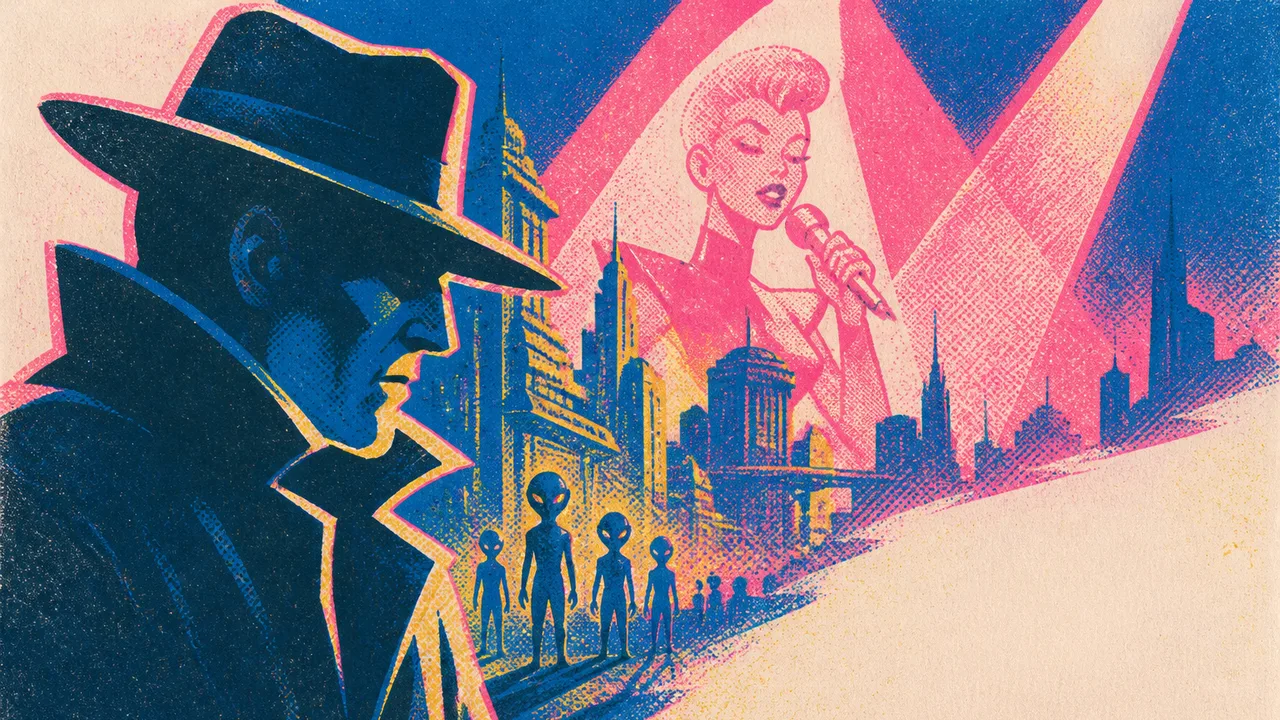
Brad Bird’s Ray Gunn gives Metropia’s aliens their own hospitals while its humans use other facilities. That rule does more work than a speech about prejudice could: it tells us who can walk through a door, who must go elsewhere and how ordinary an injustice has become to the people living with it. It also poses a question for Bird’s animated detective story. Once private eye Raymond Gunn starts following clues through this city, will he find out how its rules work, or simply pass through them?
Ray Gunn premiered at the London Film Festival on October 10. It is scheduled for select theaters on December 4 and Netflix on December 18. Sam Rockwell voices Ray, Tom Waits voices his one-eyed alien partner Eye-Ra, and Scarlett Johansson voices Venus Nova, a pop star whose affairs pull the detectives toward murder and corporate intrigue. Metropia mixes private-eye patter with flying cars, jetpacks and holographic advertising. Bird gives a familiar detective an unfamiliar place to investigate.
The hospital rule is part of a larger arrangement: aliens perform manual labor and cannot enter certain human facilities. A mystery can make that arrangement unusually clear. It sends a character between workplaces, offices and neighborhoods, testing which doors open for whom. Ray’s partnership with Eye-Ra also puts a human and an alien in the same investigation, where their different standing in Metropia might affect what each can do.
One of the film’s most pointed images makes the pressure to fit in almost painfully literal. An alien business magnate tucks her extra appendages into a two-armed suit. The costume suggests that success has a dress code built for somebody else’s body. Elsewhere, aliens are refused medical treatment because of their appearance, yet some move through society as apparently integrated members. Those differences could make for a convincing city with uneven privilege. The question is whether Ray Gunn gives viewers enough to understand why one alien can belong and another cannot.
The investigation begins near that question. Ray’s case involves a lawyer working on immigration matters and documents forged for extraterrestrials. The film also has him use the term “illegals” for those aliens. A forged document is useful plot equipment, but it points beyond the immediate puzzle: someone in Metropia has the authority to decide whose papers count. The term Ray uses suggests how casually a person can become a category. If that strand recedes as the mystery grows, the city keeps its visible signs of exclusion while the mechanism behind them stays harder to grasp.
That is one way to understand the film’s competing demands, rather than a reason to demand a civics lesson from a cartoon detective. Bird has an elevator struggle over a gun and a car chase up the side of a building. The action promises speed; the alien characters invite questions that take longer. Eye-Ra can help solve Ray’s case without the story stopping to explain every rule governing Eye-Ra’s life. But as the immigration plot and unequal treatment accumulate, those rules begin to carry more weight than background decoration. A viewer who enjoys the chase may still want to know what changes for the people the detective passes on his way to the next clue.
There is a generous reading of this approach. Film noir has room for a city that feels compromised before anyone can draw a complete map of its compromises. Ray works with Eye-Ra despite the prejudice around them. An alien magnate can hold power and still feel compelled to hide part of herself. Those details resist an easy division of Metropia into two uniform populations. They let the setting do some thinking through character and design, even where the mystery does not pause to spell out its politics.
The harder reading starts at the same images. A separate hospital, a hidden appendage and a forged document suggest different forms of exclusion, each with its own cause and consequence. If the plot treats them chiefly as clues or striking sights, viewers may leave with a strong impression of unfairness and a weaker sense of what sustains it. That concern grows when the story turns toward Venus Nova. Her public image fills Metropia’s holographic ads, while her case brings corporate offices into Ray’s path. The late story takes up the power of entertainment conglomerates over artists, adding control of a star’s work and image to the film’s questions about who gets to move freely.
These strands can speak to each other. Metropia’s aliens must accommodate institutions built around humans; Venus’s celebrity can be shaped by the business that sells it. Both situations concern people negotiating systems with more power than they have. The analogy has a limit: an excluded worker and a famous performer face different risks, and the film’s corporate plot does not explain its hospital rule. What connects them is a question about who sets the terms under which someone else may participate. The detective format could make that question concrete, one encounter at a time, even if its sprawling case sometimes pulls attention elsewhere.
Ray Gunn has carried its detective-and-jetpack premise across decades. Bird had been thinking about the project for years before Skydance Animation signed it in 2021. The film arrived at the London Film Festival in 2026 with an old-fashioned private eye navigating advertising technology and a celebrity business. That history helps explain the pleasure of the design: the setting imagines a future from an earlier era, so a hologram can feel at home beside Art Deco curves. The long development does not, by itself, tell us when the immigration or corporate themes entered the story. It does make their placement beside the durable noir machinery an especially revealing choice in the finished film.
Noir gives Ray a reason to enter places where powerful people would prefer him gone. It gives the audience the pleasure of finding out what a glamorous city has concealed. Ray Gunn extends that promise to a pop star and her corporate world, while Metropia’s aliens live with restrictions that are visible before the mystery is solved. The film’s most useful question may survive its final revelation: after Ray finds out what happened to Venus Nova, who can walk into the hospital?
More Like This
Johnny Thunder: The Rise and Fate of LEGO's First Hero
How Johnny Thunder became LEGO's first original hero in 1998—and what the Adventurers theme reveals about branding, licensing, and toy storytelling.
When ABS Challenges Go Wrong: A Rules Breakdown
Umpire Carlos Torres denied two ABS challenges in one A's-Orioles game. Here's what the tape reveals about a protocol still working out its kinks.