The Psychology Behind Elite Athletic Performance
Dr. K of HealthyGamerGG breaks down the mental mechanics of Jordan, Kobe, Phelps, Brady, and Woods—and what they reveal about motivation, fear, and agency.

Written by AI. Ellis Redmond

Photo: AI. Renzo Vargas
We are obsessed with how elite athletes think. Not just because we want to win things, but because most of us are quietly struggling—with motivation, with consistency, with the gap between what we intend to do and what we actually do. So we watch interviews. We mine their quotes for instructions. We want the formula.
Dr. K (psychiatrist Alok Kanojia of HealthyGamerGG) recently spent nearly 30 minutes doing something more interesting than serving up the usual inspiration. He played clips from Michael Jordan, Kobe Bryant, Michael Phelps, Tom Brady, and Tiger Woods—and then pulled them apart mechanistically, looking at why certain mental approaches work, when they don't, and for whom. The result is less a how-to than a genuinely useful map of the terrain.
It's worth spending some time on that terrain.
The Jordan Problem
Dr. K opens with Michael Jordan's notorious chip-on-the-shoulder motivation—being cut from his high school varsity team and spending the rest of his career proving people wrong. Jordan's entire competitive identity was built on grievance. Dr. K calls it, plainly, a "non-optimal strategy."
His reasoning is worth following carefully, because it's not the obvious critique. The problem isn't ego per se. It's structural: outcome-oriented motivation is brittle. If you study for an A and get a B, the behavior often doesn't get reinforced. You're less likely to study hard again. The reward circuit requires the reward. The Harvard Law analogy he offers is quietly devastating—take the kids who've always been the smartest in the room, make them average overnight, and watch imposter syndrome bloom. They got to the top. They found out the top has a top. The motivation, which was being the best, suddenly has nowhere to go.
Then there's the harder question Dr. K doesn't fully resolve, which I find more interesting than if he had. He notes it's genuinely unclear whether Jordan was made by his chip-on-the-shoulder mentality, or whether he simply had the talent to survive it. "Is he Jordan because he believed that, or can he get away with believing that because he's Jordan?" That's not a rhetorical question. As a framework for evaluating advice, it's one of the more important ones you can ask.
What Kobe Actually Said
Kobe Bryant, in the clip Dr. K plays, is asked whether he's the type of player who loves to win or hates to lose. His answer: neither.
"I play to figure things out. I play to learn something. Because if you play with the fear of failing, or you play with the will to win—I think it's a weakness either way."
Dr. K uses this to surface something real about fear. Both orientations—winning-obsessed and loss-averse—carry fear as a side effect. And fear, neurologically, is future-directed. It's cognitive energy spent on problems that don't exist yet, pulled away from the problem directly in front of you. He's unambiguous here: "the more anxiety someone has, the more they frankly suck at life." Not brutal, just descriptive. Anxiety is an attentional tax. Even 1% of your cognition rehearsing disaster is 1% not available for the actual task.
The Kobe framing—being "dead center," oriented toward learning rather than outcome—sidesteps the fear that both winning and losing generate. It's not emotionless. It's present.
Whether this is achievable for most people is a separate question, and Dr. K doesn't fully press it. Kobe Bryant also had the psychological infrastructure of world-class coaching, stable income, and decades of deliberate practice. The advice to "just be present" can land differently depending on whether your circumstances are threatening or merely challenging. Still, as a description of what elite focus actually looks like, the mechanism checks out with what the research on anxiety and performance shows.
Phelps, Brady, and the Conditioning Argument
The Phelps section is where Dr. K's argument gets structurally interesting. Phelps, who won 28 Olympic medals across multiple Games, describes his approach after winning gold: shelf it immediately. There are seven more events. Every day is a new challenge. Recovery, sleep, nutrition—"putting money in the bank."
Dr. K connects this to a broader problem with outcome orientation: achieving the goal tends to dissolve the motivation that created it. The midlife crisis, he argues, is often just the moment you've gotten everything you were chasing. The wanting was the engine. Getting what you wanted stalls it.
The Tom Brady section extends this into what might be the most practically testable idea in the video. Brady describes the advice of sports psychologist Greg Harden:
"When you go out on the practice field and you run a two-minute drill, you treat that drill like it's a game-winning drive against Ohio State. I don't want to hear it's only practice. It needs to matter as much to you on that practice field as it does when you do it on the game field."
Dr. K's gloss on this is about conditioning—the idea that treating every day like game day isn't just motivational advice, it's training the nervous system. Players who choke under pressure, he argues, have built a gap between their practice intensity and their game-day intensity. The pressure of the moment exceeds what their system has been conditioned to handle. Brady, by contrast, had no gap to close. He'd already been living at game-day intensity.
The counterargument—"I can't give 100% every day, I'm already exhausted"—gets addressed directly. Dr. K distinguishes between being tired because you're doing too much versus being tired because you've conditioned yourself toward low output. A deconditioned person finds a small workout exhausting. A conditioned person doesn't. The physical analogy holds. Whether it translates cleanly to cognitive work and creative output, where recovery dynamics are less well understood, is worth holding as an open question.
He also gets oddly specific here in a way I find credible: he describes noticing that he was "conditioning laziness" into himself through small daily half-measures—dishes left on the table instead of rinsed, keys dropped anywhere instead of put away. The vat utarvanu his mother called it—doing things half-assed. He argues these micro-surrenders trained his brain to seek the minimum. Stopping them, over time, increased his capacity for full effort elsewhere. It's a small empirical experiment he ran on himself, and it's the kind of specific, testable claim that tends to hold up better than sweeping motivational generalizations.
The Agency Question
The Tiger Woods section is where Dr. K earns his nuance credits, and it's the most genuinely complicated part of the video.
Woods, describing golf as a microcosm of life, says: we determine our own fate. Dr. K doesn't dismiss this. He also doesn't let it stand unchallenged. He notes that belief in personal agency is at generational lows among young adults in the US—50% of employed adults under 30 live with their parents, home ownership is down, loneliness is up. These aren't mindset failures. They're structural conditions. The critique that "believe in yourself" advice is easier to give from a position of power than to receive from a position of precarity is, Dr. K acknowledges, entirely valid.
And then he makes a move worth sitting with: he separates the accuracy of believing you have agency from the utility of that belief. "I'm not talking about an objective measure of power, wealth, or agency. I'm talking about the belief in your own power."
The framing he offers—that someone with 5% real agency should lean into that 5% because it's the only lever they have—is not the same as telling them the system is fair. It's more like: the 95% is real, and fixating on it costs you the 5%. That's not a satisfying answer to structural injustice. It's not meant to be. It's a practical argument about where to point your attention when options are genuinely limited.
The programming market example he closes with captures this precisely: the job seeker was right that the market was bad. AI is replacing junior devs. Big tech is laying off. All true. Also true: their resume had fixable problems. Both things were real simultaneously. The question isn't which reality is more accurate—it's which one you can actually act on.
That distinction—between accurate and actionable—might be the most useful thing in the entire video. It doesn't resolve the tension between systemic constraints and individual agency. But it clarifies what kind of question you're trying to answer when you ask "what should I do?"
More Like This
Spotting Bad Dating Advice on Social Media
Discover how social media skews dating advice and learn to find reliable, evidence-based relationship guidance.
The Power of Starting Conversations with 'What'
Discover how asking 'what' instead of 'why' can transform communication and influence.
Rethinking Attraction: Dr. K's Dating Insights
Explore Dr. K's unconventional advice on why attraction may not lead to healthy relationships and how to rethink your dating patterns.

Alan Stein Jr. on Kobe Bryant, Discipline, and Elite Performance
Performance coach Alan Stein Jr. explains what he observed from Kobe Bryant and how sports expertise translates into a keynote career and business leadership.
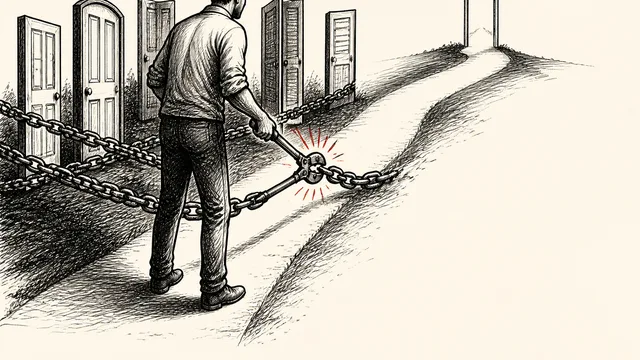
Discipline Is About Removing Options, Not Building Willpower
Mark Manson argues discipline has nothing to do with willpower—it's about eliminating choices. Here's what the research says, and what the theory leaves out.

Agentic Engineering: The 5-Pillar Framework for 2026
IndyDevDan's 5-pillar agentic engineering framework is technically sharp—but who actually gets to build these systems, and at what cost to the OSS tools underneath?

Investing at 30 vs 40: What One Decade Costs You
Same $500/month, same fund, same discipline — but a 10-year head start produces $540,000 more by retirement. Here's the math behind the gap.

How Friction and Awareness Can Reduce Doomscrolling
A recent video from The Art of Improvement outlines a practical, low-pressure system for breaking the doomscrolling habit—no willpower required.