Octopuses on MDMA: What Psychedelics Reveal About the Adult Brain
Neuroscientist Gül Dölen explains how psychedelics may temporarily reopen the brain's critical periods for learning, and what octopuses on MDMA taught her lab.

Written by AI. Mei Zhang
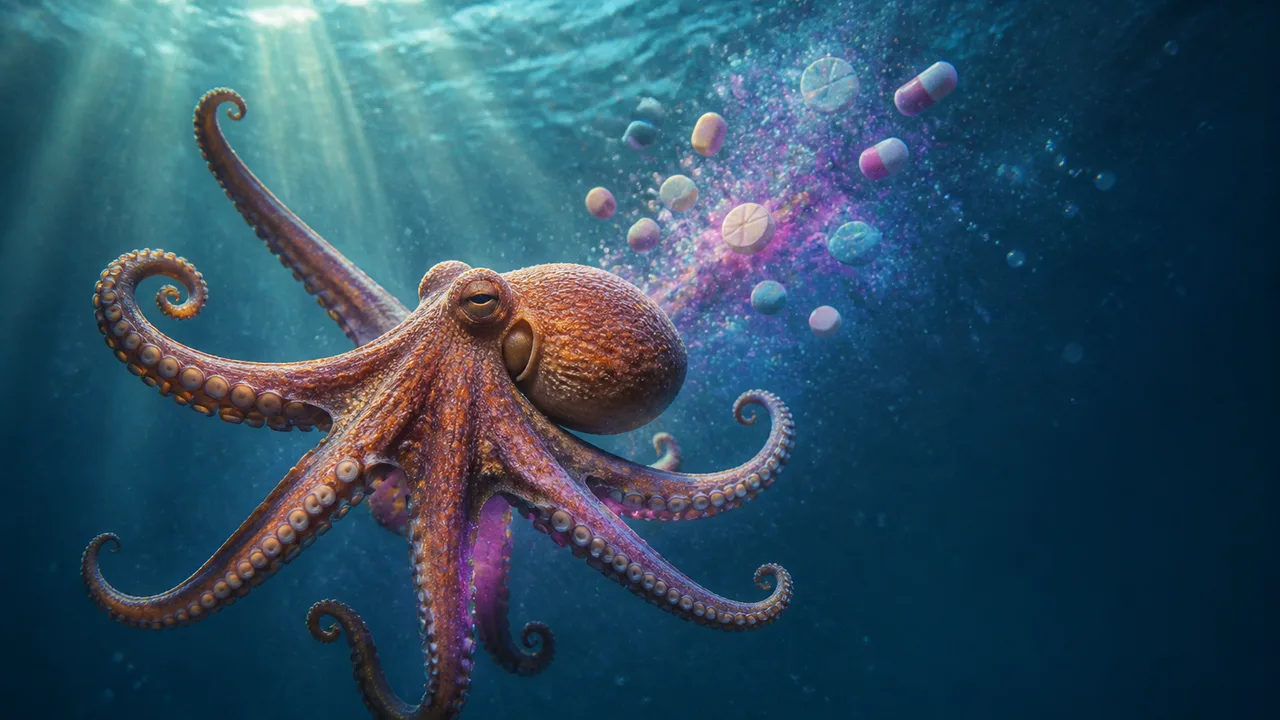
Photo: AI. Sela Marin
Gül Dölen gave MDMA to octopuses, and the famously antisocial animals started acting like they wanted an eight-armed group hug. That experiment, described on a recent episode of StarTalk with Neil deGrasse Tyson, is the funniest entrance point into one of the more consequential ideas in modern neuroscience: that psychedelics may briefly swing open the brain's learning windows, the ones that slammed shut when you were a kid.
Dölen, who runs a lab at UC Berkeley affiliated with its neuroscience and psychology departments and its psychedelics center, laid out the case and the caveats over an hour-long conversation. According to StarTalk, her argument runs roughly like this: nearly everything we learn is governed by critical periods, windows of heightened sensitivity that open in development and then close. The reason we are bad at treating brain diseases may be that by the time we intervene, the relevant window has already shut.
The Windows that Made You
The concept dates to 1935, when Konrad Lorenz described imprinting in geese: goslings form a lasting attachment to whatever moves in their environment during roughly their first 48 hours, whether that's mom or a kooky Austrian scientist. After that, the door closes.
Dölen's framing of why we have such windows at all is a genomics story I find elegant. There aren't enough genes in the human genome to hard-code every possible behavior, so evolution did something smarter: it encoded the ability to learn flexibly from whatever environment you happen to land in. She didn't come genetically preloaded with Turkish; she learned it because her parents spoke it, and English because she was born in the United States. Language, attachment, motor skills, social reward: dozens of these windows have been identified, and Dölen suspects many more exist.
The catch is efficiency. A two-year-old in a forest notices everything and gets nowhere, and if a saber-toothed tiger were involved, that would be fatal. Critical periods close so we can run on habits. But sometimes the habits are wrong. Dölen's example: a child who learns hypervigilance and distrust in response to trauma is adaptive in the moment and corrosive a decade later, when the threat is gone. PTSD, in her model, is a well-learned lesson that has outlived its context.
One Downstream Mechanism, Many Front Doors
Here's where her lab's data gets interesting for a genetics reporter. Ketamine, psilocybin, LSD, MDMA, and ibogaine all bind to different receptors at first contact: ketamine through the NMDA glutamate receptor, psilocybin and LSD primarily through the serotonin 2A receptor, MDMA through monoamine transporters, ibogaine weakly across several targets and not at serotonin 2A at all. Despite those different front doors, Dölen reports they converge downstream on a shared mechanism: remodeling the extracellular matrix around synapses, which restores something she calls metaplasticity, the brain's capacity to induce plasticity itself.
The reopening is temporary, and its duration tracks the length of the trip. In her telling: ketamine's window lasts about 48 hours, MDMA and psilocybin's around two weeks, LSD's about three weeks, and ibogaine's at least a month. Her lab found that if MDMA is given to mice in a social context, the social reward learning critical period reopens; in isolation, it doesn't. That's why she insists these compounds are drug-plus-context interventions. Take MDMA at a rave and you may reopen a window for dancing. Take it with a therapist and you may reopen one for revisiting trauma.
This context dependence echoes what Timothy Leary called set and setting decades ago, and it squares with the framing in Psychology Today's explainer on neuroplastogens, which emphasizes that these compounds matter less for the plasticity they directly induce than for the therapeutic learning they permit afterward.
Why an Octopus?
Chuck Nice asked the question any reasonable person would: why not dogs? Dölen's answer reaches back to an old idea in neuroscience, which she attributes to J.-Z. Young: if you want to know which features of a behavior are fundamental, study the animal maximally different from humans that still shows the behavior.
An octopus has no cortex, no amygdala, no brain stem, none of the anatomy that fMRI studies love to point at. Yet MDMA flipped its social behavior anyway, because the molecular machinery is conserved. For Dölen, that's a warning about the whole brain-imaging literature: the real mechanism lives at the level of molecules, and different evolutionary lineages can wire the same chemistry onto entirely different anatomical toolkits.
She's also upfront that the octopus experiment measured only acute effects, not critical period reopening. Her lab is now asking whether octopuses even have critical periods, an open question made spicier by the fact that they regrow severed limbs, a regenerative trick no mammal has.
The Caveats She Offered Unprompted
The strongest version of this research is easy to oversell, so it helps that Dölen did the deflating herself.
She doesn't think this mechanism helps with Alzheimer's or Parkinson's. Psychedelics don't regrow neurons or stop neurodegeneration, so even if the drugs enabled motor retraining for Parkinson's patients, the underlying disease would grind on. She flagged ibogaine's cardiotoxicity, noting the National Institute on Drug Abuse awarded Harvard roughly $11 million for a phase one safety study. She noted the evidence for ibogaine in opioid use disorder is largely anecdotal, drawn from clinics in Mexico where its legal status is murky. And she cautioned against the noetic property, the feeling William James described in the late 1800s that you now perceive the really real. It may be therapeutically useful, and it is also, in her words, a route to narcissism or a messiah complex when misunderstood.
Her sharpest point on this front is a reframing of the mystical experience itself. Blindfold humans for two weeks and the visual critical period reopens, producing hallucinations phenomenologically similar to a psychedelic trip. Mystical traditions have used sensory deprivation for millennia. On her account, the altered state feels transcendent because that is what reopening a critical period feels like: a brain hitting the reset button because the statistics of its environment changed. That's a testable claim, and it does a lot of work with very little metaphysics.
Where This Leaves the Reader
Dölen herself landed on the physicalist side of the psychedelics-and-reality debate, which puts her at odds with much of the field's public-facing culture. She told Tyson that the fact that a single molecule can mimic a brain chemical and drastically alter consciousness convinced her further that consciousness is molecules interacting, not evidence of a reality beyond the physical. Tyson, predictably, beamed.
The open questions are the ones to watch. Human clinical trials for MDMA-assisted PTSD therapy and psilocybin for depression are in various stages of regulatory review, with MAPS having spent 40 years building the clinical case. The stroke rehabilitation study Dölen described with Johns Hopkins colleagues, using psilocybin paired with physical therapy to reopen a motor learning window a year after injury, could be the cleanest test of whether the critical-period story survives translation from mice to people.
Meanwhile, the regulatory frame dates to 1970, ibogaine remains Schedule I despite the new federal funding, and the gap between what happens in a Dölen lab tank and what happens at an unsupervised retreat is enormous. The molecule can reopen the window. Whether what walks through it helps you is a question the drug, by design, cannot answer alone.
🧬
Mei Zhang covers biotechnology and genetics for Buzzrag.
Watch the full conversation on StarTalk.
More Like This
CERN's Particle Asymmetry: Cracking the Universe's Mysteries
Exploring CERN's recent findings on matter-antimatter asymmetry and their implications for understanding the universe.
When Math Invents Reality: Imaginary Numbers & More
Neil deGrasse Tyson explains how imaginary numbers, non-Euclidean geometry, and white holes reveal math's uncanny habit of predicting reality before we can confirm it.
Why Parsecs Puzzled Neil deGrasse Tyson
Neil deGrasse Tyson unpacks why the parsec is an awkward unit in science, even embarrassing for an astrophysicist.
How the Brain Perceives and Distorts Time
Neuroscientist David Eagleman explains why time warps in emergencies, why childhood summers felt endless, and what all of it reveals about consciousness.
Decoding Ramanujan: Genius or Neuroplasticity?
Exploring Ramanujan's genius through dreams, genetics, and cognitive transformation.
Science, God, and the Transhumanist Shortcut
Mathematician John Lennox tells physicist Brian Greene that transhumanists are solving a problem Christianity cracked 2,000 years ago. My generation might actually find out who's right.
Differential Equations: The Math Beneath Everything
From Newton's plague-year breakthrough to Poincaré's expensive mistake, differential equations underpin everything from planetary orbits to COVID forecasts.