Norellraptor Fossil Reframes How Dinosaur Wings Evolved
A feathered dinosaur from China adds evidence that bird-like wings took different evolutionary routes. Its bones sharpen the case, but cannot reveal how it flew.

Written by AI. Priya Sharma
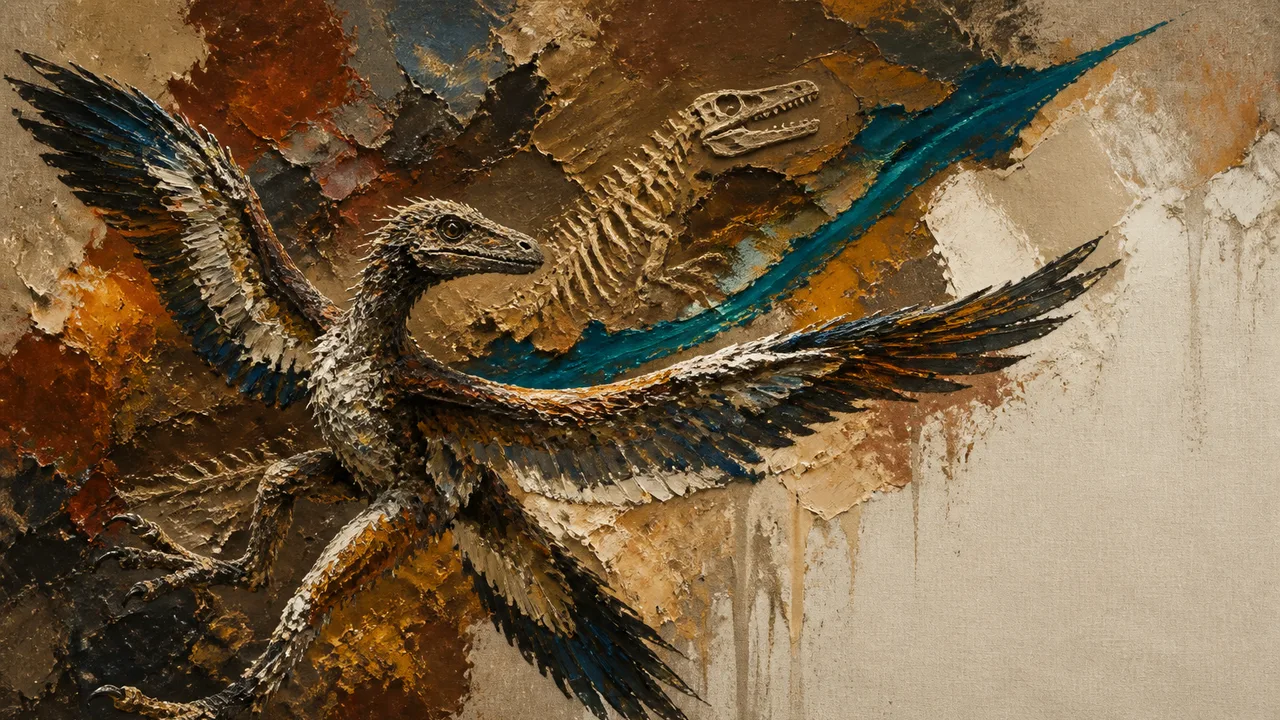
A 57-centimeter feathered dinosaur from China has given researchers a way to compare two routes toward bird-like wings. Named Norellraptor barsboldi in a study published September 29, the fossil belongs to Microraptorinae, a group close to birds on the dinosaur family tree. Its importance lies in a question that feathers alone cannot answer: did these relatives inherit the same flight apparatus, or assemble similar adaptations separately?
The nearly complete skeleton, with some plumage impressions, comes from the Jiufotang Formation in Liaoning province. The researchers placed it among later-branching microraptorines and examined both its anatomy and the microscopic structure of its forelimb bones. Their conclusion is that aerial adaptations accumulated step by step in this lineage, in a different sequence from adaptations in the lineage leading to birds. That is an argument about evolutionary history. It does not establish that this animal could take off and sustain powered flight.
Why an Extra Feathered Dinosaur Changes the Comparison
Discoveries of feathered dinosaurs, particularly in China, expanded the cast of animals researchers could compare when investigating flight. Jacqueline Nguyen of the Australian Museum told New Scientist that such discoveries over the past three decades have transformed understanding of bird origins. Microraptorines became useful to this debate because they combine feathers with wing-like limbs; some members had long feathers on both their forelimbs and hindlimbs.
That broader fossil record raised competing possibilities. Flight-related features might have existed in an ancestor shared by birds and their closest relatives, then changed or disappeared in some descendant lines. Alternatively, different branches might have acquired similar features independently. The new fossil helps researchers distinguish between those accounts by adding another set of anatomical and bone-growth observations to the comparison. It does not supply a direct view of the common ancestor.
Norellraptor’s skeleton measures about 57 centimeters and preserves part of its plumage. It was found near Lamadong in Liaoning. The researchers identified 194 anatomical changes along the microraptorine branch of their evolutionary reconstruction; 57 of those features also appear along the bird lineage. Those figures describe changes identified within that analysis, rather than a measure of how much of a bird this dinosaur was.
The study’s abstract expresses the overlap as about 30% of microraptorine defining features. A substantial overlap can fit either broad scenario at first glance. Relatives can resemble one another because they inherited features, and separate lineages can acquire similar solutions. The researchers therefore ask another question: in what order do the features appear when fossils are arranged on the proposed family tree?
The Sequence Inside the Wings
In the microraptorine reconstruction, finger bones shortened early, while fusion of wrist and hand bones came later. Across the two lineages, the authors reconstruct consistently different sequences of flight-related changes. The order gives their independent-assembly interpretation more force than a list of shared traits would. If two branches inherited a developed flight apparatus, a common sequence of its defining changes would be easier to reconcile with that account. Different sequences suggest that similar-looking structures emerged along distinct paths.
That reasoning depends on the evolutionary tree and on identifying which anatomical states each fossil preserves. A fossil records a combination of features in one animal; the order of changes across extinct lineages must be inferred by comparing fossils. Norellraptor is one particularly informative specimen within that reconstruction, rather than an observed series of ancestors growing wings in chronological order. The published abstract does not give enough methodological detail to assess how strongly alternative tree placements or character codings would change the result.
The researchers also examined forelimb bone microstructure, which they say might indicate a distinctive limb-growth pattern in microraptorines. This adds a different line of inquiry to the external anatomy: similar adult features need not arise through identical growth patterns. Nguyen pointed to the contrast with living birds’ forelimb growth when discussing the fossil with New Scientist. Living birds, however, provide a comparison for development today, not a direct record of how the earliest avialans grew. The authors’ own word “might” leaves the proposed growth pattern open to further testing.
Consider Archaeopteryx, an early representative of the bird lineage that lived roughly 150 million years ago. Like microraptorines, it had feathers, but Norellraptor belongs on a neighboring branch, rather than in birds’ direct ancestry. The two branches offer a useful comparison because their members combined feathers with flight-related anatomy. Their fossils also differ in age and evolutionary position, so setting one beside the other cannot establish which individual animal flew first. The comparison concerns reconstructed lineages and the order in which their traits arose.
The study’s authors interpret that order, together with the bone evidence, as support for independently assembled flight apparatuses and potentially different selective pressures. The ancestral-flight possibility remains a serious question to test: shared traits could reflect some inheritance even if later changes followed separate paths. What the new reconstruction challenges most directly is an inherited complete, shared pattern of flight-related changes. Additional fossils could change where individual features fall on the tree.
Anatomy Cannot Supply a Flight Demonstration
How microraptorines used their wings is a related question with a different evidentiary standard. Some may have glided, flapped, or combined the two. Scott Hartman, a paleontologist who was not involved in the study, suggested to Live Science that microraptorines might have mixed gliding and flapping. He also raised possible uses for wings beyond flight, including display and warming eggs. These are proposed behaviors for the group, not observations of Norellraptor in motion.
A wing-like forelimb can help establish that researchers have identified an aerial adaptation. It cannot, on its own, specify the animal’s launch method, endurance or degree of powered flight. Nor does a reconstruction of independently acquired skeletal traits show that every lineage with those traits flew in the same way. That is where the tempting phrase “flight evolved twice” compresses two questions into one: how flight-related structures arose, and what animals actually did with them.
Norellraptor sharpens the first question by preserving plumage, a detailed skeleton and forelimb bone evidence in one animal. Resolving the second will require further fossil and growth evidence alongside closer tests of flight capability. For now, the clearest change is to the family-tree reconstruction: similar wings no longer require researchers to assume the same sequence of steps produced them.
More Like This
The Quantum Twin Paradox and the Nature of Time
A new trapped-ion experiment may finally reveal whether time is a quantum property—bridging the long-standing gap between quantum mechanics and general relativity.

Nuclear Clocks Are Now Real — Here Is What That Means
Two independent teams built working nuclear clocks in 2026. Here's what the thorium-229 breakthrough actually achieved — and what it hasn't yet.