NetworkChuck's Free CCNA Program Draws 35,000
NetworkChuck and Jeremy Ciorra launched a free CCNA program that drew 35,000 signups. Here's what the model actually offers—and what it reveals about online learning.

Written by AI. Bob Reynolds
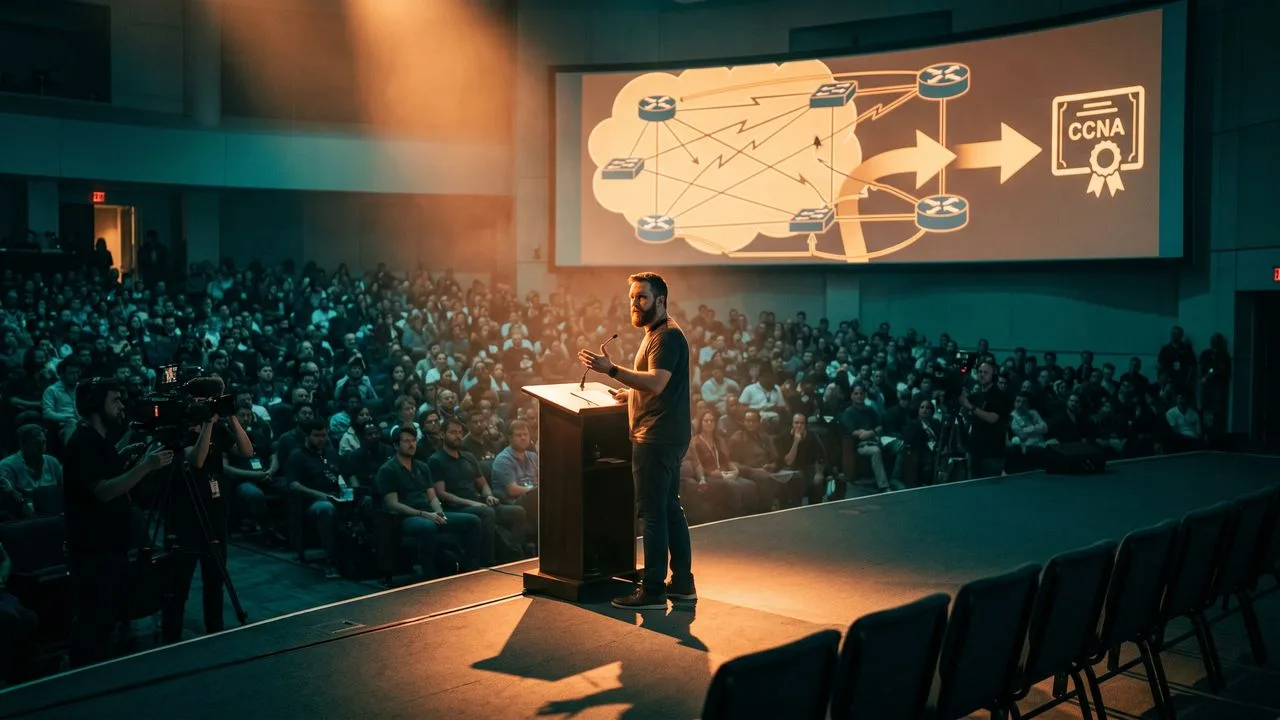
Photo: AI. Astrid Lehmann
There is a number buried in the launch stream for NetworkChuck Academy's Summer of CCNA program that deserves more attention than it received. When Chuck and his co-host Jeremy Ciorra built their original CCNA course last year, thousands of people signed up. After a couple of months, three finished it.
Three.
Ciorra put it plainly during the stream: "We don't just need information anymore. We live in an AI age." That's a striking admission from educators whose entire business is selling information. It's also, frankly, accurate—and it points to the more interesting story underneath this launch.
The Summer of CCNA, which launched this week via a live stream on YouTube, is NetworkChuck Academy's attempt to solve a problem that has plagued online education since the first MOOC went live over a decade ago. Completion rates for self-paced courses are notoriously, almost comically, low. MIT and Stanford researchers have clocked them in the low single digits for years. The information isn't the problem. Access to the information has never been the problem. The problem is that human beings, left alone with a video library and good intentions, mostly don't finish things.
Chuck—whose full name is Aaron, though nobody calls him that—and Ciorra are betting that structured accountability can move that needle. The mechanics of their program are worth understanding clearly, because the marketing language around "free" requires some translation.
Here's what "free" actually means: you can access the course content on a rolling two-week window. Stay current, keep access. Fall behind, and the content gates itself. It's a treadmill model, which is a reasonable way to engineer engagement into something people aren't paying for. Ciorra compared it to a gym membership, which is an apt analogy, though it cuts both ways—gym memberships are famous for being purchased and abandoned.
The paid tier—they're calling it the premium option—gets you persistent access to the course content (lifetime, they clarified live on stream, walking back an earlier "one year" framing), a year of access to cloud-hosted virtual labs running real Cisco VMs, and daily check-in sessions with Chuck and Ciorra themselves. That last part is the differentiator, and also the part that raises the most questions about long-term sustainability. Running daily live sessions with 35,000 enrolled students—even if a fraction are premium—is a significant operational commitment. They acknowledged during the stream that they're already scaling server infrastructure to handle the load; they expected a thousand signups and got thirty-five times that.
The CCNA itself—Cisco Certified Network Associate—is worth some context for readers who haven't spent time in the IT certification ecosystem. It has been the entry-level networking credential of record for roughly twenty-five years. Not because Cisco is the only networking vendor, or even necessarily the best, but because it became a standard early and the industry built around it. Ciorra made the case during the stream: "They all have a network and they all have Cisco's fingerprints all over it." That's not hyperbole. Walk into almost any enterprise environment—or any MSP serving small businesses—and you'll find Cisco gear, Cisco-adjacent gear, or gear that operates on Cisco principles.
The credential also carries a commercial dimension that Ciorra discussed openly, and that most CCNA promoters tend to gloss over. Companies that employ certified Cisco professionals get discounts on Cisco equipment purchases. At the higher certification levels—Ciorra holds a CCIE, the top tier—this dynamic gets strange enough that he described engineers who are technically on staff at resellers purely for their certification number, collecting a salary for gear discounts while working elsewhere. That's a quirk of the Cisco partner ecosystem, not a scam, but it illustrates how thoroughly certification status is woven into the commercial fabric of enterprise IT.
For someone starting out, though, the CCNA's value is more straightforward: it demonstrates that you did the work. Chuck described the signal it sends to hiring managers—"You have to know your stuff to get your CCNA"—which is more than can be said for credentials that have drifted toward checkbox status.
The backstory between Chuck and Ciorra is worth knowing because it shapes what this program actually is, pedagogically. Chuck, who now has well over four million YouTube subscribers, built his teaching style by watching Ciorra's CBT Nuggets CCNA course in 2013. He was on the help desk, studying for a cert he couldn't really afford. He has acknowledged, with some amusement, that he did not pay for the content at the time.
"When I watched his training, it got me excited to learn it," Chuck said during the stream. "It was like watching TV."
That's not a throwaway compliment. The challenge with technical education—networking in particular, with its acronym-dense protocols and abstract topology diagrams—is that most instruction drains the life out of it. Ciorra built a reputation by doing the opposite, by making routing protocols feel consequential rather than merely correct. Chuck absorbed that approach and built a YouTube channel on it. Now they're teaching together, which means the lineage is direct: Ciorra taught Chuck, Chuck is one of the most-watched IT educators on the internet, and their styles have converged enough that, as Chuck put it, "it won't feel very different" moving between them.
Whether that pedagogical continuity translates to better completion rates is the open question. The accountability mechanisms are real—rolling access windows, daily live sessions, a Discord community—but they're also relatively new implementations at this scale. Thirty-five thousand signups is impressive. What matters, and what Ciorra said explicitly their target is, is getting a thousand people to the actual certification exam and through it.
There are things this program doesn't address that are worth naming. The CCNA has competitors. CompTIA's Network+ covers similar foundational terrain and is vendor-neutral, which some employers prefer. Cloud-specific networking credentials from AWS, Google, and Microsoft have grown in relevance as infrastructure has shifted. Chuck acknowledged this—"whether it's cloud, whether it's cybersecurity, whatever path you want to go down, the CCNA has always been one of those steps"—positioning the cert as a foundation rather than a destination, which is defensible, though it's also the framing that Cisco and its training partners have always preferred.
The question of who this program is actually for is also worth sitting with. The pitch is aimed at career-changers and IT beginners. But the CCNA is not a beginner certification in any meaningful sense—it covers OSPF, BGP, spanning tree protocol, VLANs, access control lists. Students who arrive without any prior networking exposure will face a steep gradient, daily check-ins or not. Ciorra's "removes the fear" framing is aspirational. Fear is often just unfamiliarity, and unfamiliarity responds to good teaching. But some of what people feel when they open a networking textbook is recognition of genuine complexity, not irrational anxiety.
None of that is a reason not to try. It is a reason to go in with clear eyes.
"Just information, just videos, just going through a course—it's just not enough," Ciorra said. "That's nowadays just like table stakes."
He's right. The question the Summer of CCNA is actually running as an experiment is whether structured community and daily human contact can do what information alone demonstrably cannot. Three completions out of thousands is a baseline that almost anything should beat. Whether they can get to a thousand certified professionals by August is a different matter entirely.
More Like This
OpenAI's Codex: What This 4.5-Hour Course Reveals About AI Coding
A deep dive into OpenAI's Codex certification course shows what's actually happening when AI writes your code—and what remains frustratingly opaque.
When Software 'Works' But You Can't Trust It
A veteran Microsoft engineer explains the difference between software that appears to work and software that actually works—and why that gap matters.

Amazon Spring Sale Tech Deals: What's Actually Worth It
Tech reviewer Alex covers 10 Spring Sale deals, from charging stations to OLED monitors. We examine what's genuine value and what's seasonal hype.
Why Learning Networking Still Requires Pen and Paper
FreeCodeCamp's 12-hour networking course reveals what's still broken about how we teach foundational tech concepts—and what actually works.
The Fall of Stack Overflow: A Cautionary Tale
Exploring Stack Overflow's decline and the lessons from its community dynamics.
The Console Killer Problem Nobody's Talking About
Mini PCs could replace gaming consoles, but GPU form factors are the real bottleneck. Why the industry needs new standards before the next component shortage.

Claude Code and AI-Driven SEO for Shopify Stores
A live walkthrough of using Claude Code, SEMrush MCP, and Shopify to build AI-optimized pages raises real questions about where SEO is heading.

Garry Tan's Blueprint for the AI-Native Company
Y Combinator's Garry Tan argues that how you organize AI matters more than which AI you use. Here's what that means in practice.