NestyNet Symbolic Regression and the Hunt for Hidden Laws
NestyNet-SR uses neural surrogates to extract clean, human-readable equations from messy data. Here's what that means for physics and scientific AI.

Written by AI. Mei Zhang
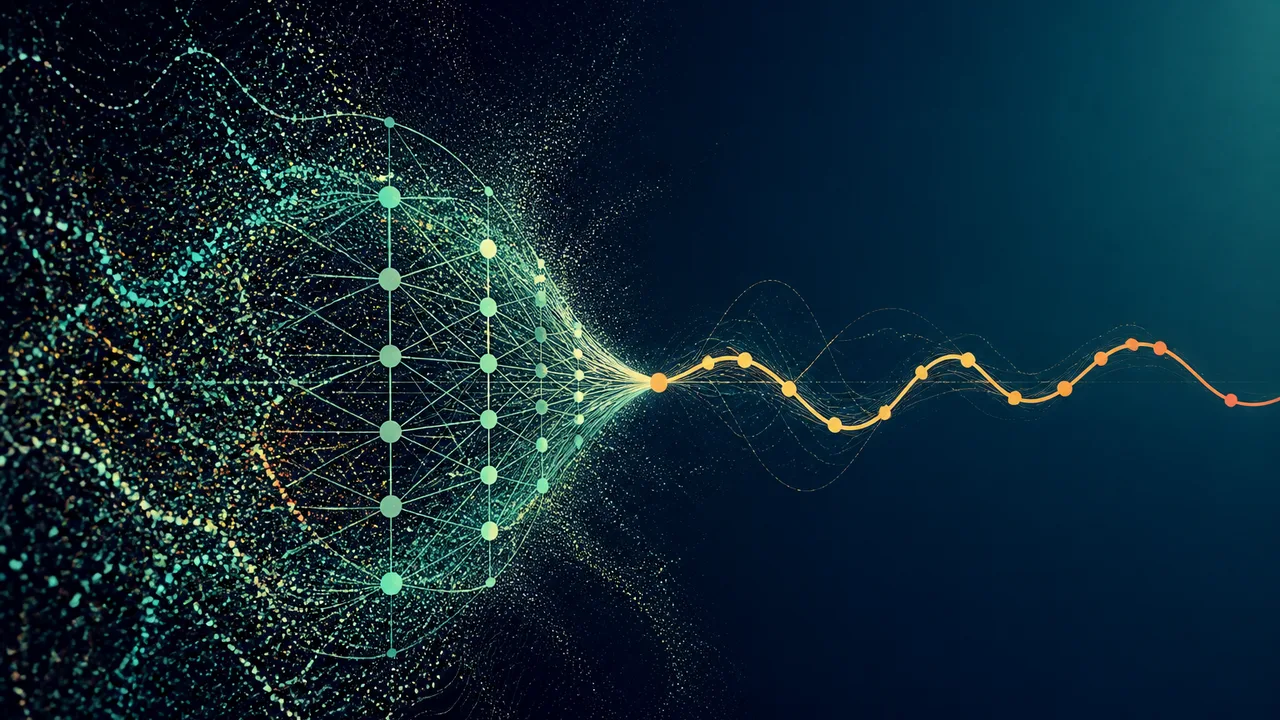
Here's a puzzle that sits at the heart of modern science: you have mountains of data, and somewhere buried in those mountains is a clean, elegant equation—the kind that fits on a chalkboard and actually means something. The problem is finding it without already knowing what you're looking for.
That's the core promise of symbolic regression. And a newly published series of papers on NestyNet-SR is offering what researchers are calling a more principled path to that goal. 🧬
What Symbolic Regression Actually Does (And Why It's Hard)
Standard machine learning is great at pattern recognition. Feed a neural network enough data and it'll learn to make accurate predictions. But ask it why its predictions work, and you'll get a shrug in the form of millions of inscrutable weights. The model is a black box. For physics, that's often not good enough. You don't just want to predict the trajectory of a particle—you want the equation that governs it.
Symbolic regression flips the script. Instead of fitting a fixed model to data, it searches the space of possible mathematical expressions to find one that fits. The output isn't a neural network—it's something like F = ma or E = mc²: a compact, interpretable formula a human can read, critique, and build on.
Emergent Mind's overview of neural symbolic regression describes it as "a hybrid approach that integrates deep neural networks with symbolic techniques to automatically discover concise, interpretable analytical expressions from data." That hybrid character is key. Pure symbolic search methods are computationally brutal—the space of possible expressions is enormous. Neural networks help navigate it, but they bring their own complications.
One of the most persistent complications: many of the functions that matter most in physics are precisely the ones that neural networks are worst at fitting. As the NestyNet Part I paper on arxiv.org (2608.05862) puts it directly, "many of the smooth functions that matter most in physics are precisely the ones that standard neural network methods struggle to fit accurately." Think sharply peaked functions, functions with poles, or functions that vary over many orders of magnitude. A vanilla neural network will smear them out or miss them entirely.
NestyNet's Architecture: A Three-Paper Program
The NestyNet project is ambitious enough that it rolled out as a trilogy. Each paper handles a distinct piece of the pipeline.
Part I, linked at arxiv.org, introduces the core framework: a coupled model-and-optimizer approach designed to fit difficult physics targets accurately while also producing analytic derivatives. That second part matters more than it might seem. Analytic derivatives—exact mathematical expressions for how a function changes—are essential for doing real physics, where gradients and Jacobians appear everywhere.
Part II, at arxiv.org, tackles uncertainty. Once you have a well-trained surrogate, you want to know how confident to be in it. Normally, quantifying that uncertainty requires expensive Markov Chain Monte Carlo methods (MCMC)—computationally intense sampling procedures that can take days or weeks to run. The NestyNet II paper argues its framework can produce "coherent function-space posteriors" without that cost. The authors identify five properties of NestyNet surrogates that make this tractable, including "deterministic fitting, which removes algorithmic randomness from repeated-data experiments" and the availability of "analytic Jacobian–vector products." For scientists who need to propagate uncertainties through complex pipelines, this is not a minor convenience—it's potentially a significant acceleration.
Part III, at arXiv Physics, is where symbolic regression enters. The idea is that having a high-quality analytic surrogate makes the symbolic regression problem more tractable. Instead of searching directly through noisy empirical data, you search through the smooth, differentiable landscape of the surrogate itself. That's a cleaner target—and the paper argues it enables the extraction of closed-form symbolic expressions that genuinely capture the underlying physics.
The Broader Landscape This Fits Into
NestyNet-SR doesn't arrive in a vacuum. The field of neural-assisted symbolic regression has been building for several years, and the NestyNet program is one of the more architecturally coherent entries.
A 2023 paper on arxiv.org (2302.00773) laid out one strand of the problem precisely: the goal is a "maximally sparse neural network model representing a desirably concise" function. Sparsity here is doing real work—the fewer terms in your discovered expression, the more likely it is to reflect genuine structure rather than overfitting to noise.
A separate line of work on parametric equations, documented at arxiv.org (2207.00529), extended symbolic regression to systems where "some coefficient may vary but the structure of the underlying governing equation remains constant." That's closer to real-world physics, where the same governing law might show up across different experimental conditions with different parameter values.
And then there's the SINDy (Sparse Identification of Nonlinear Dynamics) tradition. A 2024 paper at arxiv.org proposes "Nested SINDy," which aims to improve on standard SINDy's expressiveness by introducing multi-layer structure. The French-language abstract signals this is addressing "the limits of traditional symbolic regression methods and system identification"—a field-wide acknowledgment that existing tools leave real ground uncovered. NestyNet-SR is operating in that same contested territory.
What's Genuinely New, and What's Still Open
The most compelling thing about the NestyNet approach, reading across all three papers, is the emphasis on the surrogate as an intermediate step. Rather than treating neural networks as the final product, NestyNet treats them as a scaffold—a way to get a clean, differentiable representation of the underlying function that can then be handed off to symbolic search.
That's architecturally sensible. Symbolic search algorithms generally work better when their input is smooth and well-behaved. If the surrogate is accurate and its derivatives are reliable (which NestyNet Part I specifically targets), the downstream symbolic regression task becomes less like searching a haystack and more like solving a well-posed puzzle.
The uncertainty quantification piece from Part II is also worth flagging. In scientific applications, error bars aren't optional—a discovered equation without quantified uncertainty is harder to publish, replicate, or act on. The claim that NestyNet's structure enables posterior estimation without expensive MCMC is significant if it holds up to scrutiny, though the details of how well those posteriors behave in practice will need external validation.
What the published record doesn't yet settle: how NestyNet-SR performs across a wide range of benchmark problems compared to existing symbolic regression methods, and how it handles the genuinely hard cases—noisy data, high-dimensional inputs, or functions that don't have clean closed-form representations at all. The brief sources don't contain benchmark comparison tables or specific numerical results I can point to here. Those are the follow-up questions the community will be stress-testing.
Why This Kind of Tool Matters Beyond Physics
It's worth pausing on who else might care about this. The physics framing is natural—the NestyNet papers are clearly written by and for physicists dealing with difficult smooth functions. But the underlying problem, finding interpretable equations in complex data, is live in biology, climate science, economics, and materials science too.
The genomics angle isn't far-fetched: gene regulatory networks are systems of interacting equations, and understanding them analytically rather than just predictively is increasingly important for designing interventions. If tools like NestyNet-SR can extract reliable closed-form approximations from biological data, that's a different category of scientific leverage than a model that merely predicts.
The equity concern is quieter here than in direct medical applications, but it's not absent. Tools that accelerate scientific discovery tend to accelerate it unevenly—better-resourced labs adopt new computational methods first, extend their leads, and the gap between well-funded and under-funded science widens. NestyNet is posted on arXiv, which means the papers are freely available. Whether the code and infrastructure required to actually run it are equally accessible is a different question, and one the papers don't address.
The machine learning revolution in scientific discovery is real, and it's moving fast. What NestyNet-SR represents is a careful, architecturally motivated bet that the path to interpretable science runs through neural networks rather than around them—and that the quality of that neural scaffold determines everything that comes after it.
Whether that bet pays off at scale is still being written. But the research program is coherent, the problem it's addressing is genuine, and the timing—with the field actively debating how to make AI-discovered science actually trustworthy—is not coincidental.
More Like This
How Maxwell Unified Electricity and Magnetism
A compass needle twitched in 1820 and set off a chain of discoveries that now powers every wireless signal in your life. Here's the physics behind it.

Yann LeCun's JEPA: Why AI's Next Big Idea Isn't for Text
Yann LeCun's JEPA predicts representations instead of pixels. It's promising for vision and robotics—but there's a reason language models aren't using it.

Total Solar Eclipse 2026 Dazzles Spain and Science
The August 12, 2026 total solar eclipse over Spain was a spectacle—and a rare scientific window into a solar mystery we still can't solve.

NVIDIA Nemotron 3.5 Lightning Targets AI Agent Work
NVIDIA's Nemotron 3.5 Lightning is a 30B MoE model built to handle the repetitive, high-volume work inside AI agents—faster and cheaper than frontier reasoning models.

Black Hole Paradox: Are Reference Frames the Key?
Exploring how reference frames might resolve the black hole information paradox.

AI Agents for Science Hit a Wall: the Hypothesis Problem
Sina Shahandeh of Radicait explains why AI agents plateau on real scientific tasks — and the structural fix he's using to unstick them.

Black Holes, Colliding Galaxies, and the Chaotic Universe
Astrophysicist Mordecai-Mark Mac Low joins StarTalk to unpack galaxy collisions, planets orbiting black holes, dark matter, and why the universe is messier than we thought.

Ten Discoveries That Rewired How We See Everything
From CRISPR to dark energy, ten scientific breakthroughs that didn't just change their fields — they changed what questions we're allowed to ask.