Moon’s Far Side Reopens the Ancient Lunar Dynamo Debate
Orbital gravity and magnetic data point to a lunar field 4.2 billion years ago, while Apollo conflicts and the Moon’s small core keep the case open.

Written by AI. Amelia Nwofor
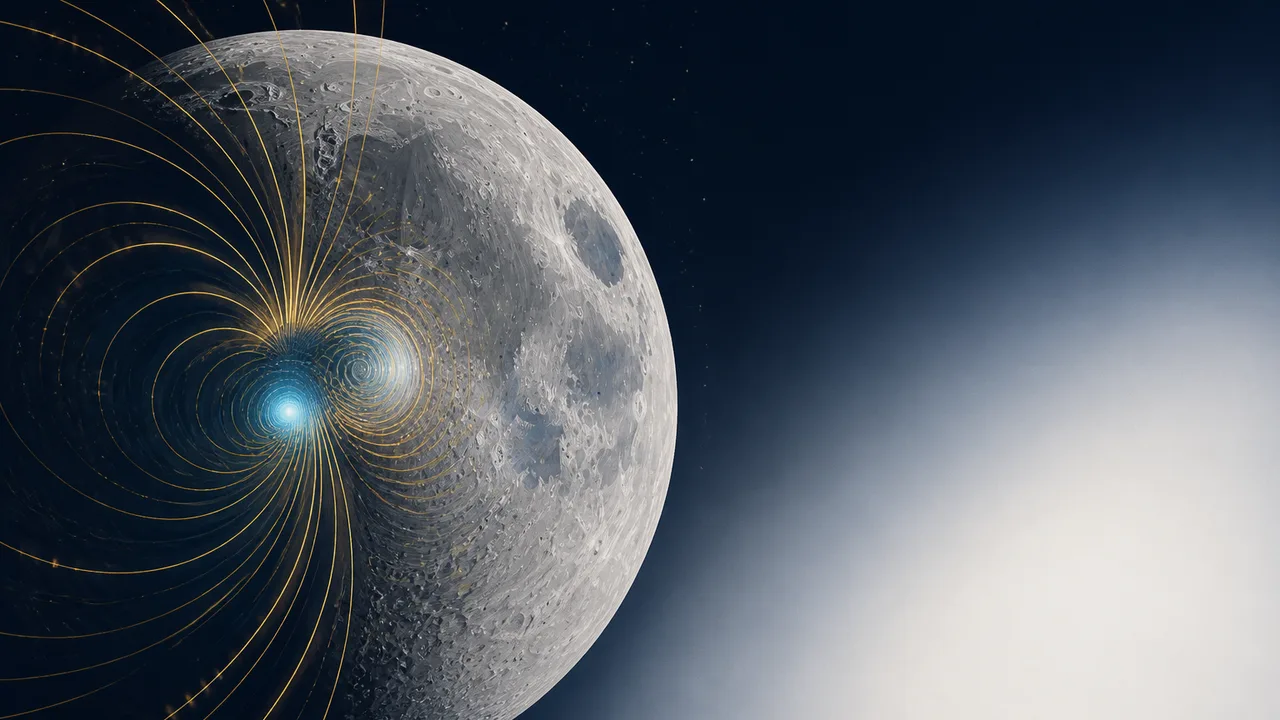
The Moon’s Dewar region contains a buried, magnetized rock formation that researchers date to about 4.2 billion years ago. Their interpretation gives the long argument over an ancient lunar magnetic field a new source of evidence: spacecraft measurements rather than another Apollo rock.
The formation sits beneath the lunar far side, where a strong magnetic anomaly overlaps a gravity anomaly and a bright surface feature called a lunar swirl. A Science Advances study described by ETH Zurich used gravity measurements from NASA’s GRAIL probes alongside magnetic-field models based on Lunar Prospector and Kaguya observations.
The researchers infer that magma rose from inside the Moon, cooled and hardened into a buried volcanic complex. A separate account of the findings puts the modeled body at about 60 kilometres wide and roughly nine kilometres deep.
That is the proposed geological object. The ancient dynamo enters through the magnetization it preserved.
How Gravity Helps Interpret Magnetism
A magnetic anomaly alone does not identify the rock producing it. The Dewar analysis combines two measurements that constrain different properties: gravity indicates an unusually dense structure, while magnetism shows that the structure is strongly magnetized.
Study co-authors Xi Yang and Anna Mittelholz told Gizmodo that the team jointly inverted the two datasets, solving for crustal density and magnetization in one model. Combined with surface chemistry and the area’s arched topography, the result points to solidified magma rather than an unidentified patch of ordinary crust.
The reasoning then runs in steps. Slowly cooling magma can retain a record of the surrounding magnetic field. The modeled rock body contains an estimated amount of iron, which affects how strongly it can become magnetized. Given that iron content and the observed anomaly, the researchers calculated the minimum ambient field needed while the magma cooled.
Their institutional account gives that minimum as stronger than 10 microtesla. Yang and Mittelholz separately described the field to Gizmodo as around 11 microtesla. Those formulations should not be collapsed into a precise measurement. The evidence presented supports a lower bound above 10 microtesla; 11 microtesla is an approximate estimate derived from the model.
Earth’s present magnetic field is around 50 microtesla. Using those reported round numbers, the lunar lower bound is roughly one fifth or more of Earth’s current field. This comparison supplies scale, but Earth is an active planet with a continuing geodynamo. It is no mechanical stand-in for the smaller, ancient Moon.
That size difference leaves the study with an awkward and productive problem: how could the Moon’s relatively small core have sustained a field of this strength? The result supports a dynamo while leaving its power source and longevity unsettled.
Apollo Rocks Built the Case, Then Complicated It
According to Yang and Mittelholz’s account of the debate, earlier paleomagnetic work on Apollo samples supported a long-lived lunar dynamo operating from about 4.25 billion to 3.5 billion years ago. Later analyses of the sample record contested both its timing and, in some interpretations, its existence.
The historical irony has scientific consequences. Apollo rocks helped establish the dynamo hypothesis, then produced conflicting interpretations that the new study does not reconcile. Sample magnetism can be difficult to translate into a global history when researchers disagree over what magnetized a rock and whether its magnetic record survived later alteration.
Dewar approaches the question from another direction. The team starts with an anomaly mapped from orbit, links it to a buried geological structure and asks what field that structure required as it cooled. Orbital modeling has its own dependencies, including assumptions about the body’s shape, composition and magnetization. Still, it does not simply repeat the disputed Apollo analysis.
This is why the study changes the debate without closing it. Agreement between gravity, magnetism, geochemistry and topography makes the magmatic interpretation more constrained than a magnetic signal considered alone. Yet all those clues describe one exceptional region. A model that works at Dewar still needs testing against other lunar anomalies and, eventually, measurements at the site.
The Impact Alternative Survives Outside Dewar
A core dynamo is not the only proposed way to magnetize lunar crust. Large asteroid or meteorite impacts could produce temporary magnetic conditions and leave magnetized rocks behind.
The researchers argue that this explanation is unlikely at Dewar because the region lies outside areas identified as candidate sources for such an impact-generated field. That geographic exclusion strengthens the dynamo interpretation for this formation. It carries less weight as a Moon-wide dismissal of impact magnetization, and the authors still acknowledge that the contradictory Apollo record remains unresolved.
The inference therefore has a defined reach: Dewar appears difficult to explain with the impact scenario considered by the team, while one anomaly cannot establish the duration or global structure of an ancient lunar field. A field strong enough to magnetize the buried complex could have existed 4.2 billion years ago without behaving like Earth’s present field for hundreds of millions of years.
A Bright Swirl Above a Buried Archive
Dewar also carries a visible clue at the surface. Its lunar swirl is a bright, curved pattern associated with the local magnetic anomaly. One proposed mechanism holds that horizontal magnetic fields deflect some solar wind, reducing surface weathering and leaving the protected material brighter than its surroundings.
That proposal connects a 4.2-billion-year-old geological record to future exploration. Mittelholz said magnetic field lines could offer astronauts some protection from solar wind and that swirls may indicate where those configurations occur. The study does not establish how much protection a crew would receive, so a bright swirl should not be treated as a ready-made radiation shelter. It does identify a location where surface measurements could test the magnetic geometry, the weathering hypothesis and the buried-rock model together.
Yang also suggested that the orbital method could be applied to other bodies. Mars is an obvious candidate in principle, but the researchers say sufficiently high-quality data are not yet available. That limitation clarifies the method’s present value: old spacecraft datasets can answer new questions when gravity and magnetic coverage overlap at useful resolution, but clever inversion cannot manufacture detail the instruments never recorded.
Dewar has moved the lunar-dynamo argument beyond a contest among Apollo samples. The next test is less rhetorical and more lunar: find another anomaly where gravity, magnetism and geology converge, then see whether the same chain of inference survives.
More Like This
JWST's Little Red Dots May Be Cocooned Black Holes
New JWST spectral data on a single "little red dot" galaxy offers the strongest case yet that they're supermassive black holes wrapped in dense gas cocoons.

Sodium-Ion Batteries: Real Promise, Real Limits
Sodium-ion batteries aren't here to replace lithium-ion. They're here to do different jobs—and understanding which jobs matters more than the hype.