A Medieval Chinese Skull Records Punishment and Care
A 700-year-old skull from Henan links ancient Chinese penal texts to a woman's survival, care and stigmatized burial, while leaving key questions unresolved.

Written by AI. Sofia Ramirez
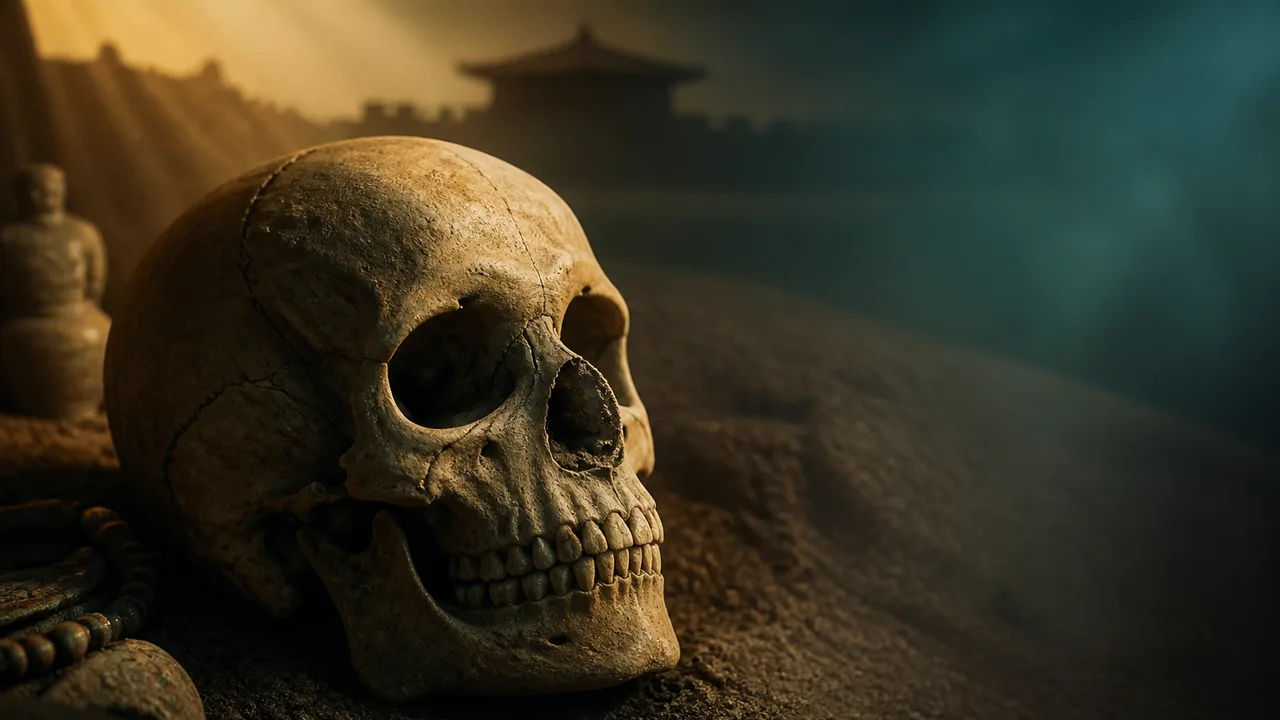
A woman buried face down at Sanzhiyuan cemetery in Henan, China, lived for years after much of her nose was cut away.
Her name is unknown. Researchers estimate that she died between ages 40 and 45, sometime from 1298 to 1404, a range spanning the late Yuan and early Ming dynasties. Isotope analysis suggests she ate mostly millet and little animal protein, a diet consistent with relatively low socioeconomic status. Her wooden coffin contained one reported possession, a copper hairpin.
Those spare details place an ordinary person inside a history usually preserved through legal codes and dynastic records. A new study argues that her skull may provide the first known archaeological evidence of punitive nasal amputation in ancient China. The case is persuasive, according to an outside bioarchaeologist, but it remains an interpretation built from several clues rather than a surviving verdict naming her crime.
That uncertainty should stay attached to the woman. Researchers do not know whether authorities punished her for livestock theft, adultery or something else. They cannot establish that she committed any offense at all. What her bones offer is narrower and, in human terms, richer: evidence of a severe injury, survival, possible care and a burial that separated her from everyone around her.
A Legal Text Finally Meets a Body
The cemetery emerged during surveys and a rapid salvage excavation ahead of construction. Accounts differ slightly on whether to date that work to the 2018 survey or the 2019 excavation, but they agree that the remains went into storage at Zhengzhou University. Archaeologist Yawei Zhou recognized the skull's unusual nasal opening while examining the collection in 2024.
That lag between digging and recognition is a reminder that archaeology also happens in storage rooms. A skeleton can leave the earth years before anyone has enough time, expertise or context to understand what it carries.
CT scans showed that substantial bone and tissue around the nose had been removed, apparently with an upward cut. Only about half of the nasal bridge remained. Broken bones inside the nose had healed and remodeled at their edges, indicating that the woman survived for years after the injury. Researchers reported no surrounding facial fractures or damaged front teeth that would point toward a fall or similar accident.
The legal context supplies another clue. New Scientist's account of the study says ancient Chinese texts placed nasal amputation among the Five Punishments, alongside decapitation, limb amputation, castration and facial tattooing. By the end of the Yuan dynasty, the law prescribed it mainly for theft of valuable livestock or repeated theft of less valuable animals.
The practice appears much earlier in the written record. Shang dynasty oracle-bone inscriptions, dated to roughly 1600 to 1046 BCE, represented nasal amputation with a character depicting a knife beside a nose. A later summary of the research reproduces that historical description and the Five Punishments list. It does not provide independent confirmation, but it reflects the same study-based account.
The written record therefore reaches back well over two millennia before this woman's death. Yet Qian Wang, a study co-author and biological anthropologist at Texas A&M University, said no published archaeological skeleton had previously been identified as a case of penal nasal amputation. Legal texts show what authorities authorized or recorded. Human remains can show that a punishment reached somebody's body.
One body cannot reveal how often officials imposed the sentence, whether enforcement varied by class or region, or how faithfully practice followed law. This woman can narrow the gap between the code and lived experience. She cannot close it.
Punishment that Continued After the Sentence
Nasal amputation differed from execution in one obvious consequence: the punished person remained alive to carry the mark. Facial tattooing and limb amputation, the closest comparisons within the Five Punishments, likewise made state punishment visible after the formal sentence ended. Death stopped a life. These penalties reorganized one.
The comparison has limits. The available evidence does not establish how communities treated people subjected to each punishment, and a single burial cannot represent Yuan society. It does help explain why survival belongs at the center of this case.
The healed bone indicates that someone probably controlled the initial bleeding and prevented fatal infection. David Shaye, a Harvard facial-reconstruction surgeon who was not involved in the research, told New Scientist that if bleeding was controlled, the wound could heal over several months. Wang inferred that caregivers may also have managed her pain.
Care complicates any simple portrait of total abandonment. Someone may have helped her through an injury that could have killed her, whether that care came from officials, relatives, neighbors or another person whose name also disappeared. The bones cannot identify them.
Small bone spurs around the nasal opening deepen the puzzle. They could have resulted from chronic inflammation. Researchers also raised the possibility that pressure from an artificial nose produced them. Wang suggested that a prosthesis, if she wore one, could represent an attempt to resume ordinary life. The prosthesis remains a hypothesis, not a recovered object.
Her diet adds another fragment. Mostly millet with little animal protein places her closer to the commoner whose labor supported the dynasty than to its courtly record keepers. It does not prove poverty, theft or social exclusion. Diet can suggest economic position without supplying a biography.
Reading a Face-Down Burial Carefully
The burial gives the punitive interpretation much of its force. The woman lay face down in a wooden coffin on the cemetery's southern edge. None of the other people buried there reportedly shared that position. Wang told Live Science that the placement could indicate disapproval and described her as a possible “cast-off after death.”
The word “could” has work to do. A face-down burial may signal stigma, but researchers do not have her family's explanation or a record of the funeral. Wang has acknowledged alternatives for the injury, including disease, accident and self-mutilation. The team found no telltale signs supporting those explanations, while the cut bone, healing pattern, legal history and unusual burial converge on punitive amputation. Elizabeth Berger, a University of California, Riverside bioarchaeologist who was not involved in the study, called that case convincing.
Convincing evidence still leaves room for revision. Future finds in clearer archaeological contexts could strengthen the interpretation, reveal regional variation or show that researchers have mistaken an unusual medical history for a legal punishment.
For now, the burial suggests a sequence rather than a certainty. A woman suffered an intentional-looking facial injury. She received enough care to survive it. She lived for years, perhaps using a prosthesis. After death, people placed her face down at the edge of a cemetery.
If the researchers are right, the legal sentence occupied only one moment in a longer punishment. Her body healed, but the visible mark could continue shaping work, relationships and public encounters. Her burial may show that judgment followed her into death. The state altered her face; the community, or whoever controlled her funeral, may have decided how history would see the rest of her.
Archaeology has now interrupted that decision. The woman remains unnamed, but she is no longer only the object implied by a knife beside a nose in an old inscription. She appears as someone who survived long enough to need food, care and perhaps a way to face other people again.
More Like This
Egypt's New Delta Project: Green Miracle or Mirage?
Egypt is engineering a new Nile in the desert. But satellite data, groundwater depletion, and a troubling history raise urgent questions about who this is really for.
Ancient Megastructures That Still Puzzle Engineers
From Göbekli Tepe to the Great Pyramid, these ancient sites raise genuine questions about what early human societies were capable of building—and how.