MacBook Ultra: What Apple's Experimental Tier Means for Devs
Apple's rumored MacBook Ultra separates innovation from utility—but for developers who depend on Mac as a stable workstation, that split cuts differently than Apple intends.

Written by AI. Dev Kapoor
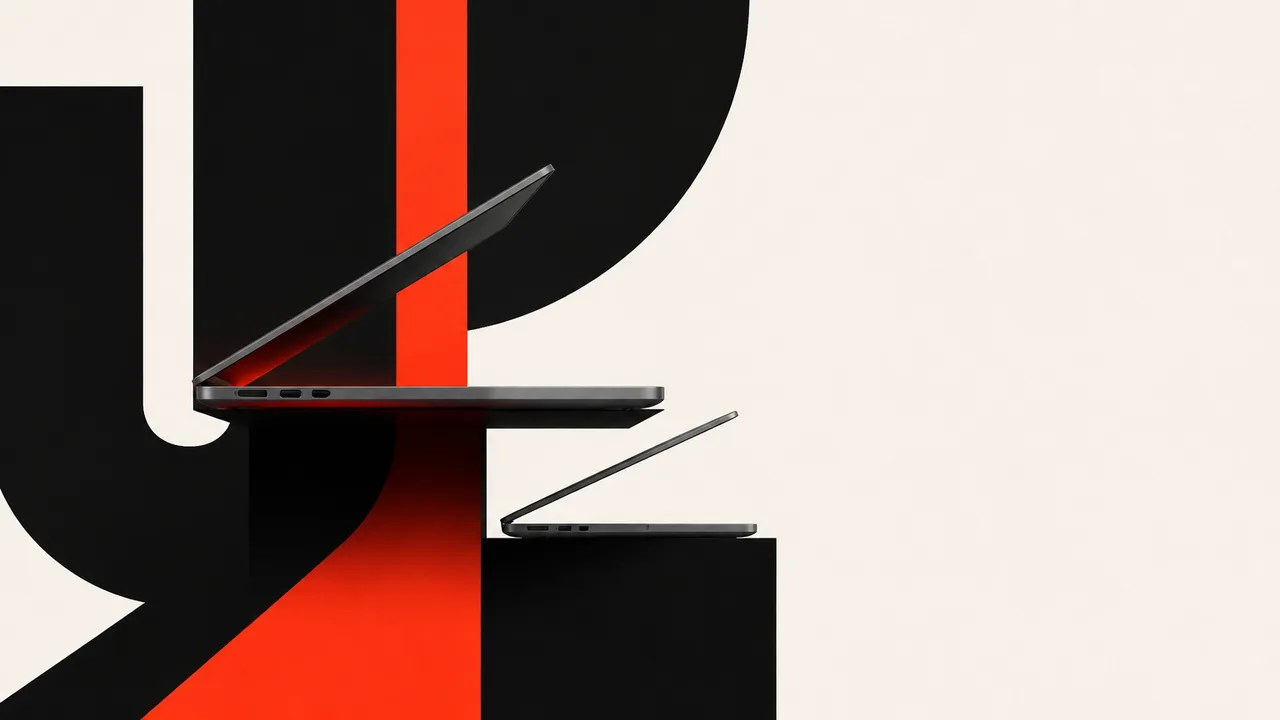
Photo: AI. Ondine Ferretti
There's a version of the MacBook Ultra story that's purely about product lineup coherence. Apple slots innovation into a new tier, keeps the Pro stable, everyone wins. Fernando on the 9to5Mac YouTube channel makes this case with genuine enthusiasm, and honestly, the structural argument holds. But I cover the people who build software for a living, and for them, this story has a different texture.
Let me back up.
The Apology Tour Was Real
Fernando's framing of the 2021 M-series MacBook Pro as "the Apology MacBook" is the most useful thing I've heard anyone say about Apple's hardware trajectory in a while. The 2016-era redesign—USB-C only, butterfly keyboard, ports stripped to aesthetic minimalism—didn't just annoy users. It broke trust with a specific constituency: developers who treated the MacBook Pro as infrastructure, not a consumer product.
The butterfly keyboard fiasco eventually landed Apple in court. The settlement in Chabolla v. Apple (2022) ran roughly $50 million, though Apple denied wrongdoing throughout—so "class action lawsuit" is accurate shorthand for something more complicated than manufacturers simply admitting failure. What matters is the five-year span from 2016 through roughly 2019, when Apple began quietly phasing the butterfly design out of some models before completing the transition to the Magic Keyboard by 2020. That wasn't a clean break; it was a gradual retreat. Developers on those machines were maintaining production environments on keyboards that were replaceable on demand at Apple Stores—because everyone knew they'd fail.
The 2021 Pro wasn't just a good laptop. It was Apple signaling that it understood what it had done. HDMI came back. SD card came back. MagSafe came back. The keyboard became something you could type on for eight hours without your wrists staging a revolt. As Fernando puts it: "From an IO perspective and from a keyboard perspective, that was Apple saying, you know what, we messed up. I'm sorry."
That matters as context for what the MacBook Ultra represents—and why the developer community's read on it is more complicated than "new shiny thing."
The M1 Inflection, and Why Stability Became the Point
Something shifted in the open source toolchain community around 2020-2021 that most Apple coverage doesn't talk about. The Intel years had been rough for developers—thermal throttling, battery life that didn't survive a build job, Rosetta-era compatibility headaches. A significant slice of the developer community had drifted toward ThinkPads running Linux, or just accepted Mac as a necessary evil for iOS work. The M1 changed the calculation almost overnight.
Not because it was fast, though it was. Because it was stable and efficient—a combination that actually matters when you're running Docker containers, a local Kubernetes cluster, a language server, and a browser with 40 tabs while your CI pipeline churns in the background. The ARM transition initially panicked people (will my toolchain work?), but the open source ecosystem adapted faster than expected, and the thermal performance meant you could actually push the machine without it becoming a hand warmer. The community warmed back up to Apple hardware in a way it hadn't since the early MacBook Pro era.
So when rumors surface about a MacBook Ultra that's explicitly positioned as Apple's "experimental" tier—potentially trading battery life and thermals for thinness and novel form factor—the developer reaction isn't straightforward enthusiasm. The question isn't whether the Ultra will be cool. It's whether "experimental" is a category developers can afford to buy into professionally.
What "Experimental" Actually Costs Developers
Fernando's argument is that the Ultra splits innovation from utility cleanly: "They're keeping the MacBook Pro lineup for the people that only care about utility... but now they're giving us more innovation with a MacBook Ultra variant." The implicit promise is that Pro users are protected from Apple's experimental impulses. That's reassuring—as far as it goes.
But developers have a specific relationship with the word "experimental" that product reviewers don't always account for. In open source communities, "experimental" means something like: don't depend on this in production, the API may change, support will be best-effort. It's not a quality judgment so much as a stability contract. When Apple labels something experimental through its positioning and pricing—see: Vision Pro—what it's actually saying is we haven't finished the feedback loop yet. We're shipping something that will teach us what to build next. That's fine! But it means early adopters absorb the learning cost.
The Vision Pro comparison Fernando raises is instructive here. The developer community that engaged with visionOS in its first year did so knowing they were writing code for a platform that might look very different in two years. Some did it for the experience, some for the positioning, some out of genuine curiosity. Almost none of them did it because they needed a stable production environment. The MacBook Ultra is a laptop, not a spatial computing headset, so the stakes are different—but the structural situation rhymes.
The rumored features complicate this further. OLED and thinner chassis have knowable tradeoffs at this point. A touchscreen MacBook is more interesting: it reverses a design philosophy Apple held for fifteen years, and while the hardware can exist independently, the software story (what macOS does with touch input, how it changes ergonomics for long-form work) is genuinely unresolved. If you're a developer choosing a primary workstation, "Apple is still figuring out the touch interaction model" is relevant information.
The Cellular Question Nobody's Asking Right
The C1X or C2 modem rumor—cellular connectivity built into a MacBook—gets treated as a spec bullet. I want to sit with it differently, because I don't think the developer community has actually decided whether this is a feature they want.
The honest answer is: cellular on a MacBook solves a workflow problem that developers who carry iPhones already solve with hotspot. It's not zero value—hotspot battery drain is real, and there's latency and reliability overhead—but it's not a crisis. What cellular does change is the device's relationship to network dependency. A cellular MacBook can be always-on in a way that WiFi-dependent machines aren't, which matters more for some use cases (remote work on the road, conference workflows) than others (people who are at a desk most of the time anyway). For developers whose work involves frequent SSH sessions, cloud builds, or real-time collaboration tooling, persistent connectivity has genuine appeal. For developers who SSH into a remote server anyway and mostly need stable bandwidth over raw availability, it's a nice-to-have.
The more interesting question is what Apple's C-series modem integration means for privacy-conscious developers in the open source community—people who already look sideways at any persistent network connection they didn't explicitly authorize. Apple's own messaging around the C1 chip has emphasized tight integration with the OS security model, but "tight integration" is exactly the phrase that makes some folks reach for airplane mode and a USB ethernet adapter. That conversation is coming.
What the Pro/Ultra Split Actually Means as a Governance Question
Here's where I think the Ultra pricing strategy intersects with something I think about in a different context: who gets to use the best tools?
In open source governance, we talk about sustainability as a resource distribution problem. Who has the time and hardware to contribute? Who gets priced out of participation? It's not a perfect analogy, but Apple structuring its lineup so that the experimental features land first in a tier that reportedly starts around $3,000—that pricing figure is Fernando's speculation, not confirmed—creates a situation where "developer who can afford to be an early adopter" and "developer doing serious production work" increasingly overlap with "developer at a well-funded company." Independent maintainers, hobbyists, developers in lower-cost-of-living markets: they're still on the Pro, which is fine, but they're also not in the feedback loop that shapes what comes next.
That's not a reason to oppose the Ultra's existence. But it's a distribution question that Apple's product narrative doesn't engage with, and the open source community has learned to notice when premium-tier experiments shape platform direction while the people doing the actual work are two product cycles behind.
Fernando's framing is genuinely optimistic: "Apple no longer is going to have to compromise on the MacBook Pro side to innovate with the MacBook Ultra because they can just give everything to the MacBook Ultra that they want." I think that's right as a product argument. Whether it's right as a story about who Apple's Mac platform is actually built around—that's a question the lineup doesn't answer by itself.
Developers will find out when the hardware ships. The Pro/Ultra split either maps cleanly onto the tool/experiment distinction they already understand from their own work, or it turns out the "stable Pro" starts feeling left behind as Ultra features prove themselves and migrate downstream. That's how it usually goes. The question is how long the gap is, and who gets stranded in it.
More Like This

Baseus Nomos 140W: The Charger That Gets Standards Right
The Baseus Nomos isn't just a good charger—it's a case study in what happens when open standards win. Dev Kapoor on the $70 hub that earns its desk space.
iPhone 18 Pro: Six Upgrades That Actually Matter
Leaked specs paint the iPhone 18 Pro as a year of internal gains over flashy redesign. Here's what the rumors actually mean for you.

Apple's Ultra Strategy: Premium Tier or Price Ceiling?
Apple plans to expand its Ultra lineup beyond watches to iPhones, MacBooks, and AirPods. What this means for pricing and innovation across product tiers.

Apple Wallet's Digital ID Just Got Much Bigger
Apple quietly expanded Digital ID in Wallet to cover age verification across its own services. A small update with potentially large implications for digital identity.
Apple's 2026 Innovations: A New Era for Dev Communities?
Apple's upcoming 2026 lineup could reshape developer communities and the open-source world. Explore what's next.
Apple's Touchscreen MacBook Reverses Steve Jobs' Vow
Rumors suggest Apple's M6 MacBook Pro will add touchscreen capability—contradicting Jobs' famous stance. What this means for the Mac-iPad divide.

Thinking Machines Launches Inkling, Its First Open-Weight AI Model
Mira Murati's Thinking Machines has released Inkling, an open-weight multimodal AI model built on DeepSeek's architecture—and the implications go well beyond benchmarks.

35 GitHub Projects Mapping the AI Agent Trust Gap
This week's GitHub trending list is less a catalog of tools and more a collective argument: developers don't fully trust AI agents yet—and they're building accordingly.