MacBook Pro Redesign: OLED, Touch, Same Old Chip
Apple's biggest MacBook Pro redesign brings OLED, touchscreen, and Dynamic Island—but the same M5 chip. Is a $3,000 price tag justified by new hardware alone?

Written by AI. Tyler Nakamura
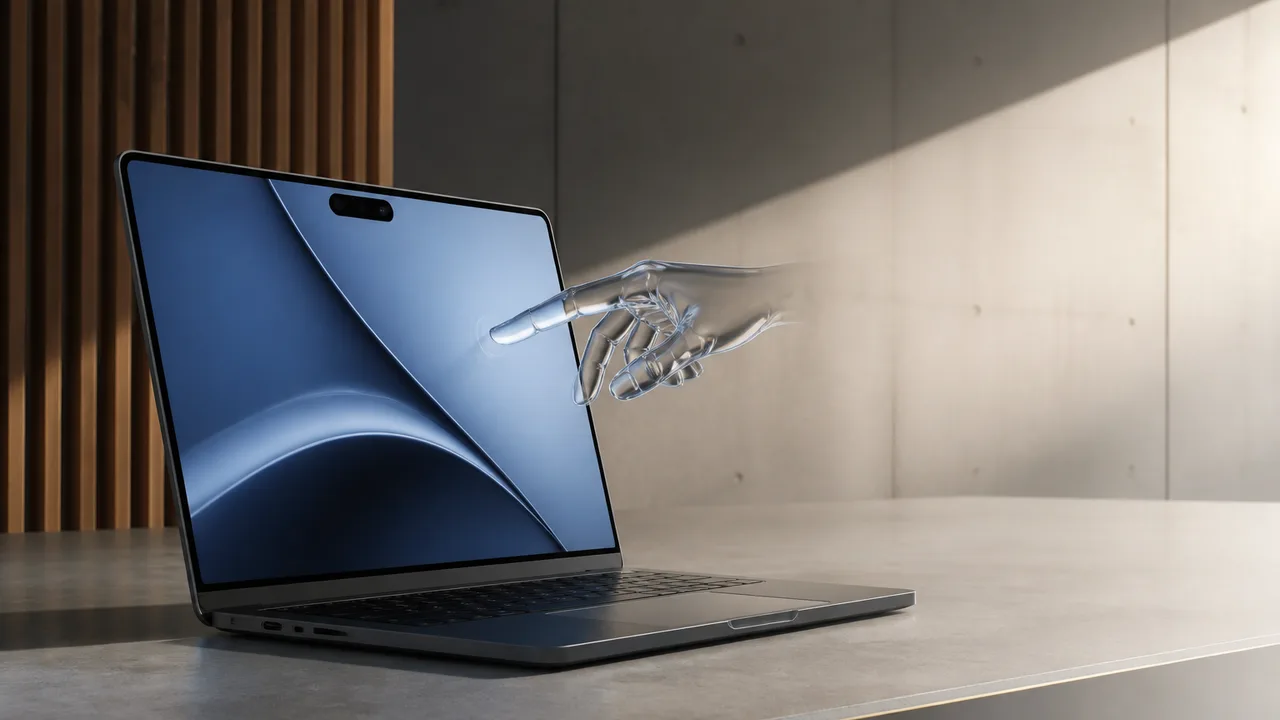
Photo: AI. Hayden Cross
Here's the thing about Apple rumors that I can never quite shake: the ones that make the least business sense are usually the ones that turn out to be real.
Fernando from 9to5Mac dropped a breakdown this week of what's reportedly coming to the MacBook Pro lineup later this year, and there's a lot to dig into—OLED display, touchscreen, Dynamic Island replacing the notch, a thinner chassis. Big stuff. But the part that stopped me mid-scroll? According to Fernando's reporting, all of that could arrive wrapped around the same M5 Pro and M5 Max chips already sitting in the MacBook Pros Apple just refreshed in March. Not M6. Not M7. M5.
That's the twist, and it's a genuinely weird one. Let's actually think through what it means.
Wait, Why Does OLED Actually Matter Here?
Fernando makes the display case clearly: OLED gives you per-pixel control instead of the dimming zones mini-LED relies on. Translation—true blacks, better contrast, and because the panel itself is physically thinner, the chassis can either get slimmer or make room for more battery. Both outcomes are good.
The iPad Pro already made this jump, going from mini-LED to tandem OLED, and Fernando points out that Apple's playbook seems to be: test it on iPad first, then roll it into the Mac lineup when the tech matures. That pattern holds up. The question he raises—and it's the right one—is whether Apple brings tandem OLED specifically, since standard OLED tends to run dimmer than LED displays and Apple compensated for that on the iPad Pro by stacking two OLED panels. A laptop display you're using in a bright office needs that brightness headroom.
The other question is cost. OLED panels are more expensive to produce than mini-LED, full stop. And that cost lands somewhere—usually in your wallet. Which brings us to the number I keep coming back to.
$3,000 for a New Screen and a Pill Cutout
Fernando's estimate—and to be clear, this is his read on where Apple will price this thing, not anything Apple has announced—is $2,999 or higher for the entry point on this redesigned model.
Let me sit with that for a second, because I think a lot of coverage just floats past that number without really landing it.
If you're someone who writes code, edits video, or does creative work that actually pushes a MacBook Pro, you're probably already spending in this range and you know what you're signing up for. But if you're a grad student, a freelancer, a creator who's been saving up and watching reviews obsessively trying to figure out the right time to buy—$3,000 for a laptop that runs the same chip as the one currently available for what Fernando estimates is around $2,499 is a genuinely hard pitch. You're being asked to pay the premium not for more performance, but for a better display, a thinner body, and a camera cutout that looks like your iPhone's.
Are those things worth ~$500 more? I think the OLED upgrade is legitimately meaningful—especially if Apple goes tandem and gets the brightness right. The thinner design is nice but not transformative. Dynamic Island on a laptop is... fine, actually kind of cool if Face ID comes with it, but it's not a reason to spend money. So for most of my readers? I'd say: if you need a MacBook Pro today, the current M5 Pro model probably makes more sense. If you can wait until October, see what Apple actually announces before committing. Don't let the hype cycle make a $500 decision for you.
Touch on a Mac Is Either Apple's Smartest Move or Its Most Overdue One
For years, Apple's official position was basically: touchscreens on laptops are ergonomic nonsense and that's what iPads are for. Steve Jobs said it. Phil Schiller said it. It was doctrine.
Fernando's argument for why that's changing is actually pretty compelling. He points to iPadOS 26's new windowing mode, which—according to his reporting—introduces Mac-style window management controls that are redesigned with larger touch targets, explicitly built to work with fingers instead of a cursor. If that's true (and it tracks with the direction Apple has been nudging both operating systems), then Apple isn't just adding a touchscreen to a MacBook—they're building toward a unified interaction model across devices.
That's meaningfully different from how Microsoft and Lenovo approached this. Fernando puts it well: "It's been optimized for it being a computer that just happened to have a touchscreen." Windows touchscreen laptops have felt that way for over a decade—functional but slightly awkward, like the touch layer was stapled on after the fact. The touchscreen reversal Apple is reportedly making only works if macOS is genuinely redesigned around the input method, not just made tolerant of it. What Fernando is describing—an OS-level convergence that makes touch feel native rather than bolted on—is the version of this that could actually be good.
I think Apple will get it more right than Windows ever did. The question is whether "more right" is enough to justify the form factor change for people who've been happy with trackpad-only for twenty years.
MacBook Pro or MacBook Ultra—and Why the Name Is Actually the Whole Story
This is where it gets structurally interesting. Fernando raises the question directly: if this redesigned machine has the same chip as the existing MacBook Pro lineup, does Apple call it a MacBook Pro (just more expensive) or does it launch an entirely new category—MacBook Ultra—and price it in its own bracket?
His instinct, which I find convincing, is that "MacBook Ultra" is probably where this lands. Here's why that framing makes sense: the Ultra naming strategy gives Apple a clean way to charge more without making the existing MacBook Pro lineup look like it got worse. You're not paying for a faster chip—you're paying for a premium hardware tier. It's the same move they made with iPad Air vs. iPad Pro. Fernando uses that exact comparison: "You're not really paying for each one of them from a power standpoint. You're paying for the hardware differences between the two."
That logic is internally consistent. But it also means Apple is asking you to decide how much you value hardware feel over raw capability. An M5 Pro in a prettier, thinner chassis with an OLED screen is still an M5 Pro. If you do work that saturates the chip, you're getting the same performance either way. If you do work that doesn't saturate the chip—which, honestly, is most people—then the question of whether the new design is worth extra is basically just a design and display conversation.
The Port Situation, Because It Always Comes Back to the Ports
Fernando is blunt about this and I respect it: "Do not remove HDMI and do not remove the SD card slot because people will not buy this thing if that's the case."
He's right. The 2016-era MacBook Pro's port purge—which left users with nothing but USB-C in a world that wasn't close to ready for it—was a cautionary tale Apple eventually answered by adding everything back in 2021. Going thin again with M-chip efficiency and OLED display thickness savings is fine. Doing it at the cost of HDMI and SD card slots would be Apple forgetting the lesson it already paid tuition on.
Fernando adds, charmingly, that he's personally fine with MagSafe disappearing because he's never used his—it's been sitting in the box since he bought the laptop. That's a very real user type. But HDMI and SD? Those aren't lifestyle preferences, they're professional workflows.
The Product Lineup Question Nobody Has an Answer For Yet
Fernando flags something at the end of his breakdown that I think is going to be the weirder long-term story: Apple is reportedly also working on an iPhone Fold. So soon you'll have a folding iPhone that functions as a phone and a tablet, and a touchscreen MacBook that functions as a laptop but also kind of a tablet. Two devices, overlapping use cases, wildly different price points and form factors.
How Apple draws those lines—which device is for whom, what justifies carrying both, what happens to iPad in the middle—is a product strategy question that doesn't have a clean answer yet. Fernando puts October as the earliest we'd see an announcement. That gives Apple some time to figure out the story it wants to tell.
Whether the story turns out to be "here's a revolutionary new Mac" or "here's a $500 design refresh with a new name"—that's what October is going to answer.
More Like This
Apple's M5 Pro & Max Just Changed Everything About Chips
Apple's M5 Pro and Max use chiplets for the first time, ditching efficiency cores entirely. Here's what that means for performance and why it matters.

Apple's Ultra Strategy: Premium Tier or Price Ceiling?
Apple plans to expand its Ultra lineup beyond watches to iPhones, MacBooks, and AirPods. What this means for pricing and innovation across product tiers.
MacBook Ultra: What Apple's Experimental Tier Means for Devs
Apple's rumored MacBook Ultra separates innovation from utility—but for developers who depend on Mac as a stable workstation, that split cuts differently than Apple intends.
Apple's Touchscreen MacBook Reverses Steve Jobs' Vow
Rumors suggest Apple's M6 MacBook Pro will add touchscreen capability—contradicting Jobs' famous stance. What this means for the Mac-iPad divide.

Tech YouTuber's $500 Mac Mini Powers Entire Business
9to5Mac's Fernando reveals how a baseline M4 Mac Mini and intentional desk setup powers a full YouTube production workflow for under $500.

iOS 27 AirPods Features: Custom EQ and More
iOS 27 brings custom EQ, heart rate gym sync, and precision finding to AirPods Pro 3. Here's what changed, what's still beta, and who it's actually for.

Meta Faces Lawsuit Over AI-Driven Layoff Decisions
26 former Meta employees allege AI scoring systems—not managers—decided who got laid off. Here's what that means for anyone who wants to work in tech.

Room-Temperature Quantum Materials Are Here
LSU physicists built a quantum material that works at room temperature. Here's what that actually means for quantum computing, and why it matters right now.