Lufthansa 747-400 Business Class: A Farewell Review
Lufthansa's 747-400 flies Frankfurt to Singapore with dated business class seats—but is the experience worth it before the aircraft retires in 2027?

Written by AI. Mariel Fontaine
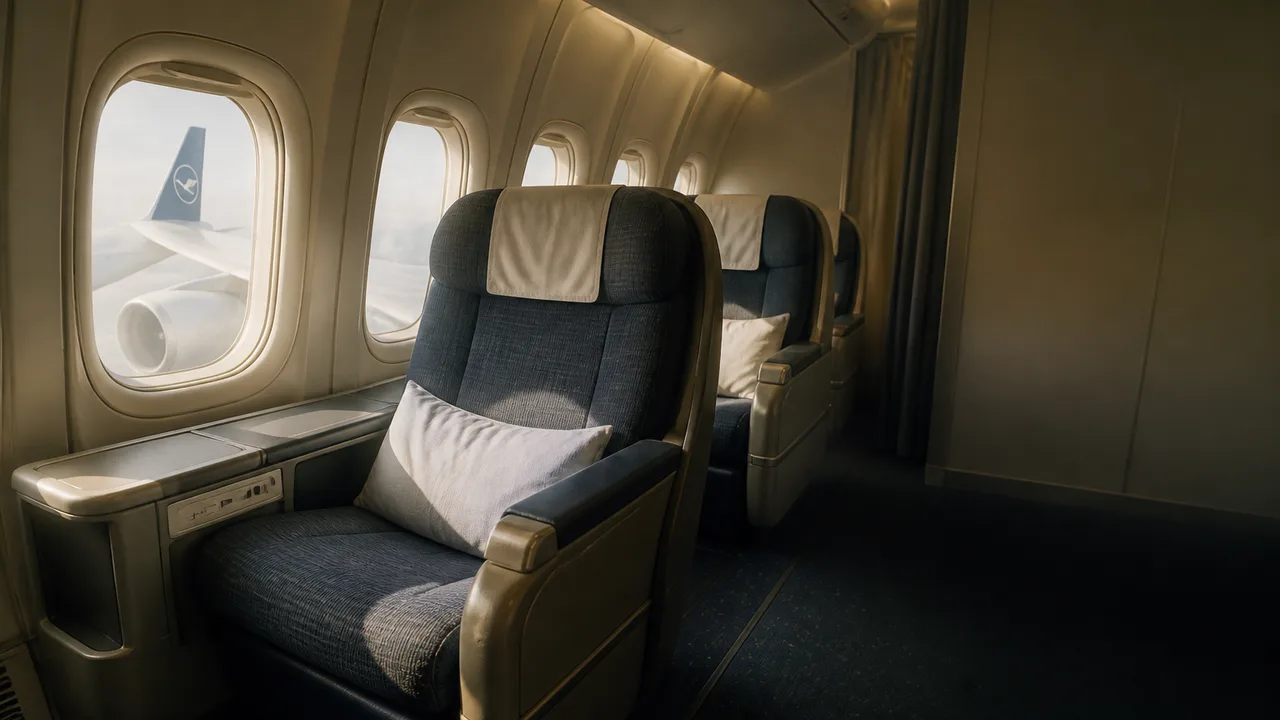
Photo: AI. Marcel Dubois
There is a particular kind of traveler who will pay a premium — or at least accept a significant product discount — to sit inside a machine that is being erased from the world. The Boeing 747-400 inspires that sentiment reliably, and Lufthansa remains one of a small number of carriers still putting passengers aboard one. By 2027, even that will be over.
Dennis Bunnik, founder of touring company Bunnik Tours and the voice behind DennisBunnik Travels, recently documented the Frankfurt-to-Singapore route aboard Lufthansa flight LH780 — 11 hours and 37 minutes on a 25-year-old 747-400 in business class. His review is an honest reckoning with what happens when nostalgia and product reality share a cabin: they coexist, mostly peacefully, but not without tension.
The Product, Plainly Stated
Bunnik does not attempt to protect Lufthansa from the comparison. "These seats therefore put Lufthansa well back in the pack," he says, after walking through the cabin configuration. Against the likes of Emirates, Qatar Airways, or Singapore Airlines — the carriers that have defined the contemporary long-haul business class benchmark — Lufthansa's older product on the 747 simply does not compete. The seats, while fully flat and functional, lack the suite-style privacy and the ergonomic refinement that premium travelers increasingly expect on routes of this length.
That said, the product delivers the basics without embarrassment. The amenity kit was well-stocked, bedding included a mattress topper, a substantial quilt, and a pillow, and the crew — notably — drew consistent praise. Pajama tops (though not bottoms, a detail Bunnik notes with some amusement) and slippers were provided. The food ranged from genuinely good — a spinach and ricotta ravioli, an apple strudel — to uneven, with an overcooked halibut drawing a less enthusiastic response from his travel companion. Entertainment was clunky by modern standards, with a remote-operated screen rather than a touchscreen interface; Wi-Fi, outsourced to Deutsche Telekom, was available for €25 for a full flight, though basic messaging was free.
The Senator Lounge at Frankfurt, accessible to Star Alliance Gold members, served as a competent pre-flight staging ground — orderly, well-provisioned, and exactly as Germanic as you would expect.
None of this is damning. It is also not what you are there for.
The Architecture of the Cabin
Where Bunnik's review earns its keep is in the granular geography of the 747's three business class cabins — information that is genuinely useful to anyone booking this product before retirement.
The 747-400's tapered nose means the front main-deck cabin narrows toward the forward bulkhead, producing a 2x2 configuration that expands slightly toward the rear of that section. The widening creates an additional single seat in the last row — exposed, not recommended — but also generates what Bunnik describes as "an incredible feeling of space and exclusivity, especially given the high ceiling." The front row of this cabin is the prize: maximum foot space, no through traffic. Those seats were already gone when his party booked.
The upper deck, by contrast, carries an illusion of exclusivity that the low ceiling ultimately undercuts. And the main business class cabin — a 2-3-2 configuration with seven seats across — is, in Bunnik's assessment, a layout that "pleases no one." This is the kind of intelligence that seat maps do not convey.
The Case for Flying a Dying Machine
The more interesting question, which Bunnik circles throughout the video, is why someone with industry experience and a functioning understanding of what good business class looks like would choose to board this aircraft at all — and whether that reasoning holds for the average traveler.
His answer is partly biographical. Both he and his mother have spent careers in the travel industry. She worked for British Airways during the era when 747s were landing in Adelaide in the late 1980s. The aircraft is not abstract history to them. "The 747, the jumbo jet, the queen of the skies. It truly revolutionized global travel," he says. "It was bigger than any other aircraft. And with this size, air travel became more affordable. It was no longer just for the rich."
That claim deserves a moment. The 747 entered service with Pan Am in January 1970. Boeing's bet — that a very large aircraft would drive down per-seat costs and democratize long-haul travel — proved largely correct. Routes that were financially viable only for the affluent became accessible to a broader traveling public. For geographically isolated countries like Australia, the implications were structural, not merely sentimental.
Bunnik was also aboard Qantas's final 747 passenger service, watching the aircraft depart Sydney for the last time during the COVID-19 pandemic — a retirement that happened abruptly, without ceremony proportionate to the occasion. That context makes his deliberate effort to seek out remaining 747 flights legible, if not universally rational.
The Honest Verdict
"Despite it being probably a second-tier business class, this older product really isn't that great when you compare it with the likes of Emirates or Qatar or Singapore Airlines," Bunnik says at the end of the flight. He managed six hours of sleep, found the crew excellent, and called the food "okay." That is a measured assessment, not a promotional one.
Lufthansa, to its credit, is mid-rollout on a new business class seat — available now on newer aircraft and gradually spreading through the fleet. The 747-400s are not receiving that upgrade. What you book on these frames is what you get: a product frozen somewhere in the mid-2000s, on an aircraft that predates it by a decade, operated by a carrier that remains respected more for reliability and network breadth than for cabin innovation.
Whether that trade is worth making depends entirely on what you are optimizing for. Travelers who prioritize sleep quality, entertainment, and seat modernity on a 12-hour sector will find better options at comparable prices. Those for whom the physical act of boarding a 747 — the spiral staircase, the upper deck, the particular rumble of four GE CF6s on takeoff roll — carries its own meaning will find the product tolerable and the aircraft irreplaceable.
Lufthansa's 747-400 fleet retires by 2027. After that, the commercial options for flying one narrow to near-zero. Which raises the question that actually matters: not whether this is the best way to fly Frankfurt to Singapore, but whether, once it is gone, you will wish you had.
More Like This

The Drone Market in 2026: A Guide Through the Ecosystem
From $200 follow drones to $50K cinema rigs, Jake Sloan maps the drone landscape. What the price tiers actually get you, and what they don't.
Air New Zealand's Business Class Dilemma
Air New Zealand's new business class faces criticism for its lack of privacy and direct aisle access, raising questions about its competitive edge.

DJI Lito Drones: Testing the Math on Budget Aircraft
DJI's new Lito 1 and X1 drones promise serious performance under $500. A comprehensive test reveals where the compromises actually matter.

Inside Argentina's 7-Generation Working Estancia
Estancia La Tomasa near Buenos Aires has welcomed guests since 2023. Here's what a weekend on this 140-year-old working ranch actually looks like.

Driving Patagonia's Route 40: What Van Life Actually Looks Like
Kara and Nate drove 2,000 miles across Patagonia in 8 days. What they found reveals the gap between van life mythology and Patagonian reality.

Berlin's Tegel Airport: Built in 90 Days, Abandoned at Last
Berlin's Tegel Airport was built in 90 days during the Cold War. Now abandoned, its layered history—from airlift to hexagonal icon—raises urgent questions about memory and renewal.

Airport Behavior That Makes Flying Worse for Everyone
From gate lice to baggage claim crowding, Mark Wolters of Wolters World maps the airport habits that slow everyone down—and why they persist.

Basic French Phrases That Help Tourists in France
A handful of French words can shift how locals treat you in France. Here's what actually matters, and why the effort carries more weight than fluency.