Lilly's EloraTZP Trial Tests Weight Loss and Tolerability
Lilly's EloraTZP showed substantial weight loss in a Phase 2b trial, alongside treatment discontinuations. What the results say about benefit and tolerability.

Written by AI. Kira Yoshida
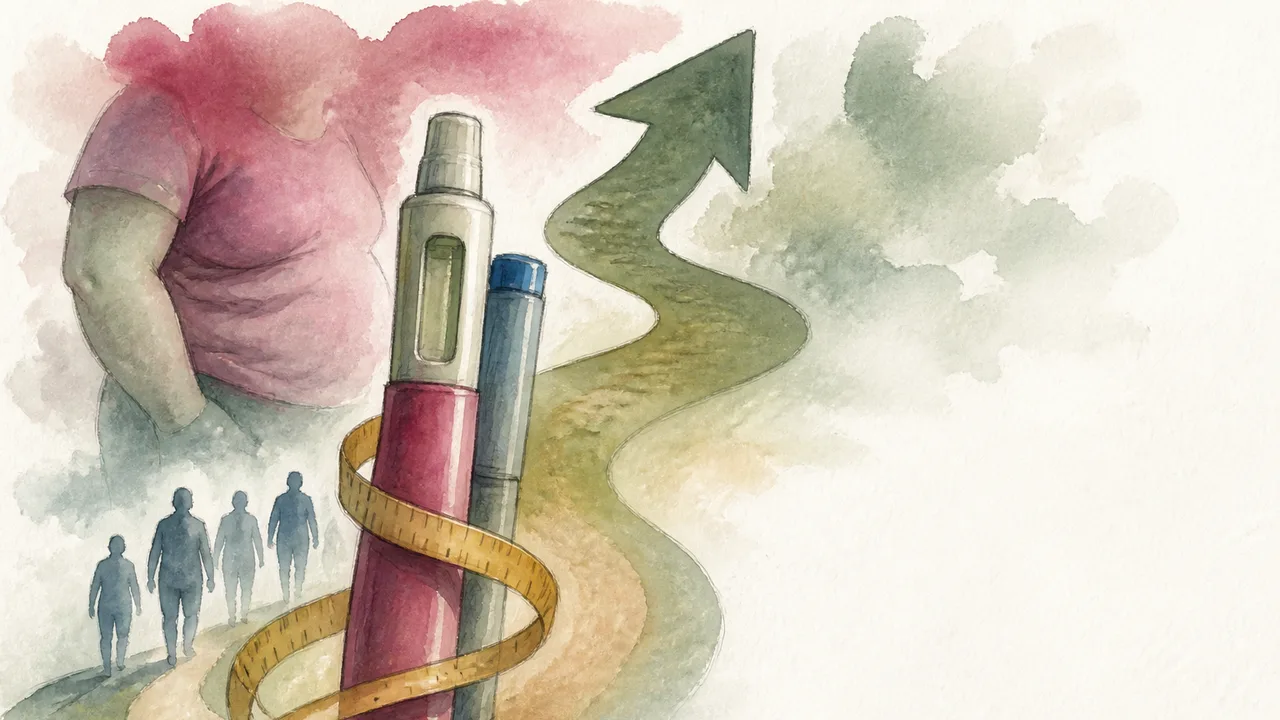
Eli Lilly's EloraTZP combination produced an average 23.3% weight-loss estimate at 48 weeks in the highest-dose group of a Phase 2b trial. Across the combination groups, 10.8% to 27.0% stopped treatment because of adverse events, Lilly said. The same trial offers both the number that could sell a treatment and a warning about what taking it might demand.
The trial tested investigational eloralintide alongside tirzepatide, the ingredient in Zepbound and Mounjaro. Lilly randomized 367 adults in the United States and Argentina to receive different doses of the combination, either drug alone, or placebo. All had type 2 diabetes and obesity or overweight. The double-blind study ran for 48 weeks, and Lilly presented results on September 30 at the European Association for the Study of Diabetes meeting in Milan. The company has released a results summary, rather than a full paper showing how outcomes varied among participants.
Put the Drugs Beside Their Actual Comparators
In Lilly's results table, 9 mg eloralintide plus 15 mg tirzepatide had an estimated average weight reduction of 23.3%. The 15 mg tirzepatide-only group had a 14.8% reduction; the largest reported eloralintide-only result was 12.3% at 6 mg. Placebo's figure was 3.0%. Those groups belonged to the same randomized trial and were followed over the same period. A medication leaderboard assembled from separate trials would mix different people and treatment schedules, then pretend the numbers were neighbors.
The trial's primary endpoint was the combination's percentage change in weight versus placebo at 48 weeks. Comparisons with tirzepatide alone and the other treatment groups were secondary. Tirzepatide still provides a useful within-trial alternative to examine: the question of adding eloralintide only makes sense beside what tirzepatide achieved on its own. The average changes, though, cannot tell any one person whether the added treatment would be worth taking.
Lilly defines its efficacy estimand as the effect treatment would have achieved had all randomized participants remained on their assigned intervention, allowing possible dose interruptions or changes, without starting prohibited weight-management treatments. For blood-sugar outcomes, the definition also excludes starting rescue therapy. That's the question behind the 23.3% estimate. It includes an assumption about continuing treatment, even though some participants stopped it.
The summary gives a discontinuation range across combination groups without pairing a rate with each dose's weight result. We therefore cannot put a corresponding adverse-event discontinuation rate next to the 9 mg plus 15 mg result. If you're weighing an additional medicine against the one you already take, that missing pair of numbers is more consequential than another decimal place in the weight estimate.
Weight was only one outcome for participants living with type 2 diabetes. From an average starting A1C of 8.1%, the highest-dose combination group had a reported average A1C reduction of 2.9 percentage points, compared with 2.4 percentage points for tirzepatide alone and 0.3 percentage points for placebo. A1C reflects average blood glucose over recent months. The glucose result gives researchers another reason to test the pairing; a contest over weight loss alone would leave out an outcome relevant to this trial's participants. These 48-week results do not establish whether the combination reduces cardiovascular events.
When the Doses Go Up, Who Keeps Taking Them?
Lilly described the most common adverse events as gastrointestinal, generally mild or moderate, and occurring mainly while doses increased. They were more frequent in combination groups than with either medicine alone. Treatment discontinuation because of adverse events was 2.9% with tirzepatide alone, compared with the 10.8% to 27.0% range across combination groups. The placebo figure was 16.7%. These figures count people who stopped treatment because of adverse events, rather than everyone who left the trial.
The placebo rate cautions against assuming every event that preceded stopping treatment was caused by a drug. It offers no reason to wave away the combination rates. Nor does a label of mild or moderate tell you how long someone would want to put up with nausea or another symptom. For a person considering a second medicine, being able to continue it belongs in the benefit discussion, right alongside what it can achieve.
Kenneth Custer, who leads Lilly's cardiometabolic business, argued that raising doses of two drugs at once complicates judgments about tolerability, BioSpace reported from an EASD press conference. Lilly plans an adjusted dose-escalation schedule in Phase 3. That change could test his explanation; these Phase 2b results cannot show whether a revised schedule will reduce discontinuations.
The two drugs came as separate injections in this trial. Lilly plans to study a co-formulated product containing both in a single injection. One injection could simplify the routine. It cannot tell us, in advance, whether the combination will be easier on the stomach. Lilly's results summary reports weight, A1C and adverse events; it does not report how treatment fitted around anyone's workday or meals.
The Earlier Signal, and the Next Test
An earlier Phase 1 test helps explain why Lilly took the combination further. Adding 3 mg eloralintide to 5 mg tirzepatide was associated with 17% weight loss over 16 weeks, versus 10% with that tirzepatide dose alone, according to Lilly's figures reported by CNBC. The Phase 2b study followed people longer, included people with type 2 diabetes, and tested several doses; its highest-dose pairing used 9 mg eloralintide and 15 mg tirzepatide. Different participants, doses and durations prevent a clean numerical comparison between the stages. Phase 1 supplied a reason to ask a larger question, rather than a preview of everyone's 48-week result.
Tirzepatide acts on the GIP and GLP-1 pathways; eloralintide targets the amylin pathway, which is involved in appetite and fullness. The combination tests whether engaging another pathway can improve weight and glucose outcomes enough to justify another medicine. In this trial's group averages, the highest-dose pairing did more on both measures than tirzepatide alone. The adverse-event discontinuations make the next experiment about the regimen as well as the molecules.
Lora Heisler, a researcher who was not involved in the trial, told New Scientist that additional benefit might not outweigh added burden or side effects for someone already doing well on tirzepatide. That's her judgment about a possible choice, rather than an outcome measured in a group selected for doing well on that drug. Someone else may value a further change in glucose or weight enough to consider the trade-off. Neither preference can be read from an average, and no trial participant owes anyone the largest possible weight change.
Lilly plans to begin Phase 3 studies of the combination by the end of 2026, with a revised dose schedule and a single-injection product. The current results give a credible reason to test those changes. They cannot say whether the person drawn to the 23.3% figure will be able, or want, to stay with the treatment that produced it.
More Like This
The Sardine Fast: Metabolic Reset or Wellness Trend?
Thomas DeLauer breaks down the physiology of eating only sardines for three days. Here's what the science actually supports—and where the gaps are.

Eckhart Tolle Says Know Less. Your Body Already Does.
Eckhart Tolle's case for 'not knowing' as spiritual awakening has real overlap with movement science—and a $139/year subscription attached to it.