Kelly Clarkson's AI Chart Proposal Tests Who Gets Ranked
Kelly Clarkson wants AI artists on separate music charts. Billboard favors identifying AI use; Australia's ARIA draws an eligibility line at human performance.

Written by AI. Bob Reynolds
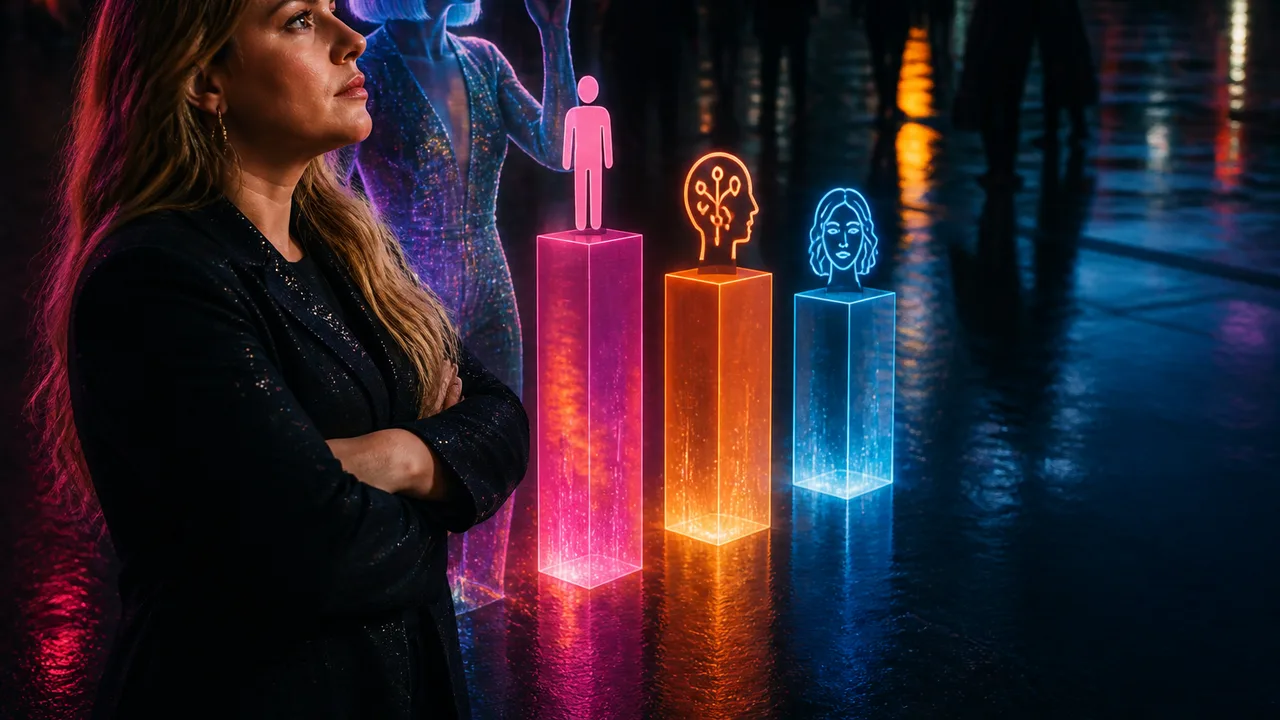
Kelly Clarkson wants AI artists on a separate music chart from human musicians. On the Las Culturistas podcast, she said she enjoys using AI creatively but objects when an AI artist competes on the same chart as a human artist. “I think there should be a separate chart,” she said. She thinks listeners can have an appetite for both kinds of music. Her objection is to giving them the same ranking.
Consider two recordings: one has a generated lead vocal over instruments played by people; the other has a human performance finished with AI mastering. Sending both to an AI chart would group an automated production step with a synthetic singer. Sending only the first would require someone to decide which parts of a recording count as its primary performance. Either decision changes where the songs can appear, even if their listeners do nothing differently.
Clarkson compared a shared chart to robots competing against humans at the Olympics. A musician who sees a chart as recognition for performance may find that persuasive. But an Olympic result measures competitors under common rules. A music chart ranks recordings through audience activity. Someone can stream a track without knowing who sang it or how it was produced; the rank cannot tell us what that listener valued. Clarkson wants the chart to recognize the people making the music as well as the people listening to it.
AI-associated acts were appearing on charts before Clarkson made that argument. Xania Monet entered Billboard charts in September 2025 and later signed a $3 million record deal, Consequence reported. The chart entry made the issue concrete: an act identified with AI could be ranked alongside other acts. It does not tell us whether any individual Xania Monet recording would pass a rule based on who performed its vocal or instruments.
Counting Plays, Choosing Entrants
Billboard's stated direction leaves room for an AI-generated song on a shared chart. In August, it reaffirmed a commitment to identify such songs if they enter its charts. Silvio Pietroluongo, its executive vice president of charts and data partnerships, said it would keep testing identification tools so the charts could “accurately and responsibly reflect music consumption.” That is a public commitment to identification, not a complete rule for classifying every mix of human and generated work.
A listener checking a shared ranking could see the popularity of an AI-generated recording alongside other releases. A useful identification would also tell that listener what AI did. “Uses AI” alone leaves the generated lead vocal and the AI-mastered human performance looking much the same. Billboard has described work on identification tools; its statement does not establish that it can already settle every borderline case. For an artist, meanwhile, a label beside a shared rank may still leave intact the competition Clarkson objects to.
Australia has made a more explicit choice about entry. On August 25, the Australian Recording Industry Association announced that wholly AI-generated tracks would be ineligible for its charts, while recordings using generative AI in a supporting role could remain eligible. The change took effect with the chart dated August 31. Among ARIA's conditions for a recording developed using generative AI: it must be substantially human-made and raise no stream or chart-manipulation concerns. ARIA can remove a recording it finds ineligible, and artists or their representatives can contest an exclusion.
ARIA's examples put a generated lead vocal or key instrumental performance on the ineligible side. Music made entirely from a prompt is out too; human mixing or mastering afterward does not reverse that decision. A song written and chiefly performed by people can remain eligible with minor AI-generated backing vocals, provided it meets the other conditions. AI mastering alone does not disqualify it. Under ARIA's rule, the two hypothetical recordings would land on opposite sides of the entry line.
That line requires paperwork as well as judgment. ARIA says every release submitted to its chart survey must include a declaration about generative AI use. If someone raises a credible concern, it seeks more information from the rights holder and gives the artist a chance to respond. A declaration gives ARIA a starting point; a dispute process gives an artist a way to challenge its decision. ARIA also acknowledges that deciding whether human input was primary may get harder. Clarkson has proposed a second chart, but has not set out where a song with minor generated backing vocals would go. Both arrangements require a person to make the classification before the ranking can do its work.
ARIA's rule does not determine what a listener can play. Streams and sales still set positions among recordings that qualify, while chart eligibility does not determine royalties, radio play or whether a service carries a track, ARIA says. A generated lead vocal could therefore keep attracting streams and remain available for distribution while earning no place on ARIA's chart. The AI-mastered human performance could qualify for that chart. The songs have not changed; the rule decides which listening counts toward a position.
More Like This

Instagram Now Labels AI-Generated Profiles. What Changes?
Instagram is renaming its AI creator label and threatening reach reductions for undisclosed AI profiles. Here's what the policy actually covers and what it doesn't.
Grok 4.6, Cursor, and xAI's Accountability Gaps
Grok 4.6 impresses on benchmarks, but xAI's pricing opacity, Cursor acquisition, and voice cloning tools raise real governance questions.
Major Labels Want AI Music Off the Charts
Universal, Sony, and Warner are pushing to ban AI-generated songs from global charts. Here's what their proposal actually says — and who it really helps.

MiniMax-Music3 Generates Full Songs From Lyrics
MiniMax-Music3 is an open-weights AI model that turns lyrics into complete five-minute songs. Here's what it actually does, and what it means for music.

How Theo Cut a $2,000 AI Coding Run Down to $150
Developer Theo shows how configuring Claude's Fable 5 as an AI orchestrator—not just a chatbot—cleared a month of backlog in three days for around $150.
UBTech's Humanoid Robot Pushes Into Home and Border
UBTech's UWorld U1 humanoid aims to replicate human faces, voices, and emotions. Here's what the launch actually shows — and what it quietly sidesteps.