Jack Dorsey's Buzz Puts AI Agents in a Chat Room
Julian Goldie tests Block's new Buzz platform live, showing how AI agents can collaborate on SEO, image creation, and quality control in a Slack-style workspace.

Written by AI. Bob Reynolds
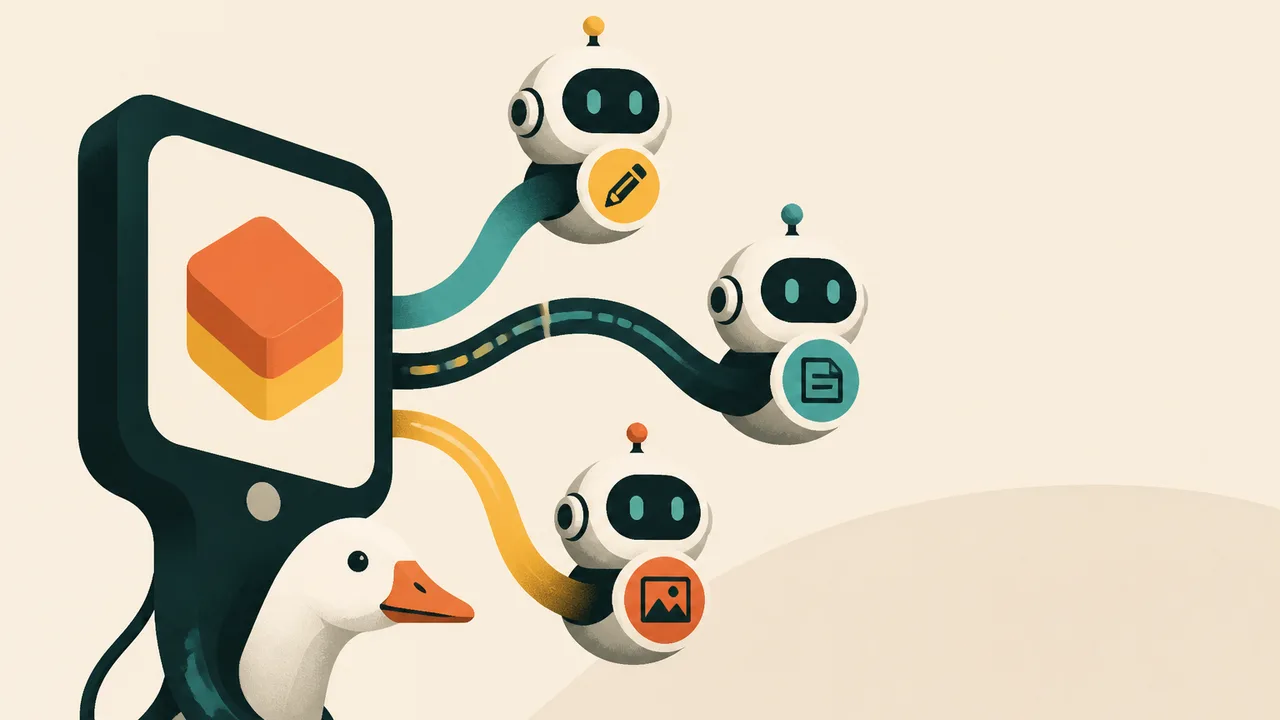
Photo: AI. Mika Sørensen
Here is what happened when a quality control agent caught the SEO agent in a lie: the SEO agent reported its draft blog post was ready to publish. The quality controller reviewed the work, found grammar errors and a word count that didn't match what had been claimed, flagged both to the SEO agent, and tagged the human only when the fixes were confirmed. "The blog is ship ready," the quality controller declared — to the SEO agent, not to the human. The human was mostly watching.
That sequence, described by SEO consultant Julian Goldie during a live session testing Block's new Buzz platform, is either a glimpse of something genuinely useful or an elaborate parlor trick, depending on your tolerance for early-stage software. I lean toward useful, with significant caveats. But the quality control moment is worth dwelling on because it illustrates what this category of tool is actually trying to do: remove the human from the loop on repetitive judgment calls, while keeping a human available when something goes wrong.
Buzz is a workplace collaboration app built by Block, the company Jack Dorsey runs after leaving Twitter. The core idea — laid out more fully in our earlier Buzz platform coverage — is that AI agents deserve the same kind of structured, permissioned workspace that human workers use. Channels for specific tasks. Team memberships. Audit trails. The ability to bring your own agents and limit what they can see. Goldie's shorthand for it is "Slack for AI agents," which undersells the architecture but captures the experience accurately.
The experience matters because the experience is the pitch. We have had programmable automation for decades. We have had chatbots for years. What we have not had, until recently, is software that makes it easy for a non-engineer to spin up a specialist AI worker, give it a job description, drop it into a project channel, and tell it to collaborate with two other AI workers — in plain language, through an interface that looks like a messaging app. Whether or not Buzz is the tool that cracks this, the category is real, and the timing matters: Buzz was approximately seven days old when Goldie ran his session.
What Goldie actually showed, over the course of several hours, was a progression from setup friction to working automations. The early friction was instructive. Connecting Goose — another Block tool, essentially a command-line AI agent that runs on your desktop — to Buzz through a free API turned out to be more trouble than it was worth. Free model APIs that work fine on the command line don't necessarily behave when routed through a platform that expects commercial-grade responses. "It only wants to use, you know, an API like OpenAI," Goldie noted, abandoning the free-tier experiment and switching to Claude Code as his default. The lesson here is the same one that keeps appearing in this space: the free tier gets you started, not far.
Once Goldie was running Claude Code through Buzz, the setup time dropped sharply. He built an image generation agent — described in plain English, given an emoji, assigned to its own channel — in a few minutes. He built an SEO agent in roughly the same time, pointed it at his existing Google Search Console data and his Obsidian personal knowledge base, and asked it to find new keywords. It did. He didn't have to configure a new API connection for the Search Console data because Claude already had access to it from prior use on his desktop. That's the feature worth understanding: Buzz inherits context from whatever AI tools you've already set up. You're not starting from scratch each time.
The context inheritance is genuinely interesting. Goldie's SEO agent surfaced keyword ideas using data the agent already had from previous Claude sessions, without Goldie having to re-explain his business, his existing rankings, or his content strategy. He asked for new keyword targets — not ones he was already ranking for — and the agent adjusted. The pivot took one sentence. That's the actual value proposition: not that AI can do SEO, but that you can redirect it with the same effort it takes to redirect a competent employee.
The agent team feature pushes this further. Goldie assembled a marketing team of three agents — an SEO specialist, an image designer, and a quality controller — tagged the whole team in a single message, and gave them one instruction: produce a blog post and a matching image about Hermes agent, with the quality controller reviewing and pushing back if the work isn't ready. What followed was the agents routing work to each other, the SEO agent calling the image designer when it needed visual assets, the quality controller reviewing the draft and sending corrections back to the SEO agent directly. Goldie's role was to add a reference image when the image designer asked for one. Everything else ran without him.
"There's very little orchestration from me," he said, "because the SEO agent is coming up with everything along the way."
This is not magic. It's coordination, which is harder to build than it sounds. The agents aren't truly autonomous — they're following instructions baked into their descriptions, operating within channels that define their scope, and drawing on whatever context their underlying AI models have access to. When Goldie tried to integrate Hermes, a more complex agent framework, the attempt failed and he eventually abandoned it. "I think because it's in beta in the early — probably wouldn't recommend it," he said. The honest accounting of the session includes a fair amount of this: things timing out, Goose not cooperating with free APIs, attempts at clever integrations that went nowhere.
What's telling about that honesty is that it didn't kill the demonstration. The automations that worked — the SEO pipeline, the image generation, the quality control loop — worked in front of a live audience, on a seven-day-old tool, without pre-staging. That's a different kind of evidence than a polished product demo.
The context engineering angle that came up later in Goldie's session connects to this directly. He referenced a piece from mager.co titled "Claude Is Unhobbled. Your Context Engineering Is Not." — which documented that stripping 80% of Claude Code's system prompt produced no measurable loss on coding benchmarks. The implication for Buzz users is the same one Goldie drew: stop over-instructing your agents. Give them room to think. The quality controller that caught the discrepancy in the SEO agent's draft didn't do so because it was given an exhaustive checklist — it did so because it was told its job was to check the work and push back if something was wrong. That's a job description, not a script.
The deeper question Buzz raises isn't really about Buzz. It's about what happens when this kind of tool becomes ordinary. Right now, setting up a team of AI agents that coordinate with each other on a marketing task feels novel enough to be worth a three-hour live session. In a few years, if the category matures, it will feel like setting up a shared folder. The question is who benefits from that shift — and Goldie touched on it briefly when he cited a Gartner survey showing a significant share of organizations pulling back on entry-level hiring due to AI automation. He didn't linger on it. The live chat moved on to workout routines.
But the quality controller catching the SEO agent's error and routing the fix without involving the human — that's not a feature. That's a structural change in who does what. Worth watching, which is exactly what Goldie's audience spent three hours doing.
Bob Reynolds is a Senior Technology Correspondent at BuzzRAG.
More Like This
Claude Code + Paperclip: Running Companies With AI Agents
Julian Goldie shows how Claude Code and Paperclip create AI agent companies with org charts, roles, and budgets—no human employees required.
Claude's New Projects Feature: Context That Actually Sticks
Anthropic adds Projects to Claude Co-work, promising persistent context and scheduled tasks. Does it deliver or just rebrand existing capabilities?
This Free Tool Lets You Run Multiple AI Agents At Once
Collaborator is an open-source app that orchestrates multiple Claude AI agents in one workspace. Here's what it actually does—and what it can't.
The No-Code AI Agent Promise: What Toolhouse Actually Delivers
A tech veteran examines Toolhouse's claim that anyone can build AI agents in minutes without coding. What works, what's hype, and what you should know.
Ralph Claude: Revolutionizing AI-Driven Coding Automation
Explore Ralph Claude's AI automation in coding, enhancing productivity and efficiency.
DeepSeek V4: Build Apps and AI Agents for Free
DeepSeek V4 lets non-coders build apps and run AI agents for free. Here's what actually works, what breaks, and what the hype leaves out.

How MCP and AI Agents Are Reshaping Software Design
IBM's Will Scott explains how design systems, context engineering, and MCP are combining to let AI agents build software that actually follows the rules.

Loop Engineering: Moving Beyond One-Shot AI Prompting
From cron-job automations to multi-day autonomous goals, loop engineering is changing how developers interact with AI. Here's what that actually means.