Infections Linked to One in Eight New Cancers Worldwide
IARC links 12% of new cancers in 2024 to infections. HPV, H. pylori and hepatitis B show why local incidence and service access shape prevention plans.

Written by AI. Priya Sharma
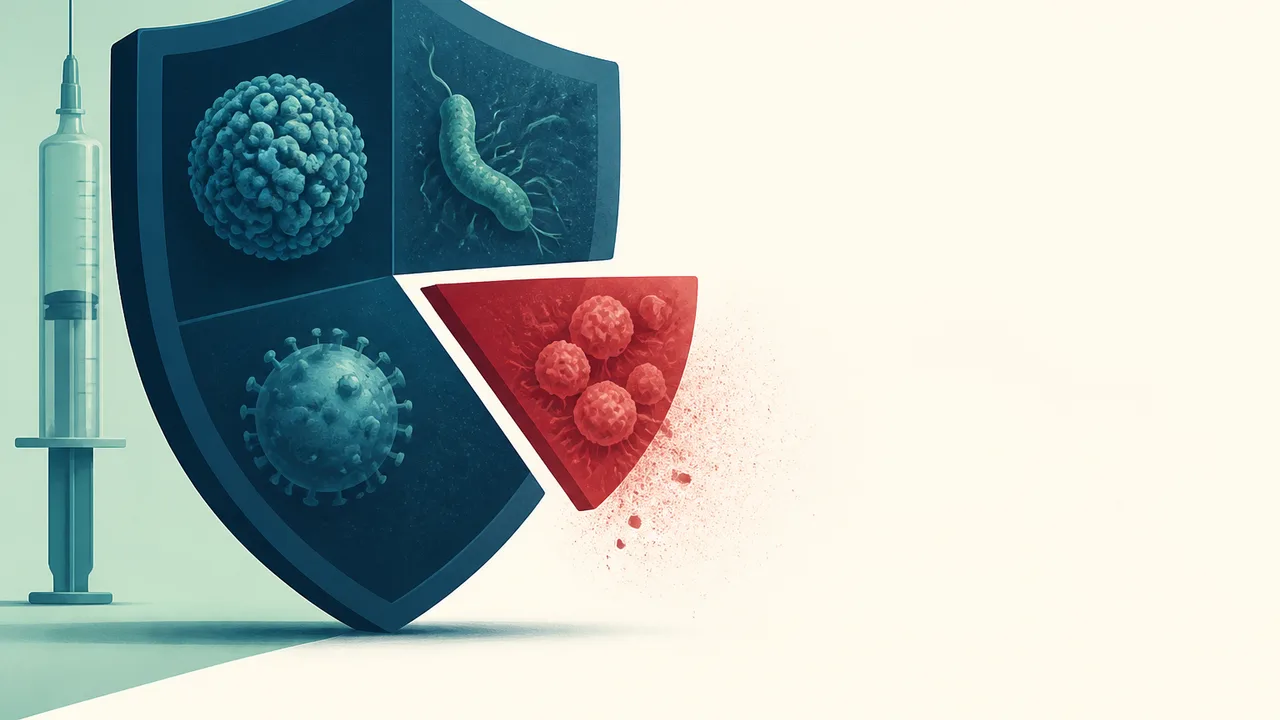
The International Agency for Research on Cancer estimates that infections contributed to 2.3 million new cancer cases worldwide in 2024, about 12% of all new cases. Published in The Lancet Oncology, the analysis gives health systems a measure of cancer burden tied to pathogens. It also poses a narrower planning question: which of those infections can a health system address, and with what service?
IARC’s 2024 analysis draws on cancer burden estimates from its Global Cancer Observatory. It covers agents including the bacterium Helicobacter pylori, human papillomavirus (HPV), hepatitis viruses and Epstein-Barr virus. Its denominator is new cancer cases in 2024, rather than people who have ever had an infection. It estimates how much cancer across populations is attributable to known infection–cancer links; it does not identify the cause of each patient’s tumour.
H. pylori and HPV together accounted for more than an estimated 1.5 million cases. The study figures also put hepatitis B at about 360,000 cases and Epstein-Barr virus at about 260,000. Those totals identify pathogens that warrant attention, but the route from an infection to a cancer, and the available point of intervention, differ across the list.
From a Cause to a Service
Most people infected with H. pylori never develop cancer, although long-term infection raises stomach-cancer risk. An attributable case is therefore a population estimate, rather than an individual diagnosis or a case guaranteed preventable by a service now available. That is the necessary boundary around the headline figure.
An annual attribution estimate can tell planners the scale of cancer associated with recognized infections. Choosing a programme requires another set of measurements: which infection-attributed cancers occur locally, how many people a proposed service could reach, and when it would reach them. Vaccination can prevent an infection; testing and treatment can address one already present; screening can detect disease earlier. A worldwide total of cancers diagnosed in 2024 does not supply those local incidence and delivery figures.
The biology explains part of the split. Long-lasting H. pylori infection can drive inflammation and damage in the stomach lining as tissue repairs itself. Some cancer-causing viruses interfere with controls on cell growth and division. For H. pylori, finding and treating an existing infection is a plausible prevention route. For vaccine-preventable viruses, reaching people before infection is another. The same label, “infection-attributed cancer,” covers interventions aimed at different stages of disease.
HPV makes the timing especially visible. Vaccination protects against virus types associated with cervical and other cancers, while cervical screening offers an opportunity to detect disease earlier. The HPV vaccine was introduced in the United States in 2006. In some US states, cervical cancer rates later fell by more than 50% among women aged 20 to 31, the first group eligible for vaccination as preteens, according to research described by Scientific American. That reported decline concerns those ages and states; it is not an estimate of the vaccine’s effect on every cervical cancer case worldwide in 2024.
For H. pylori, the proposed service may begin with an infection already present: find it and treat it. Antibiotics can reduce cancer risk in infected people. A 2025 Nature Medicine study approached the problem over a much longer horizon, projecting lifetime gastric cancers among cohorts born from 2008 to 2017. Its authors combined national age-specific cancer-incidence estimates with demographic projections and discussed population-based H. pylori testing and treatment. That model asks about cancers a cohort might face over its lifetime; IARC’s new estimate counts cancers attributed to infections in a single year. Their different time frames offer useful views of the problem, but the resulting totals cannot be compared directly.
Hepatitis B supplies a third route: vaccination can prevent infections that might otherwise lead to liver cancer. A health system considering HPV vaccination and cervical screening needs to know who can receive each service. One considering H. pylori testing needs to know whom it could test and treat. For hepatitis B vaccination, it needs to know whom its programme can reach before infection. The global pathogen totals help identify the causes under discussion. Local incidence and delivery evidence determine what a proposed service could accomplish.
The geography of the burden adds urgency without settling that choice. Around 75% of infection-attributed cancers occurred in low- and middle-income countries, John (Eddie) La Marca and Sarah Diepstraten wrote in a Conversation article republished by Medical Xpress. They noted that access to vaccination, screening and treatment programmes can be limited in low- and middle-income countries. Gary Clifford, a senior author of the IARC analysis, pointed to investment disparities, including cervical-screening provision in sub-Saharan Africa, in comments to Scientific American. The distribution of cases directs attention to access as well as biology; countries within that income grouping still need to assess their own cancer patterns and service capacity.
This estimate also has a history. Earlier worldwide analyses included one for 2018. The 2024 analysis adds agents including HIV and Merkel cell polyomavirus, along with additional infection–cancer associations. IARC says it incorporates recent evidence linking Epstein-Barr virus with stomach cancer. Data sources used for earlier analyses changed over time, as Nautilus explained. A difference between published percentages could reflect changes in cancer burden, changes in what researchers counted, or both. The current 12% describes estimated 2024 incidence; it cannot serve as a progress score since 2018.
IARC has put a number on the worldwide burden associated with infections. A health system still has to put local numbers on the next decision: which cancers its population develops, which people its services can reach, and whether the service arrives before infection, during infection or after disease begins.
More Like This

Black Holes: Destroyers, Organizers, and Open Questions
Black holes destroy worlds and organize galaxies—but what does the science actually show? A look at Sagittarius A*, adaptive optics, and the limits of what we know.

The Quantum Twin Paradox and the Nature of Time
A new trapped-ion experiment may finally reveal whether time is a quantum property—bridging the long-standing gap between quantum mechanics and general relativity.