Howard Marks on Market Complacency and Valuation Risk
Howard Marks of Oaktree Capital argues the real stock market risk isn't the Magnificent Seven — it's the 493 companies nobody's watching.

Written by AI. Jin Seo
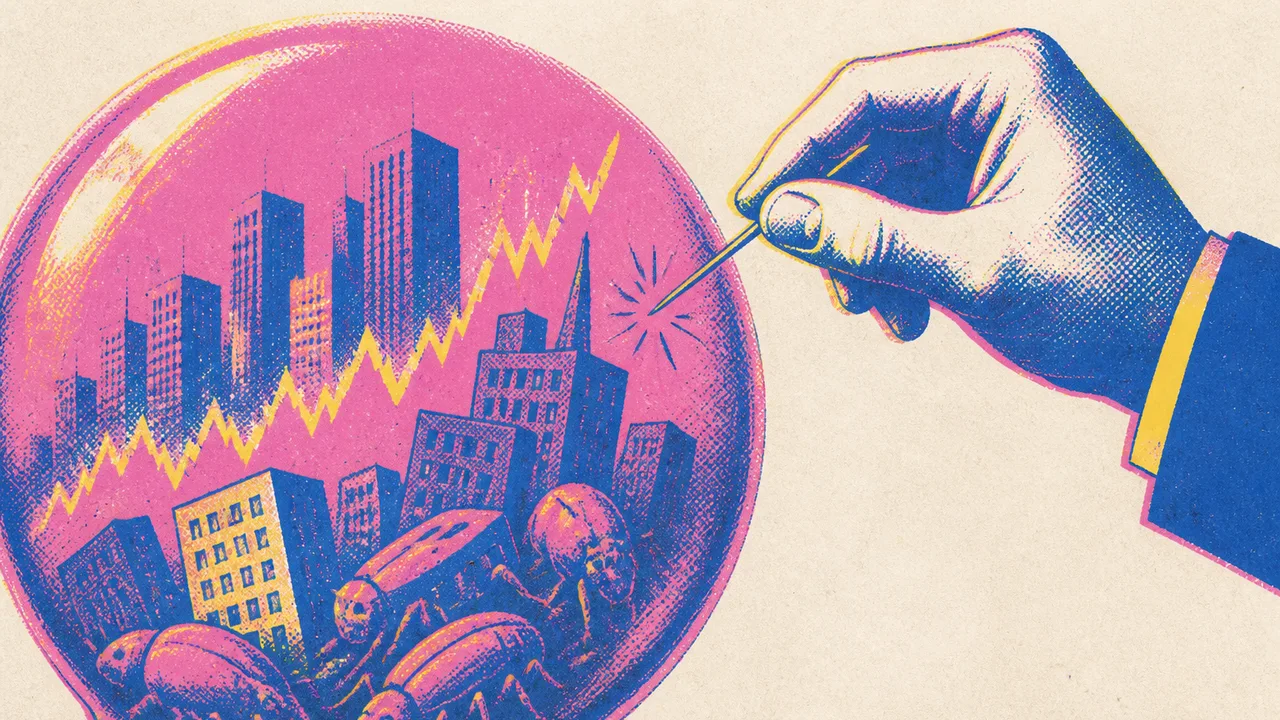
Photo: AI. Jorah Maktoum
Howard Marks has managed money through enough cycles — the savings and loan collapse, the dot-com bust, the 2008 implosion — that when he says something unsettling, it's worth pausing on. The Oaktree Capital co-founder, who oversees roughly $150 billion in assets, recently argued that the market's current complacency looks a lot like the kind that precedes the moments everyone later calls "obvious in hindsight."
His thesis comes in two parts, and the second one is considerably more counterintuitive than the first.
When the Good Times Write Bad Loans
The first part is the easier sell: prolonged calm produces sloppy credit. "If everything's been going quite well in the markets with a few minor exceptions for 17 years now," Marks said, "when things go well for 17 years, people let down their guard, they lose their risk aversion, they stop being careful, they stop being skeptical, they stop doing thorough due diligence. And so, bad deals get done."
He frames this through an old banking aphorism: "the worst of loans are made in the best of times." The mechanism isn't complicated. When markets reward risk-taking year after year, the professional incentive to be cautious erodes. The analyst who flags a deal as too risky looks like the problem. The one who finds a way to make it work gets the fee. Repeat that dynamic for seventeen years, and you accumulate a lot of loans that only made sense if rates stayed low and growth kept compounding.
The Silicon Valley Bank episode of 2023 demonstrated exactly how fast the bill arrives. SVB had been the institutional lender of choice for the tech startup ecosystem — flush with deposits, invested heavily in long-duration bonds when rates were near zero. On March 8, 2023, it disclosed a $1.8 billion loss on bond sales. According to the FDIC, depositors withdrew $42 billion within roughly 24 hours. The FDIC seized the bank that Friday. Two additional institutions failed in the same week.
The companies that had borrowed from institutions like SVB — and the broader landscape of debt-laden firms that survived the low-rate era — now face a different arithmetic. An Associated Press analysis identified nearly 7,000 so-called "zombie companies" globally, including roughly 2,000 in the United States: firms whose operating earnings don't cover their interest payments. They survived when money was effectively free. The question of how they survive at 6% or 8% is not rhetorical.
Marks's point isn't that a crash is imminent. It's structural: risk aversion is what keeps markets functional, and when the fear of missing out displaces the fear of losing money, the foundation gets soft. "It is risk aversion that makes the market safe and sane," he said. "And when people forget to be risk-averse, and they start worrying about missing out more than they do about losing money, then the market becomes a dangerous place."
Jamie Dimon, discussing the regional bank stress that preceded SVB's failure, put it with characteristic bluntness: "When you see one cockroach, there are probably more." The cockroach framing captures something accurate about how credit risk surfaces — not in a tidy disclosure, but in a surprise earnings revision at a firm you'd half-forgotten you were exposed to.
The Index Isn't What You Think You Bought
Here's where Marks's argument pivots, and where the conventional market narrative breaks down in an interesting way.
The popular concern has been that the S&P 500 is a bubble driven by a handful of mega-cap technology companies. Marks's read is more granular, and frankly more troubling. He's not particularly alarmed by the Magnificent Seven's valuations. He is alarmed by everyone else's.
"The seven stocks, the so-called Magnificent Seven, are overweighted, but not insanely expensive," he said. "They have PE ratios in the 30s. And that's high, but not crazy, in my opinion." His historical reference point: when he entered the investment business, there was a craze around what were then called the Nifty 50 — the fifty fastest-growing American companies. Marks says those stocks traded at PE ratios he describes as between 60 and 90. By that benchmark, 30-something looks restrained.
A quick translation for anyone who doesn't traffic in PE ratios daily: a price-to-earnings ratio tells you how much investors are paying for each dollar of a company's annual profit. A PE of 20 means you're paying $20 for every $1 of earnings. Historically, the S&P 500 has averaged around 16. The higher the ratio, the more you're betting on future growth — and the more painful it is when that growth disappoints.
The number Marks flags as genuinely elevated is the average PE of the other 493 companies in the index — the ones not in the headlines. He puts that figure at around 19 or 20. Which means investors are paying near-bubble-era multiples for businesses that are, by definition, not Apple or Nvidia. Many are slow-growth industrials, regional financials, consumer staples — companies that have historically traded closer to the long-run index average of 16.
The arithmetic of index concentration makes this a meaningful problem, not just an abstract valuation concern. The S&P 500 is weighted by market capitalization, meaning the biggest companies by stock value take up the most space. Marks put it plainly: "It's not much of a 500 stock index if seven of them are 40%. 1.4% of the stocks are 40% of the index. That's not very representative."
An investor buying the index thinking they're getting broad exposure to the American economy is getting something more like a large-cap tech fund with 493 other holdings attached. If the attention has been on whether those top seven are overpriced, the 493 have been able to get expensive quietly — priced as if they belong in the same conversation as the companies rewriting entire industries, when most of them don't.
The Price You Pay Is the Return You Get
The valuation argument has a practical implication that's worth making explicit. When you buy a stock at a high PE, you need the company to grow into that valuation. If the Magnificent Seven are priced at 30-something times earnings, they need to keep delivering growth that justifies the premium. Many of them plausibly can. But if the average of the remaining 493 are priced at 19 or 20 times earnings — historically associated with optimistic market peaks — the margin for disappointment is thin. A slower economy, a credit event, a repricing of risk, and those multiples compress. That's not a prediction; it's arithmetic.
Marks's larger argument is about what prolonged calm does to the people making these decisions. Seventeen years of mostly-up markets haven't just pushed prices higher; they've recalibrated what risk looks like. A generation of portfolio managers and retail investors has never sat through a prolonged drawdown. The ones who have tend to price risk differently.
There's a version of Marks's argument that functions as a permanent warning — the kind that sounds compelling at any point in a bull market and eventually proves correct by definition. That's a fair critique to keep in mind. He is also not calling a top or advising anyone to sell. His suggestion, consistent with his broader investment philosophy, is that the work of being a careful investor — reading footnotes, applying skepticism, demanding a margin of safety — doesn't disappear in a bull market. It becomes more important.
The S&P 500 has returned spectacularly since 2009. That's real. The question embedded in Marks's argument is whether the price you're paying today for the next decade of returns already has that optimism baked in — not just in the seven companies everyone's watching, but in the 493 nobody is.
More Like This

Global Wealth Is $600 Trillion — and Mostly Paper
The world's net worth hit $600 trillion, but 75% of that growth since 2000 came from rising prices, not productive investment. Here's what that means.
Rockefeller's Wealth-Building Secrets Revealed
Explore how John D. Rockefeller built a $400 billion fortune through strategic discipline and overlooked industries.
Bill Ackman's Art of Finding Invisible Money
Explore Bill Ackman's strategy of finding hidden value in companies, beyond standard metrics.

What Fintech Affiliate Models Could Teach iGaming
Line Peteri argues fintech's education-first affiliate model and retention focus offer a playbook iGaming has ignored for a decade. Here's what that gap actually costs.

Booking Holdings CEO on AI, Scale, and Survival
Booking Holdings CEO Glenn Fogel survived the dot-com crash and now faces the AI wave. His take on moats, agentic travel, and job displacement is worth your time.

The SpaceX IPO That Could Land in Your 401(k)
SpaceX's $2 trillion IPO isn't just a Wall Street story. Thanks to index fund rules, it may already be headed for your retirement account.

Vetting Expired Domains in iGaming SEO
Craig Campbell explains why domain rating misleads iGaming SEO buyers, what the Wayback Machine reveals, and how to vet expired domains before spending.
Auditing Vibe-Coded Apps Without Reading Them
A Brainqub3 video argues you can safely ship 100k-line AI-generated codebases without reading them. The framework is sound. The business model behind it is worth examining.